
[논문 리뷰] Fitting the light curves of Sagittarius A* with a hot-spot model
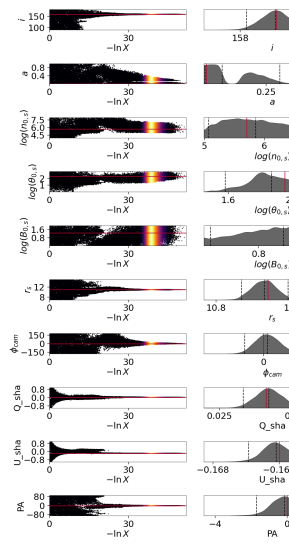
이 연구는 베타-베이지안 프레임워크 내에서 블랙홀 주위를 도는 자기장이 있는 플라즈마 블롭의 동반 동반 방출을 포함하는 반분석적 핫스팟 모델을 사용하여 은하수수소성의 편광된 밀리미터 파장 광도곡선을 피팅한다. 최적 피팅 모델은 약 90분의 선호되는 궤도 주기, 150–160°의 기울기, 10.7–13.0 중력 반지름의 반경, 케플러 속도의 0.8–0.9배인 비케플러 운동을 보이며, 낮은 스핀(a* < 0.6)을 나타낸다.
Sagittarius A* exhibits frequent flaring activity across the electromagnetic spectrum. Signatures of an orbiting hot spot have been identified in the polarized millimeter wavelength light curves observed with ALMA in 2017 immediately after an X-ray flare. The nature of these hot spots remains uncertain. We expanded existing theoretical hot-spot models created to describe the Sgr A* polarized emission at millimeter wavelengths. We sampled the posterior space, identifying best-fitting parameters and characterizing uncertainties. Using the numerical radiative transfer code ipole, we defined a semi-analytical model describing a ball of plasma orbiting Sgr A*, threaded with a magnetic field and emitting synchrotron radiation. We then explored the posterior space in the Bayesian framework of dynesty. We fit the static background emission separately, using a radiatively inefficient accretion flow model. We considered eight models with a varying level of complexity, distinguished by choices regarding dynamically important cooling, non-Keplerian motion, and magnetic field polarity. All models converge to realizations that fit the data, but one model without cooling, non-Keplerian motion, and magnetic field pointing toward us improved the fit significantly and also matched the observed circular polarization. Our models represent observational data well and allow testing various effects in a systematic manner. From our analysis, we have inferred an inclination of $155-160$ deg, which corroborates previous estimates, a preferred period of 90 minutes, and an orbital radius of $9-12$ gravitational radii. Our non-Keplerian models indicate a preference for an orbital velocity of $0.6-0.9$ times the Keplerian value. Last, all our models agree on a high dimensionless spin value ($a_{*}>0.8$), but the impact of spin on the corresponding light curves is subdominant with respect to other parameters.
연구 동기 및 목표
- 은하수수소성의 편광된 밀리미터 방출을, 자기장이 있는 플라즈마 블롭의 동반 방출을 포함하는 반분석적 핫스팟 모델을 사용하여 모델링하기.
- 베이지안 추론을 통해 핫스팟의 물리적 매개변수(크기, 자기장 강도, 궤도 속도 등)를 제약하기.
- 비케플러 운동 및 동반 방출 냉각과 같은 천체역학적 영향이 피팅 품질과 관측 결과와의 일치성에 미치는 영향을 테스트하기.
- 복사 효율이 낮은 적층 흐름(RIAF) 모델을 사용하여 핫스팟 신호를 기저의 적층 흐름 배경에서 분리하기.
- 블랙홀 스핀과 자기장 구조가 관측된 광도곡선과 편광 서명을 어떻게 결정지키는지 평가하기.
제안 방법
- Sgr A* 주위를 도는 자기장이 있는 국소적 플라즈마 블롭의 동반 방출을 시뮬레이션하기 위해 수치적 방사전달 코드 ipole를 사용한다.
- 모델 매개변수(스팟 위치, 자기장, 궤도 운동 등)의 사후 분포를 탐색하기 위해 dynesty를 사용한 베타-베이지안 추론 프레임워크를 적용한다.
- 기저 배경 방출은 별도로 RIAF 모델을 사용하여 피팅하여 관측된 스토크스 매개변수(I, Q, U, V)에 대한 핫스팟 기여를 분리한다.
- 냉각, 비케플러 운동, 자기장 극성에 대한 가정이 다른 여덟 가지 모델 변형을 고려하여 모델의 안정성 평가를 수행한다.
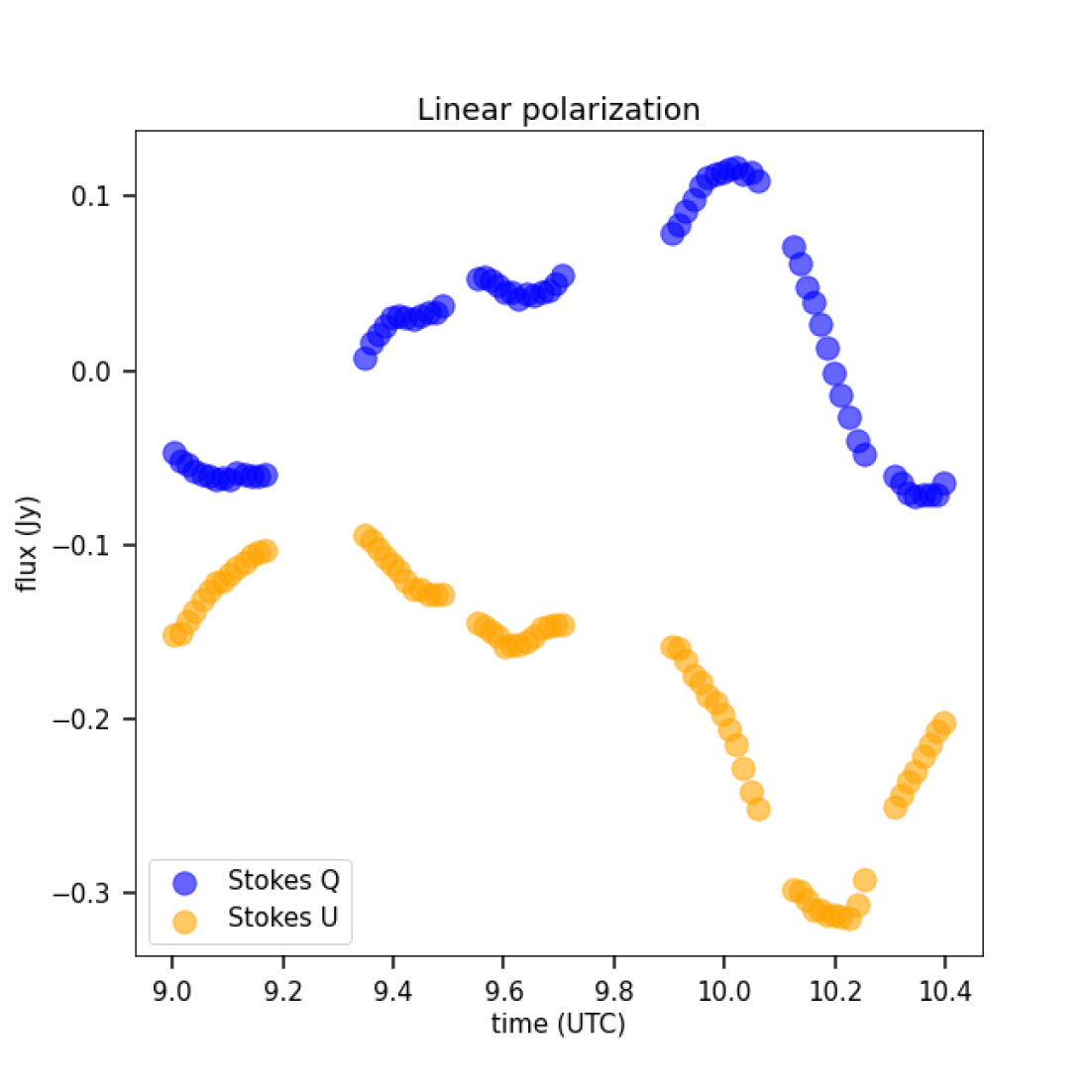
- ALMA 2017년 관측자료(1.3 mm 대역)와 모델 예측을 비교하여 Q–U 루프와 원형 편광에 중점을 둔다.
- 배경 모델이 핫스팟 피팅 과정에서 유도된 그림자 유사 스토크스 매개변수를 재현하는지 점검하여 모델 일관성 검증
실험 결과
연구 질문
- RQ1관측된 Q–U 루프를 생성하는 핫스팟에 대한 최적 피팅 궤도 및 자기장 매개변수는 무엇인가?
- RQ2동반 냉각 또는 비케플러 궤도 운동을 포함할 경우, 기존 모델 대비 ALMA 광도곡선에 대한 피팅 품질은 어떻게 향상되는가?
- RQ3관측 결과는 블랙홀 스핀과 기울기에 대해 어떤 제약을 가진다?
- RQ4자기장 구성(예: 내향성 대비 외향성)이 편광 서명과 모델의 가능도에 어떤 영향을 미치는가?
- RQ5기저 RIAF 배경 방출은 유도된 핫스팟 매개변수에 얼마나 큰 영향을 미치며, 디스크-스팟 복합 모델이 모든 스토크스 매개변수를 더 잘 재현할 수 있는가?
주요 결과
- 최적 피팅 모델은 약 90분의 궤도 주기로 수렴하며, 관측된 Q–U 루프 시간스케일과 일치한다.
- 기울기는 150–160도로 제약되며, EHT 및 기타 연구에서 이전에 보고된 결과와 일치한다.
- 핫스팟의 궤도 반경은 10.7–13.0 중력 반지름으로 추정되며, 내부 안정 궤도 근처에 위치한다.
- 비케플러 운동(케플러 속도의 0.8–0.9배)을 포함한 모델은 피팅 품질을 크게 향상시키며, 기대되는 동반 냉각 시간스케일과도 일치한다.
- 동반 냉각을 포함하면 피팅 품질이 향상되고, 특히 관측자 쪽을 향한 자기장 방향일 경우 관측된 원형 편광을 재현한다.
- 블랙홀 스핀은 낮은 값(a* < 0.6)으로 제약되며, 다른 매개변수(기울기, 궤도 반경 등)에 비해 광도곡선에 미치는 영향은 열등하다.
더 나은 연구,지금 바로 시작하세요
논문 읽기부터 검토까지, 연구 시간을 획기적으로 줄여보세요.
카드 등록 없음 · 무료 플랜 제공
이 리뷰는 AI가 만들고, 인간 에디터가 검토했습니다.