
[논문 리뷰] Fourier Neural Operator for Plasma Modelling
본 논문은 Fourier Neural Operator (FNO)를 MHD 시뮬레이션과 MAST의 카메라 관찰에서 플라즈마 진화의 빠른 대리 모델(서브루타) 및 디지털 트윈으로 제시하며, Conv-LSTM 및 U-Net에 비해 속도와 파라미터 효율성에서 우수하면서 정확도도 유지함을 보여준다.
Predicting plasma evolution within a Tokamak is crucial to building a sustainable fusion reactor. Whether in the simulation space or within the experimental domain, the capability to forecast the spatio-temporal evolution of plasma field variables rapidly and accurately could improve active control methods on current tokamak devices and future fusion reactors. In this work, we demonstrate the utility of using Fourier Neural Operator (FNO) to model the plasma evolution in simulations and experiments. Our work shows that the FNO is capable of predicting magnetohydrodynamic models governing the plasma dynamics, 6 orders of magnitude faster than the traditional numerical solver, while maintaining considerable accuracy (NMSE $\sim 10^{-5})$. Our work also benchmarks the performance of the FNO against other standard surrogate models such as Conv-LSTM and U-Net and demonstrate that the FNO takes significantly less time to train, requires less parameters and outperforms other models. We extend the FNO approach to model the plasma evolution observed by the cameras positioned within the MAST spherical tokamak. We illustrate its capability in forecasting the formation of filaments within the plasma as well as the heat deposits. The FNO deployed to model the camera is capable of forecasting the full length of the plasma shot within half the time of the shot duration.
연구 동기 및 목표
- 토카막에서 실시간 제어를 가능하게 하고 계산 집약적인 코드에 대한 의존도를 줄이기 위해 빠른 플라즈마 진화 예측의 필요성을 제시한다.
- Fourier Neural Operators가 메쉬에 불변한 방식으로 MHD 해의 해석 매핑을 학습할 수 있음을 입증한다.
- 시뮬레이션 데이터와 실험 카메라 데이터 모두에 대해 표준 대리모(surrogates)인 Conv-LSTM, U-Net과 FNO를 벤치마크한다.
- MAST 토카막에서 카메라 기반 플라즈마 상태 예측을 위한 디지털 트윈으로서의 FNO를 탐구한다.
제안 방법
- 오토회귀 프레임워크에서 2D Fourier Neural Operator (FNO-2d)를 채택하여 20 입력 시간 스텝을 다음 5 시간 스텝으로 매핑하고, 차례차례 예측하여 T_out=70까지 추정한다.
- 밀도, 포텐셜, 와류도 필드에 대해 개별 FNO를 학습하며 입력은 100x100 격자에 32-폭 피처로, 각 층당 16개의 Fourier 모드를 사용한다.
- 동일한 학습 조건(Adam 옵티마이저, 500 에포크, 배치 크기 5)에서 FNO를 ConvLSTM 및 U-Net 아키텍처와 비교한다.
- MAST의 실험용 패스트-카메라 데이터에 FNO 접근법을 확장하여 중앙 솔레노이드 및 디버터 카메라가 관측하는 플라즈마 진화를 예측하고, 보정된 균일 격자를 사용한다.
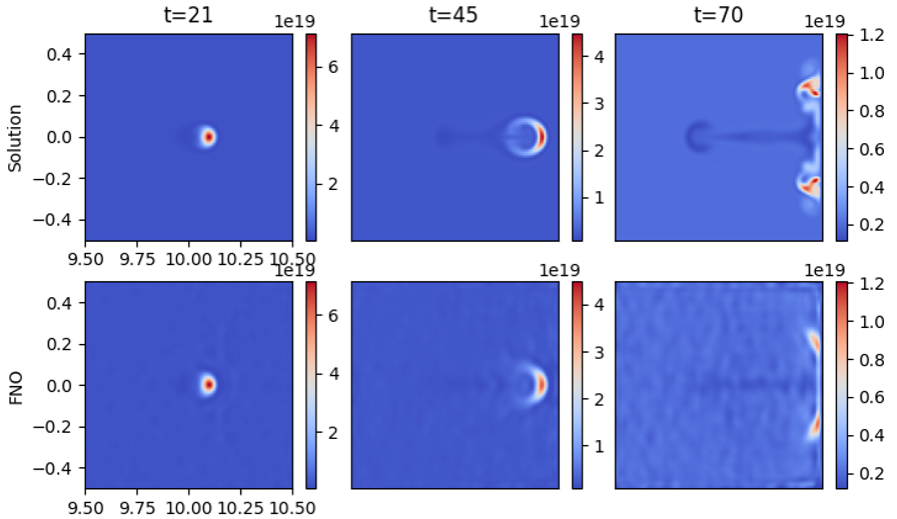
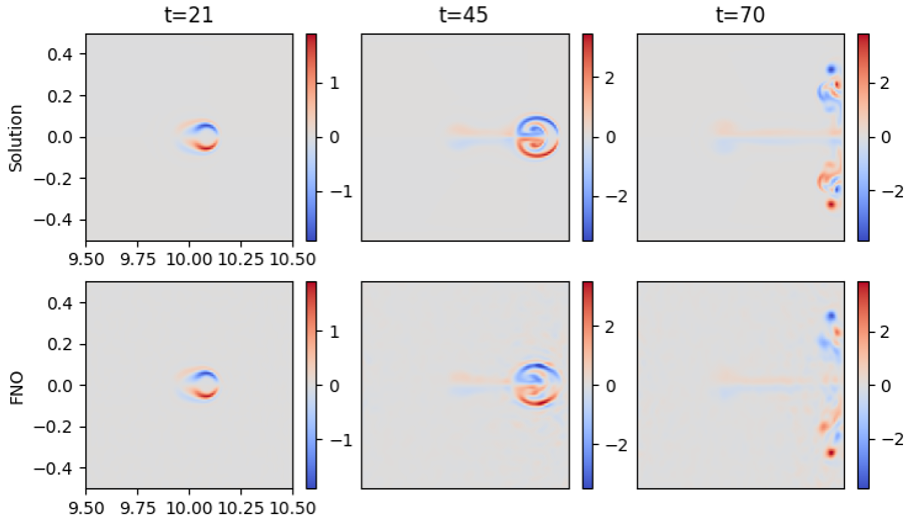
실험 결과
연구 질문
- RQ1FNO가 토로이드 기하에서 축소된 MHD 방정식의 해 연산자(MHD 솔루션 연산자)를 효율적이고 정확하게 학습할 수 있는가?
- RQ2학습 시간, 파라미터 수, NMSE에서 FNO가 Conv-LSTM과 U-Net에 비해 어떤지?
- RQ3필라멘트 형성 및 열 침착 패턴을 포함한 토카막 플라즈마의 실험용 카메라 데이터에 대해 FNO가 실시간 디지털 트윈으로 작동할 수 있는가?
- RQ4ELM이나 L-H 전이와 같은 이벤트를 예측하기 위한 카메라 기반 진단에서 FNO의 예측 능력은 어느 정도인가?
주요 결과
| 모델 | 학습 시간(분) | 파라미터 수 | NMSE | 추론 시간(s) |
|---|---|---|---|---|
| JOREK | - | - | - | 36000 |
| FNO | 13 | 2106981 | 4.245e-05 | 0.025 |
| ConvLSTM | 481 | 4874648 | 1.12e-03 | 0.14 |
| U-Net | 26 | 7931909 | 4.48e-04 | 0.033 |
- FNO는 전위, 밀도, 와류에 걸쳐 NMSE ≈ 4–5×10^-5로 축소된 MHD 진화를 예측한다.
- FNO 추론 시간은 실행당 0.025 s로 전통 해석기 및 비교 대리모에 비해 훨씬 빠르다.
- FNO는 ConvLSTM 및 U-Net에 비해 훨씬 적은 파라미터와 짧은 학습 시간을 사용하면서 더 우수하거나 비슷한 정확도를 제공한다.
- MAST의 카메라 데이터에서 FNO는 NMSE ~0.04(중앙 솔레노이드 카메라)와 ~0.014(디버터 카메라)를 달성하여 남은 촬영 기간 전체를 예측했다.
- FNO는 전역 플라즈마 특징 및 열 플럭스 영역을 효과적으로 포착하지만, 국소 픽셀 단위 정확도는 제한될 수 있다.
- 해당 프레임워크는 융합 장치에서의 실시간 계획 및 제어와 진단용 디지털 트윈으로서의 가능성을 보여준다.
더 나은 연구,지금 바로 시작하세요
연구 설계부터 논문 작성까지, 연구 시간을 획기적으로 줄여보세요.
카드 등록 없음 · 무료 플랜 제공
이 리뷰는 AI가 만들고, 인간 에디터가 검토했습니다.