
[논문 리뷰] From existing and new nuclear and astrophysical constraints to stringent limits on the equation of state of neutron-rich dense matter
이 논문은 물리학에 의존하지 않는 베이지안 프레임워크 내에서 다양한 핵 이론 및 천체물리 제약을 모아 중성자별의 상태방정식(EOS)에 대한 엄격한 한계를 도출하고, 표준 중성자별 반경과 최대 질량에 대한 주목할 만한 경계를 제시한다.
Through continuous progress in nuclear theory and experiment and an increasing number of neutron-star observations, a multitude of information about the equation of state (EOS) for matter at extreme densities is available. To constrain the EOS across its entire density range, this information needs to be combined consistently. However, the impact and model-dependency of individual observations vary. We present a broad compendium of different constraints and apply them individually to a large set of EOS candidates within a Bayesian framework. Specifically, we explore different ways how chiral effective field theory and perturbative quantum chromodynamics can be used to place a likelihood on EOS candidates. We also investigate the impact of nuclear experimental constraints, as well as different radio and X-ray observations of neutron star (NS) masses and radii. This is augmented by reanalyses of the existing data from BNS coalescences, in particular of GW170817, with improved models for the tidal waveform and kilonova light curves, which we also utilize to construct a tight upper limit of 2.39$\,$M$_\odot$ on the TOV mass based on GW170817's remnant. Our diverse set of constraints is eventually combined to obtain stringent limits on NS properties. We organize the combination in a way to distinguish between constraints where the systematic uncertainties are deemed small and those that rely on less conservative assumptions. For the former, we find the radius of the canonical 1.4$\,$M$_\odot$ neutron star to be $R_{1.4}= 12.26_{-0.91}^{+0.80}\,$km and the TOV mass at $M_{ m TOV}= 2.25_{-0.22}^{+0.42}\,$M$_\odot$ (95% credibility). Including all the presented constraints yields $R_{1.4}= 12.20_{-0.48}^{+0.50}\,$km and $M_{ m TOV}= 2.30_{-0.20}^{+0.07}\,$M$_\odot$.
연구 동기 및 목표
- 다양한 핵 이론 및 천체물리 입력이 밀집 물질의 EOS를 어떻게 제약하는지 평가한다.
- 핵자 물질에서 비핵자 물질에 이르는 고밀도 영역까지를 포괄하는 물리학에 의존하지 않는 대규모의 EOS 후보 사전 집합을 구성한다.
- 개별 제약들(χEFT, pQCD, 중성자 피부, 중대역 충돌, NS 질량-반경 데이터, GW, kilonovae)이 EOS 매개변수에 미치는 영향을 정량화한다.
- 제약들을 결합하여 고정된 불확실성 하에서 표준 NS 반경과 TOV 최대 질량을 유추한다.
- 다른 제약 조합이 추정된 EOS 및 관련 관측치(R1.4, M_TOV, p3n_sat, n_TOV)에 어떤 영향을 미치는지 평가한다.
제안 방법
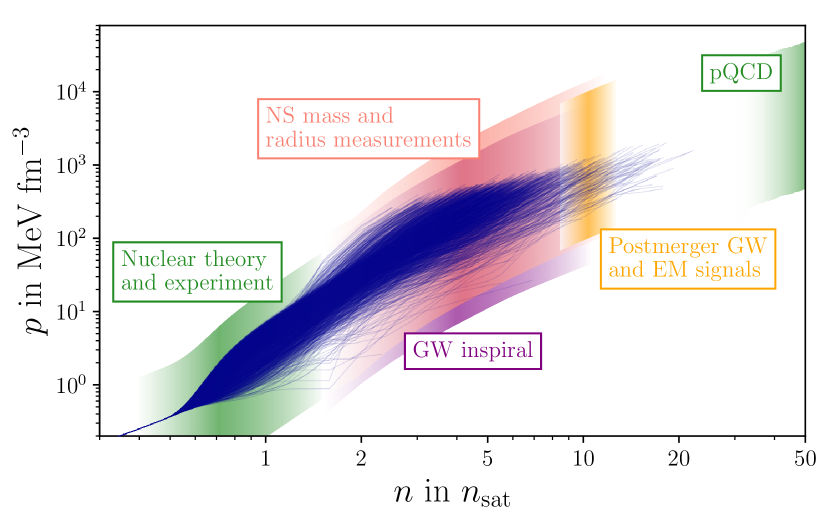
- n_break까지의 핵자 물질에 대한 메타모형을 사용하여 100,000개의 후보 EOS 사전 세트를 구성하고, 저밀도에서 결정된 크러스트 모델을 고정한다.
- c_s^2(n)을 보간하는 속도-의 소리(speeed-of-sound) 접근법을 통해 9개의 격자점까지 최대 25 n_sat의 물리-독립적 고밀도 외삽을 부착한다.
- AFDMC 밴드를 기반으로 점수 함수 f(p,n)을 통해 χEFT 제약을 적용하고 p(n) 곡선에 대해 곱/적분으로 가능도(likelihood)를 계산한다.
- 저밀도 EOS와 고밀도 pQCD regimes 사이의 보간에 대해 기계적 안정성과 인과성을 테스트하여 제약을 반영하고, n_L = n_TOV에서의 보수적 매칭과 더 엄격한 pQCD* 접근법을 모두 적용한다.
- 중성자 피부 및 중대역 데이터로 대칭에너지난 E_sym 및 L_sym를 중성자 피부 두께와의 상관관계를 통해 제약한다.
- EOS 후보들에 대한 베이지안 후방 가중치를 사용하여 R1.4, M_TOV 및 관련 양에 대한 분포를 도출한다.
실험 결과
연구 질문
- RQ1χEFT, pQCD, 중성자 피부, 중대역 데이터, NS 관측의 개별 및 총합 제약이 중성자별 EOS에 미치는 영향은 무엇인가?
- RQ2제약이 EOS의 밀도 영역에 어떻게 매핑되며 어떤 관측치(R1.4, M_TOV)가 가장 영향을 받는가?
- RQ3모든 제약을 다양한 강도로 적용할 때 어떤 표준 NS 반경 R1.4와 TOV 질량 M_TOV가 선호되는가?
- RQ4pQCD 매칭 처방의 선택(보수적 vs. pQCD*)이 후방 EOS에 어떤 영향을 미치는가?
주요 결과
- 제한된 시스템오딧를 포함할 때 95% 신뢰도에서 R1.4 = 12.27_{-0.94}^{+0.83} km 및 M_TOV = 2.26_{-0.22}^{+0.45} M_sun.
- 덜 보수적인 제약 조합은 R1.4 = 12.20_{-0.50}^{+0.53} km 및 M_TOV = 2.31_{-0.20}^{+0.08} M_sun를 제공한다.
- χEFT 제약은 저밀도에서 더 부드러운 EOS를 선호하지만 고밀도 외삽의 유연성으로 인해 고질량 구성의 엄격한 배제는 아직 불완전하다.
- pQCD 제약은 매우 뻣뻣하거나 매우 부드러운 EOS를 배제하며, pQCD* 접근법은 더 강한 제약을 제공하고 후방 분포를 M_TOV 및 p3n_sat 범위로 더 정보성 있게 이동시킨다.
- 중성자 피부 측정(PREX-II, CREX)은 대칭에너지 매개변수 E_sym 및 L_sym에 영향을 주어 NS에 관련된 중성자 풍부한 EOS 영역에 영향을 준다.
![Figure 2: Score function $f(p,n)$ from Eq. ( 4 ) used in Eq. ( 6 ) to calculate the likelihood of an EOS given $\chi$ EFT constraints. The black dashed lines show the band obtained by $\chi$ EFT calculations in Ref. [ 46 ] .](https://ar5iv.labs.arxiv.org/html/2402.04172/assets/x2.png)
더 나은 연구,지금 바로 시작하세요
연구 설계부터 논문 작성까지, 연구 시간을 획기적으로 줄여보세요.
카드 등록 없음 · 무료 플랜 제공
이 리뷰는 AI가 만들고, 인간 에디터가 검토했습니다.