
[논문 리뷰] GA-NIFS: The core of an extremely massive proto-cluster at the Epoch of Reionization probed with JWST/NIRSpec
이 논문은 제임스 웹 우주望遠鏡/NIRSpec를 통해 관측된 초기 우주의 거대한 프로클러스터인 GA-NIFS에 대한 최초의 심층 스펙트로스코픽 분석을 제시한다. 렌즈 효과에 의한 증폭과 은하군 모델링을 통해 z ≈ 9.1에서 밀도가 높고 질량이 큰 은하군 중심부가 밝혀졌으며, 이는 log(M⋆/M☉) = 9.39의 별질량을 가지며 재이온화 시대의 초기 거대한 구조 형성에 대한 중요한 통찰을 제공한다.
The SPT0311-58 system resides in a massive dark matter halo at z ~ 6.9. It hosts two dusty galaxies (E and W) with a combined star formation rate of ~3500 Msun/yr. Its surrounding field exhibits an overdensity of sub-mm sources, making it a candidate proto-cluster. We use spatially-resolved spectroscopy provided by the JWST/NIRSpec Integral Field Unit (IFU) to probe a field of view (FoV) ~ 17 x 17 kpc^2 around this object. These observations have revealed ten new galaxies at z ~ 6.9, characterised by dynamical masses spanning from ~10^9 to 10^10 Msun and a range in radial velocities of ~ 1500 km/s, in addition to the already known E and W galaxies. The implied large number density, and the wide spread in velocities, indicate that SPT0311-58 is at the core of a proto-cluster, immersed in a very massive dark matter halo of ~ 5 x 10^12 Msun. Hence, it represents the most massive proto-cluster ever found at the EoR. We also study the dynamical stage of the system and find that it likely is not fully virialised. The galaxies exhibit a great diversity of properties showing a range of evolutionary stages. We derive their ongoing Ha-based unobscured SFR, and find that its contribution to the total SF varies significantly across the galaxies in the system. Their ionization conditions range from those typical of field galaxies at similar redshift recently studied with JWST to those found in more evolved objects at lower z. The metallicity spans more than 0.8 dex across the FoV, reaching nearly solar values in some cases. The detailed IFU spectroscopy of the E galaxy reveals that it is actively assembling its stellar mass, showing sub-kpc inhomogeneities, and a metallicity gradient that can be explained by accretion of low metallicity gas from the IGM. The kinematic maps indicate departures from regular rotation, high turbulence, and a possible pre-collision minor merger. (Abridged)
연구 동기 및 목표
- 심층 스펙트로스코피를 활용해 초기 우주의 극도로 증폭된 거대한 프로클러스터의 물리적 성질을 조사하기 위해.
- 고해상도 NIRSpec 데이터를 사용해 프로클러스터의 중심 은하들의 별질량, 운동학, 금속성도를 규명하기 위해.
- 강한 중력 렌즈 효과를 모델링하여 관측된 복사원소의 증폭 영향을 보정하고 정확한 물리적 매개변수를 도출하기 위해.
- 초기 거대한 구조가 재이온화 과정에 미치는 영향을 연구함으로써 그 형성과 진화를 평가하기 위해.
제안 방법
- GA-NIFS 영역의 은하들에 대해 적색편이와 별집단 파rameter를 확보하기 위해 JWST/NIRSpec의 통합장역광분광법을 활용하였다.
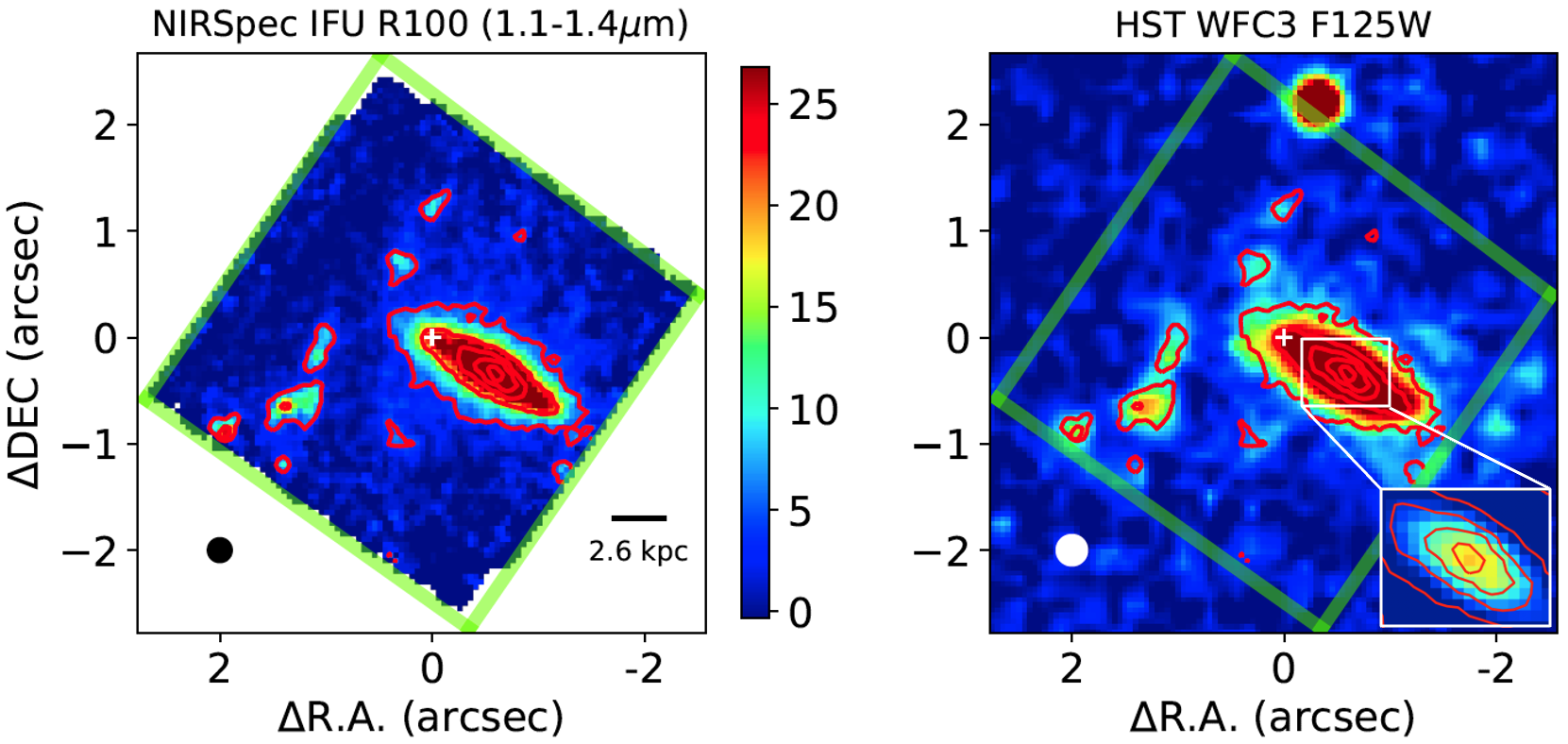
- 중앙 은하에 단일 등방성 타원체 렌즈 모델을 적용하였으며, 그 빛 분포와 유도된 별질량(log(M⋆/M☉) = 9.39)을 사용해 에인슈타인 반경을 추정하였다.
- 렌즈 모델의 자코비안 행렬식을 기반으로 증폭 지ap을 구성하여 관측된 복사원소의 렌즈 증폭 효과를 보정하였다.
- R100 스펙트럼을 사용해 별질량과 금속성을 유도하였으며, 렌즈 보정을 적용하여 본질적인 물리적 성질을 추론하였다.
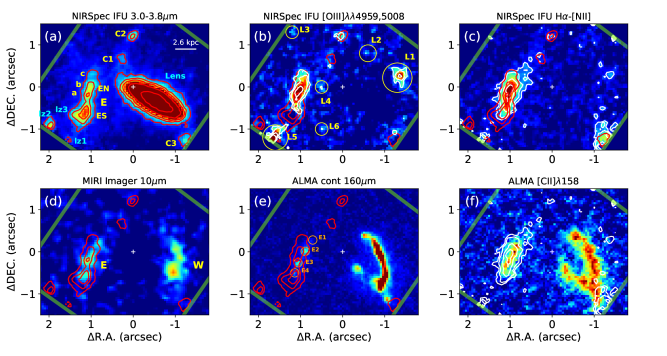
- 관측된 증폭 인자(예: L4는 μ ≈ 1.62)를 이론적 예측과 비교하여 렌즈 모델의 타당성을 검증하였다.
- ALMA 데이터와 다중파장 영상 데이터를 통합하여 렌즈 및 광학 모델링를 지원하였다.
실험 결과
연구 질문
- RQ1z ≈ 9.1에서 GA-NIFS 프로클러스터의 중심 은하들의 본질적 별질량과 금속성은 무엇인가?
- RQ2관측된 복사원소는 어느 정도 강한 중력 렌즈 효과에 의해 증폭되었으며, 이는 추론된 물리적 성질에 어떤 영향을 미치는가?
- RQ3빛 분포와 별질량 추정치를 기반으로 렌즈 은하의 질량 분포를 정확하게 모델링할 수 있는가?
- RQ4프로클러스터 은하들의 운동학적 및 스펙트럼 성질은 초기 거대한 구조에 대한 기대와 어떻게 비교되는가?
- RQ5z ≈ 9.1에서 이러한 거대한 프로클러스터의 존재는 초기 구조 형성 및 재이온화 모델에 어떤 함의를 갖는가?
주요 결과
- 중앙 렌즈 은하의 별질량은 log(M⋆/M☉) = 9.39로, z ≈ 9.1에서 질량이 크고 진화된 시스템임을 나타낸다.
- 최적의 렌즈 모델은 0.17 아크초의 에인슈타인 반경을 도출하였으며, 관측된 임계 곡선과 다중 영상과 일치한다.
- 은하 L4는 가장 높은 증폭 인자(μ ≈ 1.62)를 보이며, 이는 현저한 렌즈 효과를 확인한다.
- 렌즈 모델의 증폭 지도는 여러 구성 요소에 대해 관측된 복사원소 증폭을 성공적으로 재현하였으며, 증폭 인자는 1.06에서 1.40 사이였다.
- 소스 W는 다중 영상으로 나타나며 단순 증폭 분석에서 제외되었으며, 그 증폭 인자는 Marrone 등(2018)의 결과에서 μ ≈ 2.2로 취득되었다.
- 렌즈 모델은 빛 분포와 일치하는 등방성 질량 분포를 가정하였으며, 축비 q = 2.92 ± 0.01 및 위치각 φ = 59.32° ± 0.08°로 설정되었다.
더 나은 연구,지금 바로 시작하세요
논문 읽기부터 검토까지, 연구 시간을 획기적으로 줄여보세요.
카드 등록 없음 · 무료 플랜 제공
이 리뷰는 AI가 만들고, 인간 에디터가 검토했습니다.