
[논문 리뷰] Generative AI Meets Semantic Communication: Evolution and Revolution of Communication Tasks
본 논문은 의미통신에서 심층 생성모델에 대한 통합적 시각을 제시하며, diffusion, VAEs, GANs, 및 flow 모델이 기존의 비트 회복을 넘어선 새로운 작업, 응용 및 아키텍처 패러다임을 가능하게 하는 방법을 보여준다. 또한 효율적이고 신뢰할 수 있으며 설명 가능한 생성적 의미통신의 도전과제와 향후 방향에 대해 논의한다.
While deep generative models are showing exciting abilities in computer vision and natural language processing, their adoption in communication frameworks is still far underestimated. These methods are demonstrated to evolve solutions to classic communication problems such as denoising, restoration, or compression. Nevertheless, generative models can unveil their real potential in semantic communication frameworks, in which the receiver is not asked to recover the sequence of bits used to encode the transmitted (semantic) message, but only to regenerate content that is semantically consistent with the transmitted message. Disclosing generative models capabilities in semantic communication paves the way for a paradigm shift with respect to conventional communication systems, which has great potential to reduce the amount of data traffic and offers a revolutionary versatility to novel tasks and applications that were not even conceivable a few years ago. In this paper, we present a unified perspective of deep generative models in semantic communication and we unveil their revolutionary role in future communication frameworks, enabling emerging applications and tasks. Finally, we analyze the challenges and opportunities to face to develop generative models specifically tailored for communication systems.
연구 동기 및 목표
- 의미통신에서 심층 생성모델에 대한 통합적 관점과 이들이 미래 6G에서 차지하는 역할을 제시한다.
- 생성모델이 전통적 통신 문제를 넘어 의미 작업과 응용을 혁신적으로 가능하게 하는 방법을 보여준다.
- 효율적이고 맞춤화된 생성적 의미통신 프레임워크를 위한 도전과제와 해법을 논의한다.
제안 방법
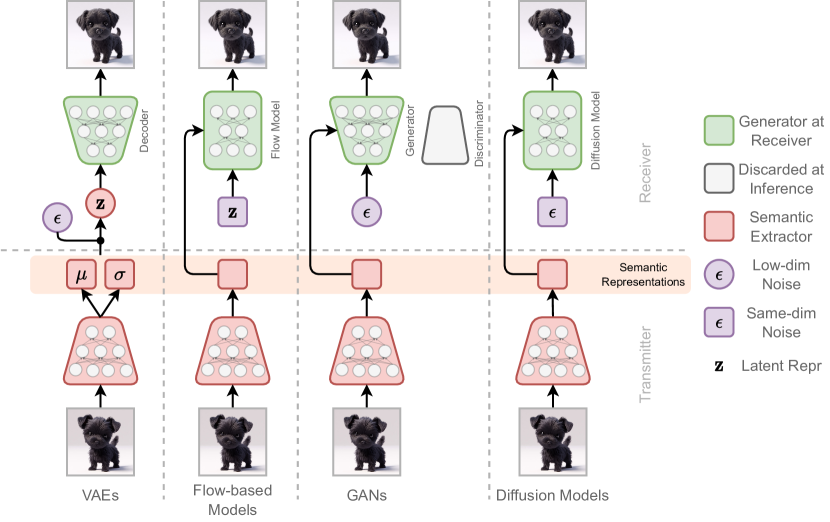
- 의미통신을 위한 생성모델 아키텍처를 분류한다 (VAEs, Flow-based, GANs, Diffusion).
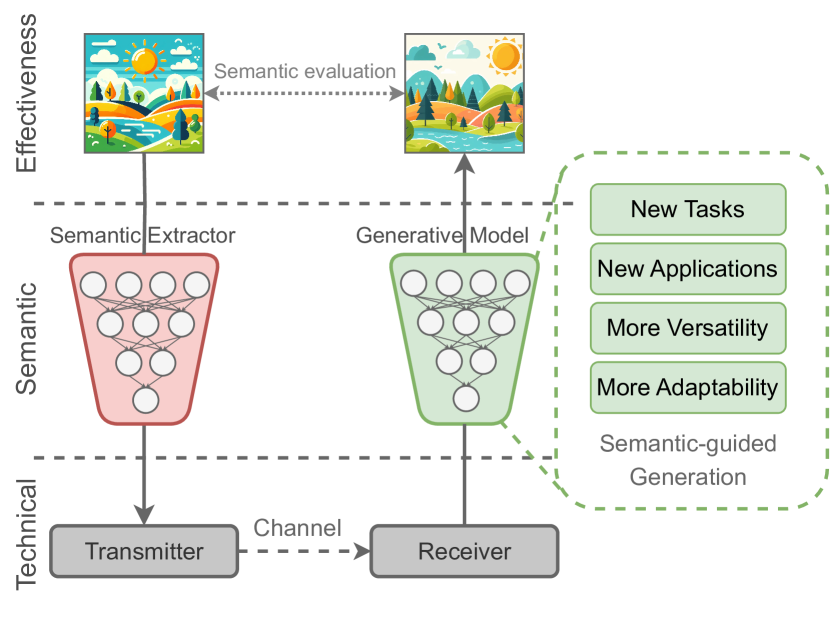
- Weaver 기반 의미통신 프레임워크의 수신단에서 생성 지시를 안내하는 핵심 메커니즘으로 semantic-conditioning을 설명한다.
- 의미 표현과 조건화가 재구성 품질과 불완전한 채널에서의 강인성에 어떻게 영향을 미치는지 설명한다.
실험 결과
연구 질문
- RQ1비트 회복을 넘어 의미통신에 심층 생성모델을 어떻게 통합할 수 있는가?
- RQ2의미통신에서 VAE, flow 모델, GAN, diffusion 모델의 장점과 한계는 무엇인가?
- RQ3채널 열악성 아래에서 생성 품질에 미치는 의미 조건화의 영향은 무엇인가?
- RQ4생성모델을 사용할 때 모듈식 대 엔드투엔드 아키텍처에서 어떤 구조적 변화가 발생하는가?
- RQ56G 시대 네트워크의 의미 작업에서 생성형 AI를 활용할 때 어떤 미래 응용과 도전이 생길 것인가?
주요 결과
- 생성모델은 정확한 비트 회복 없이 의미 압축과 내용 재생을 가능하게 하여 비용 효율적인 통신을 가능하게 한다.
- VAEs, flow 모델, GANs, 및 diffusion 모델은 의미 작업에서 압축, 샘플링 속도, 학습 안정성에 있어 트레이드오프를 제공한다.
- 의미 조건화는 중요하다; 정확한 조건화는 생성을 transmitted meaning과 정렬시키고, 조건화가 불완전하면 출력을 저해할 수 있다.
- 생성모델은 OSI 스택 내에서 엔드-투-엔드가 아닌 모듈식 아키텍처를 지원하여 잡음 제거, 복원 및 역문제 해결을 가능하게 한다.
- 신규 응용으로 콘텐츠 생성, 다중 모달 생성, 개인화 및 다중 사용자 통신, LLM-지원 워크플로우 등이 등장한다.
더 나은 연구,지금 바로 시작하세요
논문 읽기부터 검토까지, 연구 시간을 획기적으로 줄여보세요.
카드 등록 없음 · 무료 플랜 제공
이 리뷰는 AI가 만들고, 인간 에디터가 검토했습니다.