
[논문 리뷰] Geodesic Optimization for Predictive Shift Adaptation on EEG data
GOPSA는 SPD 매니폴드에서 도메인별 지오데식 전송을 학습하여 공분산 기반 EEG 특징과 예측 변화의 정렬을 공동으로 수행하고, 휴식 상태 EEG에서 교차 사이트 연령 예측을 향상시킵니다.
Electroencephalography (EEG) data is often collected from diverse contexts involving different populations and EEG devices. This variability can induce distribution shifts in the data $X$ and in the biomedical variables of interest $y$, thus limiting the application of supervised machine learning (ML) algorithms. While domain adaptation (DA) methods have been developed to mitigate the impact of these shifts, such methods struggle when distribution shifts occur simultaneously in $X$ and $y$. As state-of-the-art ML models for EEG represent the data by spatial covariance matrices, which lie on the Riemannian manifold of Symmetric Positive Definite (SPD) matrices, it is appealing to study DA techniques operating on the SPD manifold. This paper proposes a novel method termed Geodesic Optimization for Predictive Shift Adaptation (GOPSA) to address test-time multi-source DA for situations in which source domains have distinct $y$ distributions. GOPSA exploits the geodesic structure of the Riemannian manifold to jointly learn a domain-specific re-centering operator representing site-specific intercepts and the regression model. We performed empirical benchmarks on the cross-site generalization of age-prediction models with resting-state EEG data from a large multi-national dataset (HarMNqEEG), which included $14$ recording sites and more than $1500$ human participants. Compared to state-of-the-art methods, our results showed that GOPSA achieved significantly higher performance on three regression metrics ($R^2$, MAE, and Spearman's $ρ$) for several source-target site combinations, highlighting its effectiveness in tackling multi-source DA with predictive shifts in EEG data analysis. Our method has the potential to combine the advantages of mixed-effects modeling with machine learning for biomedical applications of EEG, such as multicenter clinical trials.
연구 동기 및 목표
- EEG 기반 예측 모델링에서 입력 데이터 X(공분산 행렬)와 목표 변수 y의 분포 변동을 모두 다루는 것.
- 타깃 도메인에서 재학습이 필요하지 않는 다중 소스 테스트 시점 도메인 적응 방법을 개발하는 것.
- SPD 매트릭스의 리만 기하를 활용하여 도메인별 지오데식 절편을 학습하되 전역 회귀 모델을 공유하는 것.
- EEG 공분산 데이터로부터 연령 예측에 대한 교차 사이트 일반화 향상을 입증하는 것.
- 다중센터 EEG 분석을 위한 혼합 효과 모델링과 머신러닝의 프레임워크를 제공하는 것.
제안 방법
- EEG 공분산 행렬을 SPD 매니폴드 S_d^{++} 위의 점으로 표현하고Affine-불변 리만 거리 측정을 사용하여 지오데식 거리를 계산한다.
- 리만 혼합 효과 모델을 정의하여 각 도메인 평균에서 항등으로의 지오데식으로 평행수송(parallel transport)을 통해 도메인별 지오데식 절편을 학습한다.
- 리만 로그 매핑 후 접선 공간에서 공유 선형 회귀를 학습하고, 교통 정도를 제어하는 도메인 가중치 α_k에 대한 학습 시 최적화를 수행한다.
- 훈련 시에는 모든 K개의 소스 도메인에 대해 도메인 전송과 Ridge 회귀 계수를 공동으로 최적화한다(알고리즘 1).
- 테스트 시에는 대상 평균 y_T와 예측 간 정렬을 위해 전송 매개변수 γ_T를 최적화하여 새로운 타깃 도메인에 적응한다(알고리즘 2).
- 주요 방정식에는 transport φ(Σ_i, Σ_k̄, α) = uvec(log_I(PT(Σ_i, Σ_k̄, α))) 와 능선 규제된 회귀 하에서 γ_S 및 γ_T의 최적화를 포함한다.
![Figure 1: Joint shift in $X$ and $y$ distributions on the HarMNqEEG dataset [ 31 ] . Subset of mean PSDs ( A ) and age distributions ( B ) from three recording sites used for the empirical benchmarks.](https://ar5iv.labs.arxiv.org/html/2407.03878/assets/x1.png)
실험 결과
연구 질문
- RQ1EEG 데이터에서 입력 공분산 행렬의 변동과 결과 변수의 변동이 모두 존재할 때 도메인 적응을 어떻게 수행하는가?
- RQ2SPD 매니폴드에서 지오데식 기반의 다소스, 테스트 시점 적응 방법이 EEG 기반 회귀 과제의 기존 재중심화 및 도메인 적응 기준선보다 성능을 능가하는가?
- RQ3전역 회귀 모델을 공유하면서 도메인별 지오데식 절편(병렬 수송)을 학습하는 것이 교차 사이트 EEG 연령 예측에 어떤 이점을 주는가?
주요 결과
| Site combination | Dummy | No DA | Re-center | DO Intercept | GOPSA |
|---|---|---|---|---|---|
| Ba,Cho,G,S | 0.53 ± 0.02 | 0.63 ± 0.02 | 0.52 ± 0.02 | 0.75 ± 0.02 | 0.78 ± 0.01 |
| Be,Chb,S | 0.58 ± 0.02 | 0.73 ± 0.01 | 0.43 ± 0.02 | 0.69 ± 0.02 | 0.72 ± 0.02 |
| Ba,Co,G | 0.63 ± 0.02 | 0.64 ± 0.02 | 0.42 ± 0.02 | 0.71 ± 0.01 | 0.74 ± 0.01 |
| Cu03,M,R,S | 0.63 ± 0.02 | 0.63 ± 0.01 | 0.46 ± 0.02 | 0.76 ± 0.01 | 0.76 ± 0.02 |
| Ba,Be,Cho, Co,Cu90,G,R | 0.77 ± 0.02 | 0.79 ± 0.01 | 0.44 ± 0.03 | 0.86 ± 0.01 | 0.87 ± 0.01 |
| Mean | 0.63 ± 0.02 | 0.68 ± 0.01 | 0.45 ± 0.02 | 0.75 ± 0.01 | 0.78 ± 0.01 |
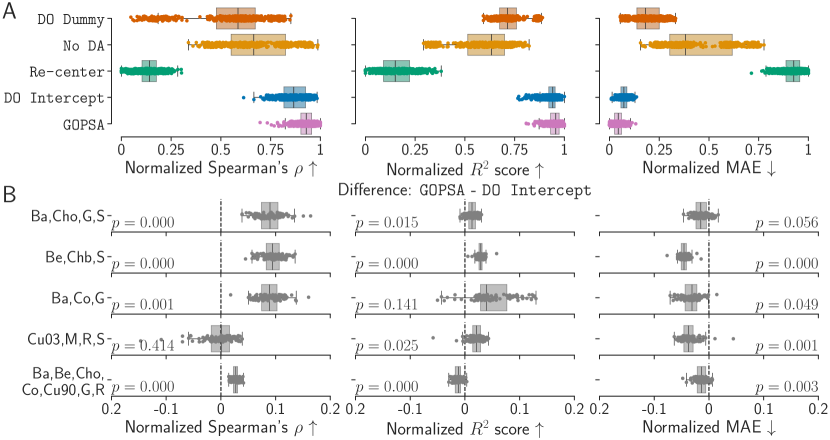
- GOPSA는 HarMNqEEG 사이트 조합에서 다양한 회귀 지표에 대해 더 높은 성능을 보였으며, 더미 DO, No DA, Re-center, DO Intercept 등 여러 기준선보다 우수합니다.
- Spearman의 ρ에 대해 GOPSA는 모든 사이트 조합 평균에서 0.78 ± 0.01에 도달하여 대안인 DO Intercept(0.75 ± 0.02)보다 우수합니다.
- R^2의 경우 GOPSA는 모든 사이트 조합 평균에서 0.61 ± 0.02로 Do Intercept(0.58 ± 0.02)보다 높습니다.
- MAE의 경우 GOPSA는 모든 사이트 조합 평균에서 8.25 ± 0.19로 Re-center(8.55 ± 0.18)보다 낫습니다.
- 특정 사이트 쌍에서 GOPSA는 지속적으로 기준선 접근법을 개선하여 다중 사이트 EEG 데이터의 예측 변화 처리에 효과를 보여줍니다.
더 나은 연구,지금 바로 시작하세요
연구 설계부터 논문 작성까지, 연구 시간을 획기적으로 줄여보세요.
카드 등록 없음 · 무료 플랜 제공
이 리뷰는 AI가 만들고, 인간 에디터가 검토했습니다.