
[논문 리뷰] GNNUERS: Fairness Explanation in GNNs for Recommendation via Counterfactual Reasoning
GNNUERS는 GNN 기반 추천 시스템에서 인구통계적 유틸리티 불균형을 최소화하기 위해 이원 그래프 구조를 변형함으로써 부당한 사용자-아이템 상호작용을 식별하는 새로운 반사적 설명 프레임워크이다. 이는 네 개의 실세계 데이터셋에서 세 개의 최신 GNN 모델에 대해 공정성 불균형을 성공적으로 설명하며, 성별 및 연령 기반의 공정성 불균형과 관련된 상호작용 패턴을 드러낸다.
Nowadays, research into personalization has been focusing on explainability and fairness. Several approaches proposed in recent works are able to explain individual recommendations in a post-hoc manner or by explanation paths. However, explainability techniques applied to unfairness in recommendation have been limited to finding user/item features mostly related to biased recommendations. In this paper, we devised a novel algorithm that leverages counterfactuality methods to discover user unfairness explanations in the form of user-item interactions. In our counterfactual framework, interactions are represented as edges in a bipartite graph, with users and items as nodes. Our bipartite graph explainer perturbs the topological structure to find an altered version that minimizes the disparity in utility between the protected and unprotected demographic groups. Experiments on four real-world graphs coming from various domains showed that our method can systematically explain user unfairness on three state-of-the-art GNN-based recommendation models. Moreover, an empirical evaluation of the perturbed network uncovered relevant patterns that justify the nature of the unfairness discovered by the generated explanations. The source code and the preprocessed data sets are available at https://github.com/jackmedda/RS-BGExplainer.
연구 동기 및 목표
- 특성 수준의 설명을 초월하여 GNN 기반 추천 시스템에서의 부당성에 대한 설명 부족 문제를 해결한다.
- 사용자나 아이템의 특성에 기반하지 않고 특정 사용자-아이템 상호작용을 통해 부당성을 설명하는 방법을 개발한다.
- 시스템 설계자가 보호 그룹과 비보호 그룹 간의 불균형에 기여하는 상호작용을 이해할 수 있도록 한다.
- 최소한의 상호작용 제거가 공정한 추천으로 이어지는 반사적 프레임워크를 제공한다.
- 이차 그래프의 위상적 구조를 기반으로 하여 설명을 구조화함으로써 그래프의 이원성에 기반한 설명을 보장한다.
제안 방법
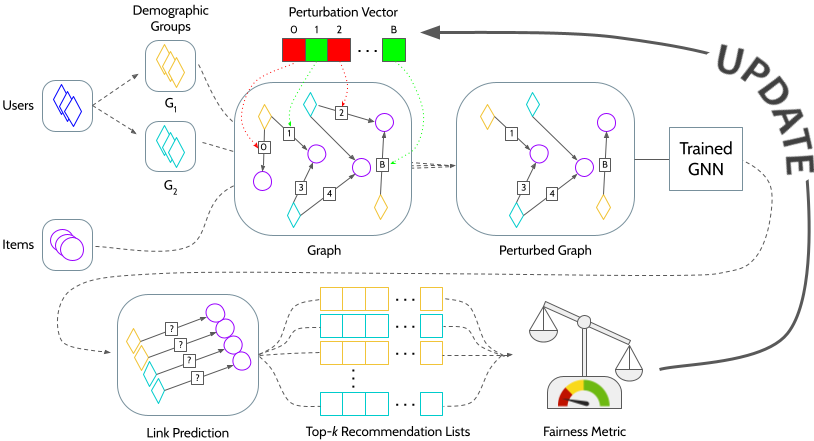
- 원래의 이원 그래프를 변형하여 보호 그룹과 비보호 그룹 간 유틸리티 불균형을 줄이는 반사적 문제로 사용자 부당성 설명을 수립한다.
- 사용자-아이템 상호작용을 이원 그래프의 간선으로 표현하며, 사용자와 아이템을 노드로 간주하고, 간선 제거를 모델링하기 위해 변형 벡터를 사용한다.
- 간선 제거의 미분 가능 근사화를 사용하여 변형 벡터를 최적화하며, 공정성 불균형을 최소화하기 위해 인구통계적 평등 원칙에 따라 지도한다.
- GNN의 위상적 구조를 활용하여, 어떤 상호작용을 제거할 경우 더 공정한 추천이 이루어지는지 식별하며, 간선 수준의 변화에 집중한다.
- 그래프 성질(예: 차수, 듀엣 수, 역 지오데식 거리)을 통합하여 식별된 간선을 해석하고 인간이 이해할 수 있는 설명을 생성한다.
- 네 개의 실세계 데이터셋에서 세 개의 최신 GNN 기반 추천 모델에 프레임워크를 적용하여 유틸리티 불균형 지표를 통해 공정성 향상을 검증한다.
실험 결과
연구 질문
- RQ1GNN 기반 추천 시스템에서 부당한 추천을 유발하는 특정 사용자-아이템 상호작용은 무엇인가?
- RQ2사용자나 아이템의 특성에 의존하지 않고 반사적 그래프 변형이 GNN에서의 부당성을 효과적으로 설명할 수 있는가?
- RQ3식별된 상호작용은 사용자 인기나 네트워크 근접성과 같은 그래프의 구조적 성질과 어떻게 관련이 있는가?
- RQ4GNNUERS는 추천 품질을 유지하면서 성별, 연령 등 인구통계적 그룹 간 유틸리티 불균형을 어느 정도 감소시킬 수 있는가?
- RQ5이 프레임워크는 다양한 GNN 아키텍처와 다중 그룹 공정성 설정으로 일반화될 수 있는가?
주요 결과
- GNNUERS는 세 개의 최신 GNN 기반 모델에서 상호작용 제거가 공정한 추천으로 이어지는 집합을 성공적으로 식별하였다.
- 이 방법은 ML-1M 데이터셋에서 낮은 상호작용 빈도를 가진 고립된 남성 사용자들이 담당하는 특이한 영화 선호 경향이 부당성의 원인임을 드러냈다.
- LFM-1K 데이터셋에서는 낮은 차수와 낮은 가까움을 가진 여성 사용자들과 높은 차수와 높은 가까움을 가진 남성 사용자들의 조합이 부당성을 유발하며, 이는 구조적 편향을 시사한다.
- 실증적 평가 결과, 변형된 그래프가 일관된 부당성 패턴을 드러내었으며, 설명은 그래프 위상과 사용자 행동에 기반하였다.
- GNNUERS는 MovieLens, Last.FM 및 두 개의 다른 실세계 데이터셋을 포함하여 네 개의 실세계 데이터셋에서 다양한 인구통계적 그룹 분포 조건에서도 강건성을 보였다.
- GNNUERS는 특성 수준의 설명을 초월하여 해석 가능하고 간선 수준의 설명을 제공하며, 공정성 완화를 위한 실질적인 통찰을 제공한다.

더 나은 연구,지금 바로 시작하세요
논문 읽기부터 검토까지, 연구 시간을 획기적으로 줄여보세요.
카드 등록 없음 · 무료 플랜 제공
이 리뷰는 AI가 만들고, 인간 에디터가 검토했습니다.