
[논문 리뷰] GraphPatcher: Mitigating Degree Bias for Graph Neural Networks via Test-time Augmentation
GraphPatcher는 테스트 시점 보정 프레임워크로, 저도수 노드의 에고그래프를 손상된 상태로 복구하기 위해 반복적으로 가상 노드를 생성함으로써 그래프 신경망(GNN)의 도수 편향을 완화한다. 이는 고도수 노드의 정확도를 떨어뜨리지 않은 채 저도수 노드의 성능을 향상시키며, GNN의 저도수 노드 성능을 최대 6.5% 향상시키고 전체 성능을 최대 3.6% 향상시킨다. 최신 기준 성능을 능가하며, 모델에 종속되지 않고 즉시 사용 가능한 방식으로 작동한다.
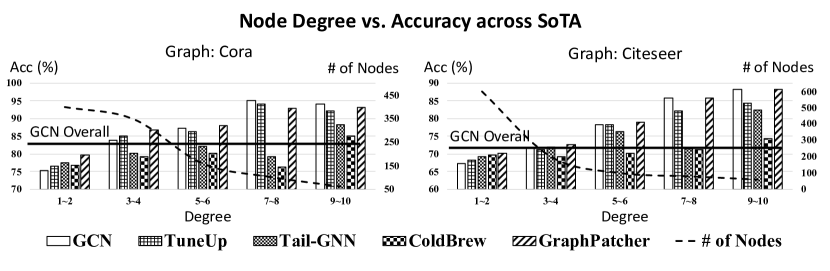
Recent studies have shown that graph neural networks (GNNs) exhibit strong biases towards the node degree: they usually perform satisfactorily on high-degree nodes with rich neighbor information but struggle with low-degree nodes. Existing works tackle this problem by deriving either designated GNN architectures or training strategies specifically for low-degree nodes. Though effective, these approaches unintentionally create an artificial out-of-distribution scenario, where models mainly or even only observe low-degree nodes during the training, leading to a downgraded performance for high-degree nodes that GNNs originally perform well at. In light of this, we propose a test-time augmentation framework, namely GraphPatcher, to enhance test-time generalization of any GNNs on low-degree nodes. Specifically, GraphPatcher iteratively generates virtual nodes to patch artificially created low-degree nodes via corruptions, aiming at progressively reconstructing target GNN's predictions over a sequence of increasingly corrupted nodes. Through this scheme, GraphPatcher not only learns how to enhance low-degree nodes (when the neighborhoods are heavily corrupted) but also preserves the original superior performance of GNNs on high-degree nodes (when lightly corrupted). Additionally, GraphPatcher is model-agnostic and can also mitigate the degree bias for either self-supervised or supervised GNNs. Comprehensive experiments are conducted over seven benchmark datasets and GraphPatcher consistently enhances common GNNs' overall performance by up to 3.6% and low-degree performance by up to 6.5%, significantly outperforming state-of-the-art baselines. The source code is publicly available at https://github.com/jumxglhf/GraphPatcher.
연구 동기 및 목표
- 실제의 파워-레인지 도수 분포에서 저도수 노드와 고도수 노드 간 지속적인 성능 격차를 해소하기 위해.
- 기존 방법들이 인위적인 분포 외 시나리오를 생성함으로써 고도수 노드의 성능을 떨어뜨리는 한계를 극복하기 위해.
- 재학습이나 아키텍처 변경 없이도 테스트 시점에서 GNN을 향상시킬 수 있는 모델에 종속되지 않고 즉시 사용 가능한 프레임워크를 개발하기 위해.
- 반복적인 가상 노드 생성을 통해 저도수 노드의 성능을 크게 향상시키면서도 고도수 노드의 성능을 유지하거나 향상시키기 위해.
- 실제 구현 환경에서 다양한 그래프 데이터셋과 GNN 아키텍처에 대해 효과적인 도수 편향 완화를 가능하게 하기 위해.
제안 방법
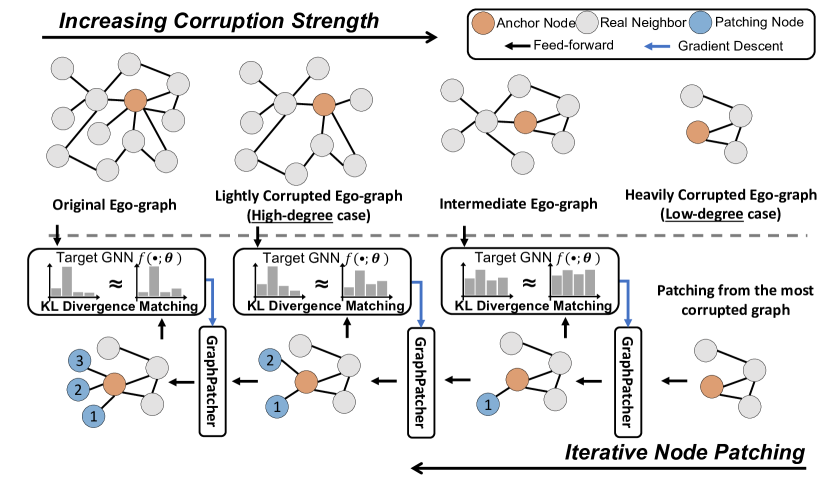
- GraphPatcher는 점점 더 강한 손상 강도를 가진 에고그래프의 시퀀스를 생성하여 점차 악화되는 이웃 정보를 시뮬레이션한다.
- 손상이 가장 심한 에고그래프를 대상으로 반복적으로 가상 노드를 생성하여, 수정된 그래프에서의 고정된 GNN 예측과 손상된 버전에서의 예측이 일치하도록 한다.
- 손상된 그래프와 수정된 그래프 간의 예측 불일치를 최소화하는 미분 가능한 목적함수를 통해 가상 노드를 최적화한다.
- 이 프레임워크는 테스트 시점에 적용되며, 대상 GNN의 업데이트가 필요 없어 모델에 종속되지 않으며 플러그인 모듈로 쉽게 배포할 수 있다.
- 학습 안정성과 일반화 성능 향상을 위해 각 손상 수준에서 다수의 샘플링된 에고그래프를 사용하는 다단계 최적화 프로세스를 사용한다.
- 이 방법은 반복적 인식 과정을 영감으로 삼지만, 데이터의 정확성 유지를 목적으로 하는 것이 아니라, 최종 GNN 성능 향상을 위해 특별히 조정되어 있다.
실험 결과
연구 질문
- RQ1테스트 시점 보정 프레임워크는 고도수 노드 성능을 떨어뜨리지 않으면서도 저도수 노드의 GNN 성능을 향상시킬 수 있는가?
- RQ2가상 노드 생성은 어떻게 최적화되어야 하며, 원래 GNN의 인덕티브 바이어스를 유지하면서 흩어진 이웃에 대한 예측을 향상시킬 수 있는가?
- RQ3모델에 종속되지 않고 즉시 사용 가능한 프레임워크는 다양한 그래프 데이터셋과 GNN 아키텍처에서 도수 편향을 어느 정도 완화할 수 있는가?
- RQ4제안된 방법은 지도 학습 및 자기지도 학습 GNN 모두에 일반화되는가? 특히 GRAND와 같은 최신 기준 모델에도 적용 가능한가?
- RQ5반복적인 가상 노드 생성 전략은 기존의 데이터 증강 또는 그래프 생성 기법과 성능 및 효율성 측면에서 어떻게 비교되는가?
주요 결과
- GraphPatcher는 일곱 개의 벤치마크 데이터셋에서 저도수 노드의 GNN 성능을 최대 6.5% 향상시키며, 기존의 베이스라인을 크게 능가한다.
- 전체 GNN 성능은 최대 3.6% 향상되어 다양한 그래프 유형과 아키텍처에서 일관된 성과를 보였다.
- 프레임워크는 고도수 노드의 원래 GNN 성능을 유지하거나 향상시키며, 이는 이전 방법에서 관찰된 성능 트레이드오프를 피하고 있다.
- GraphPatcher는 지도 학습 및 자기지도 학습 GNN 모두에 효과적이며, GRAND와 같은 최신 기준 모델에서도 성능을 추가로 향상시켜 이전의 최고 성능(SoTA)을 초월한다.
- 이 방법은 모델에 종속되지 않으며 재학습이나 아키텍처 변경이 필요 없어 기존의 생산 파이프라인에 원활하게 통합될 수 있다.
- 추가적인 계산 비용은 관리 가능하며, 모든 에고그래프가 사전에 생성되어 최적화 과정에서 중복 계산을 방지한다.
더 나은 연구,지금 바로 시작하세요
논문 읽기부터 검토까지, 연구 시간을 획기적으로 줄여보세요.
카드 등록 없음 · 무료 플랜 제공
이 리뷰는 AI가 만들고, 인간 에디터가 검토했습니다.