
[논문 리뷰] Gravitational imaging through a triple source plane lens: revisiting the $Λ$CDM-defying dark subhalo in SDSSJ0946+1006
이 연구는 다중 대역 HST 및 VLT-MUSE 데이터를 사용하여 삼중 소스 평면 렌즈 SDSSJ0946+1006를 재분석하여 이전에 보고된 어두운 준은하질서가 ΛCDM 예측과 일치하지 않는다는 점을 재평가한다. 5.9σ의 준은하질서가 발견되었으며 질량은 log₁₀(M/M☉) = 9.2⁺⁰.⁴₋₀.¹, 농도는 log₁₀c = 2.4⁺⁰.⁵₋₀.³로, 이제 CDM 시뮬레이션과 일치하며, 감지 유의성은 소스 정규화 방법에 매우 민감함을 강조한다.
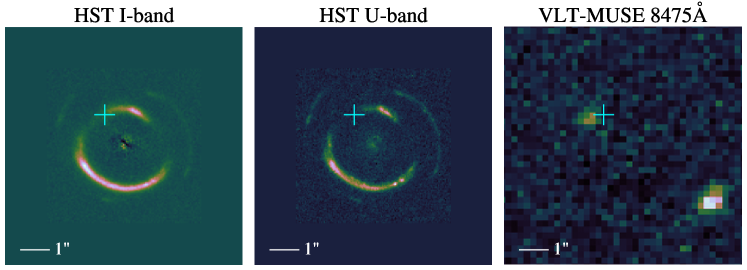
The $Λ$CDM paradigm successfully explains the large-scale structure of the Universe, but is less well constrained on sub-galactic scales. Gravitational lens modelling has been used to measure the imprints of dark substructures on lensed arcs, testing the small-scale predictions of $Λ$CDM. However, the methods required for these tests are subject to degeneracies among the lens mass model and the source light profile. We present a case study of the unique compound gravitational lens SDSSJ0946+1006, wherein a dark, massive substructure has been detected, whose reported high concentration would be unlikely in a $Λ$CDM universe. For the first time, we model the first two background sources in both I- and U-band HST imaging, as well as VLT-MUSE emission line data for the most distant source. We recover a lensing perturber at a $5.9σ$ confidence level with mass $\log_{10}(M_\mathrm{sub}/M_{\odot})=9.2^{+0.4}_{-0.1}$ and concentration $\log_{10}c=2.4^{+0.5}_{-0.3}$. The concentration is more consistent with CDM subhalos than previously reported, and the mass is compatible with that of a dwarf satellite galaxy whose flux is undetectable in the data at the location of the perturber. A wandering black hole with mass $\log_{10}(M_\mathrm{BH}/M_{\odot})=8.9^{+0.2}_{-0.1}$ is a viable alternative model. We systematically investigate alternative assumptions about the complexity of the mass distribution and source reconstruction; in all cases the subhalo is detected at around the $\geq5σ$ level. However, the detection significance can be altered substantially (up to $11.3σ$) by alternative choices for the source regularisation scheme.
연구 동기 및 목표
- 이전에 보고된 어두운 준은하질서가 ΛCDM 예측과 불일치하는 것으로 주장된 삼중 소스 평면 렌즈 SDSSJ0946+1006에서의 존재성과 성질을 재평가한다.
- 새로운 다중 파장 데이터를 바탕으로 준은하질서의 높은 농도와 질량이 냉각된 어두운 물질(CDM) 시뮬레이션과 일치하는지 조사한다.
- 특히 소스 재구성 및 정규화 방법에 의한 체계적 불확실성에 대해 준은하질서 감지의 견고성 평가.
- 어두운 준은하질서를 도입하지 않고도 렌즈 이상 현상을 설명할 수 있는 대안 질량 모델(예: 이동하는 블랙홀)이 가능한지 평가한다.
- 강력한 렌즈 모델링에서 소스 정규화(기울기 대비 곡률)가 준은하질서 감지 유의성 및 베이지안 증거에 미치는 영향 평가.
제안 방법
- 가까운 두 소스(s1 및 s2)의 I- 및 U-대역 HST 이미징과 먼 소스(s3)의 VLT-MUSE 발광선 데이터를 통합하여 렌즈 모델링을 수행한다.
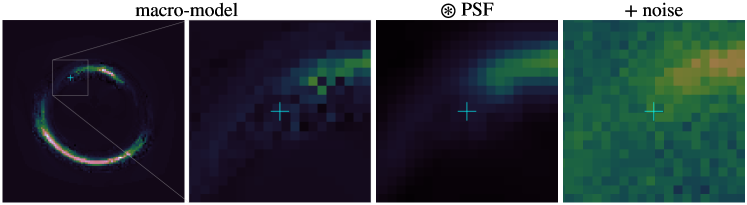
- 주 렌즈의 매개변수화된 매크로 모델과 어두운 교란자 감지를 위한 비매개변수화된 준은하질서 모델을 사용한다.
- 베이지안 증거 및 유의성 검정(χ² 및 사후 샘플링을 통한)을 통해 다양한 모델 변형에서 준은하질서 감지 평가.
- 소스 정규화 방법을 체계적으로 변화시켜 기울기 기반(기준) 대비 곡률 기반 정규화의 영향 평가.
- 매크로 모델의 복잡성 변화(3차 및 4차 다항항 포함, s1의 타원도 허용)를 통해 모델의 견고성 테스트.
- 다른 질량 모델(예: 이동하는 블랙홀 포함)을 비교하여 어두운 준은하질서 없이도 렌즈 이상 현상을 재현할 수 있는지 평가.
실험 결과
연구 질문
- RQ1다중 대역 및 다중 기기 데이터로 재분석했을 때, 이전에 보고된 SDSSJ0946+1006의 어두운 준은하질서는 여전히 ΛCDM 예측과 불일치하는가?
- RQ2소스 정규화 방법(기울기 대비 곡률)의 선택이 강력한 렌즈 모델에서 준은하질서 감지 유의성에 어떤 영향을 미치는가?
- RQ3질량 ~10⁸.⁹M☉의 이동하는 블랙홀이 어두운 준은하질서만큼이나 렌즈 이상 현상을 설명할 수 있는가?
- RQ4매크로 모델의 복잡성(예: 다항항, 타원도)을 변화시켰을 때 준은하질서 감지의 견고성은 어느 정도인가?
- RQ5이전 주장과 비교해 볼 때, 준은하질서의 질량과 농도가 이제 ΛCDM 시뮬레이션 예측과 어느 정도 일치하는가?
주요 결과
- 5.9σ의 어두운 준은하질서가 감지되었으며, 질량은 log₁₀(M/M☉) = 9.2⁺⁰.⁴₋₀.¹, 농도는 log₁₀c = 2.4⁺⁰.⁵₋₀.³로, 이제 CDM 시뮬레이션과 2.0σc 수준에서 일치한다.
- 이 준은하질서의 질량은 그 위치에서 빛이 탐지되지 않는 소형 위성은하의 질량과 호환된다.
- 소스 재구성에 곡률 정규화를 사용할 경우 감지 유의성이 기울기 정규화 대비 극적으로 변화할 수 있으며, 최대 11.3σ까지 증가한다.
- 곡률 정규화에서 더 높은 유의성에도 불구하고, 베이지안 증거는 기준 기울기 정규화 방법을 강하게 선호한다.
- 매크로 모델에 고차 다항항과 변동 타원도를 포함시켜도 준은하질서 감지 결과에 유의미한 영향을 주지 않으며, 최적 모델에서 여전히 ≥6σ의 감지 유의성이 유지된다.
- 질량 log₁₀(M/M☉) = 8.9⁺⁰.²₋₀.¹인 이동하는 블랙홀은 어두운 준은하질서 모델의 타당한 대안이지만, 증거에선 선호되지 않는다.
더 나은 연구,지금 바로 시작하세요
논문 읽기부터 검토까지, 연구 시간을 획기적으로 줄여보세요.
카드 등록 없음 · 무료 플랜 제공
이 리뷰는 AI가 만들고, 인간 에디터가 검토했습니다.