
[논문 리뷰] Helium as an Indicator of the Neutron-Star Merger Remnant Lifetime and its Potential for Equation of State Constraints
이 논문은 중성자별 병합 잔재의 수명을 측정하기 위해 킬로노바 스펙트럼 내 헬륨 발산, 특히 He i λ1083.3 nm 선을 탐사하는 방법을 제안한다. AT2017gfo의 스펙트럼을 분석함으로써 저자들은 잔재의 수명을 ≤30 ms 이내로 제한하며, 이는 직접 블랙홀 붕괴를 위한 임계 질량(M_thres ≲ 2.93 M⊙)에 가까운 총 이중성 질량임을 시사한다. 이는 중성자별 상태방정식를 최대 질량 M_max ≲ 2.3 M⊙ 및 1.6 M⊙ 별의 반지름을 약 12 ± 1 km로 제한한다.
The time until black hole formation in a binary neutron-star (NS) merger contains invaluable information about the nuclear equation of state (EoS) but has thus far been difficult to measure. We propose a new way to constrain the merger remnant's NS lifetime, which is based on the tendency of the NS remnant neutrino-driven winds to enrich the ejected material with helium. Based on the He I $λ1083.3$ nm line, we show that the feature around 800-1200 nm in AT2017gfo at 4.4 days seems inconsistent with a helium mass fraction of $X_{\mathrm{He}} \gtrsim 0.05$ in the polar ejecta. Our recent neutrino-hydrodynamic simulations of merger remnants are only compatible with this limit if the NS remnant collapses within 20-30 ms. Such a short lifetime implies that the total binary mass of GW170817, $M_\mathrm{ m tot}$, lay close to the threshold binary mass for direct gravitational collapse, $M_\mathrm{thres}$, for which we estimate $M_{\mathrm{thres}}\lesssim 2.93 M_\odot$. This upper bound on $M_\mathrm{thres}$ yields upper limits on the radii and maximum mass of cold, non-rotating NSs, which rule out simultaneously large values for both quantities. In combination with causality arguments, this result implies a maximum NS mass of $M_\mathrm{max}\lesssim2.3 M_\odot$. The combination of all limits constrains the radii of 1.6 M$_\odot$ NSs to about 12$\pm$1 km for $M_\mathrm{max}$ = 2.0 M$_\odot$ and 11.5$\pm$1 km for $M_\mathrm{max}$ = 2.15 M$_\odot$. This $\sim2$ km allowable range then tightens significantly for $M_\mathrm{max}$ above $\approx2.15$ M$_\odot$. This rules out a significant number of current EoS models. The short NS lifetime also implies that a black-hole torus, not a highly magnetized NS, was the central engine powering the relativistic jet of GRB170817A. Our work motivates future developments... [abridged]
연구 동기 및 목표
- 이중성 병합 잔재의 수명을 추정하기 위해 방사된 물질 내 헬륨 농도를 활용하는 새로운 방법을 개발하는 것.
- AT2017gfo의 스펙트럼에서 헬륨이 관측되지 않는 것과 잔재의 생존 시간 제약 간의 연관성을 규명하는 것.
- 잔재 수명과 블랙홀 형성 임계 이중성 질량에 대한 핵물리 상태방정식(EoS)의 경계를 유도하는 것.
- 특히 블랙홀-토러스 또는 마그네타르 중 어느 중심 엔진이 GRB170817A를 추진했는지 평가하는 것.
제안 방법
- 병합 후 4.4일째 AT2017gfo의 가시광선/적외선 스펙트럼에서 He i λ1083.3 nm 스펙트럼 특징을 분석하는 것.
- 중성자별 병합 잔재의 중성자율 유체역학 시뮬레이션을 통해 극방향 물질 분출에서 헬륨 질량 분율(X_He)이 잔재 수명에 따라 어떻게 변화하는지를 예측하는 것.
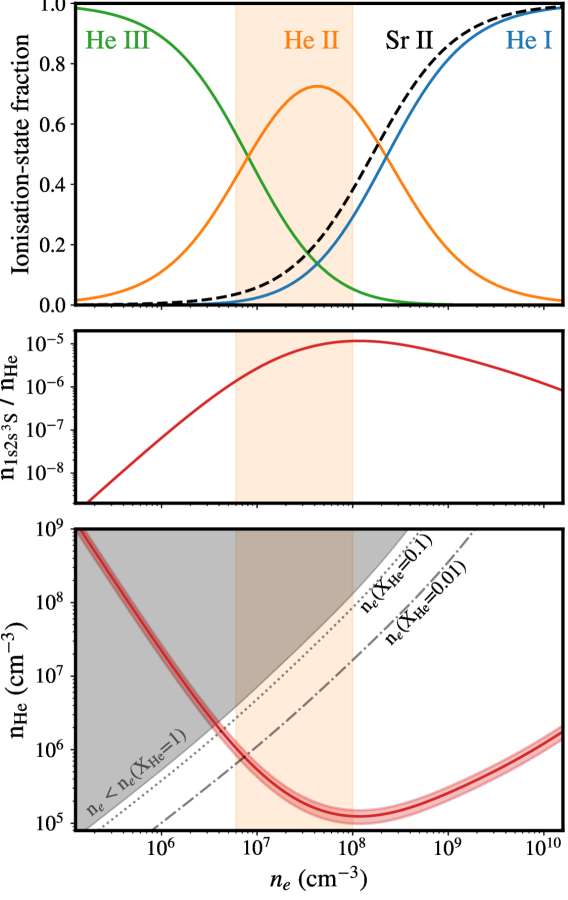
- 비-열평형 조건과 단순화된 물질 분포 기하구조를 가정하여 스펙트럼 모델링을 적용해 X_He의 상한선을 추론하는 것.
- 모의된 X_He(τ_BH) 관계를 기반으로 유도된 X_He 제한을 바탕으로 잔재 수명의 최대 20–30 ms로 매핑하는 것.
- 상태방정식에 따라 의존하는 시뮬레이션을 사용해 잔재 수명으로부터 임계 총 이중성 질량 M_thres를 유도하는 것.
- M_thres 제약 조건을 인과성 및 질량-반지름 관계와 결합하여 M_max와 R_1.6를 제약하며, R_1.6와 M_max 사이의 역관계를 활용하는 것.
![Figure 1: VLT/X-shooter spectrum of AT2017gfo 4.4 days post merger with a blackbody continuum overlaid ( $T_{\rm BB}=3200$ K from the best-fit blackbody compilation in Sneppen et al. [ 66 ] ) and P Cygni features for various helium abundances computed using the model described in Sect. II . Given a](https://ar5iv.labs.arxiv.org/html/2411.03427/assets/x1.png)
실험 결과
연구 질문
- RQ1킬로노바 스펙트럼 내 헬륨 발산을 통해 중성자별 병합 잔재의 수명을 추론할 수 있는가?
- RQ2AT2017gfo의 극방향 물질 분출에서 헬륨 질량 분율의 상한선은 얼마이며, 이는 잔재의 생존 시간에 어떤 의미를 갖는가?
- RQ3잔재 수명이 직접 블랙홀 붕괴를 위한 총 이중성 질량 임계값 M_thres를 어떻게 제약하는가?
- RQ4M_thres ≲ 2.93 M⊙일 때, 중성자별 상태방정식에 대한 결과적 제약, 특히 M_max와 R_1.6는 무엇인가?
- RQ5잔재 수명은 GRB170817A를 추진하는 중심 엔진이 블랙홀-토러스인지 마그네타르인지에 대해 어떤 시사점을 갖는가?
주요 결과
- AT2017gfo에서 4.4일째 관측된 He i λ1083.3 nm 특징은 극방향 물질 분출에서 헬륨 질량 분율 X_He ≳ 0.05인 경우와 일치하지 않는다.
- 중성자율 유체역학 시뮬레이션은 잔재가 20–30 ms 이내에 붕괴하지 않는 한 이 X_He 제한과 일치하지 않는다.
- 이는 GW170817에 대해 직접 블랙홀 붕괴를 위한 임계 총 이중성 질량 M_thres ≲ 2.93 M⊙임을 시사한다.
- 이 상한선과 인과성 제약 조건을 조합하면 최대 중성자별 질량 M_max ≲ 2.3 M⊙로 제약된다.
- M_max = 2.0 M⊙일 경우 1.6 M⊙ 중성자별의 반지름은 R_1.6 = 12 ± 1 km로 제약되며, M_max = 2.15 M⊙일 경우 R_1.6 = 11.5 ± 1 km로 제약된다.
- 약 20 ms의 잔재 수명은 GRB170817A가 블랙홀-토러스 중심 엔진에 의해 추진되었음을 시사한다. 마그네타르가 아닌 것이다.
더 나은 연구,지금 바로 시작하세요
논문 읽기부터 검토까지, 연구 시간을 획기적으로 줄여보세요.
카드 등록 없음 · 무료 플랜 제공
이 리뷰는 AI가 만들고, 인간 에디터가 검토했습니다.