
[논문 리뷰] Identifying and Explaining the Resilience of Ecological Networks
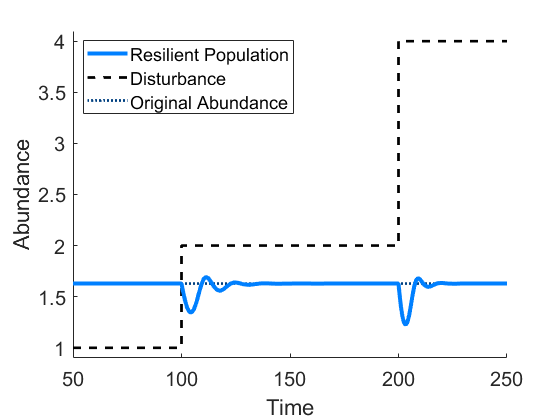
이 연구는 생화학적 조절 네트워크에서 유래한 도구를 활용하여 일반화된 Lotka-Volterra 프레임워크 하에서 세 종 생태계 네트워크에서 완전한 적응의 강건성—장애 이후 종의 개체수 정확히 원래 수준으로 복귀하는 저항성—을 식별하고 설명한다. 20,000개 이상의 가능한 네트워크 구조 중에서 23개의 네트워크가 이러한 저항성을 보였으며, 순차적 일방향 상호작용과 종내 경쟁을 포함하는 구조적 모티프가 핵심 메커니즘으로 드러났다.
Resilient ecological systems will be better able to maintain their structure and function in the emerging Anthropocene. Estimating the resilience of different systems will therefore provide valuable insight for conservation decision-makers, and is a priority goal of resilience theory. Current estimation methods rely on the accurate parameterisation of ecosystem models, or the identification of important motifs in the structure of the ecological system network. However, both of these methods face significant empirical and theoretical challenges. In this paper, we adapt tools developed for the analysis of biochemical regulatory networks to prove that a form of resilience - robust perfect adaptation - is a property of particular ecological networks, and to explain the specific process by which the ecosystem maintains its resilience. We undertake an exhaustive search for robust perfect adaptation across all possible three-species ecological networks, under a generalised Lotka-Volterra framework. From over 20,000 possible network structures, we identify 23 network structures that are capable of robust perfect adaptation. The resilient properties of these networks provide important insights into the potential mechanisms that could promote resilience in ecosystems, and suggest new avenues for measuring and understanding the property of ecological resilience in larger, more realistic socioecological networks.
연구 동기 및 목표
- 강건한 완전한 적응—장애 이후 종의 개체수가 정확히 사전 장애 수준으로 복귀하는 형태의 저항성—을 보일 수 있는 생태계 네트워크 구조를 식별하는 것.
- 생태계 모델의 매개변수 추정 과제를 해결하기 위해 동적 매개변수 대신 구조적 특성에 초점을 맞추는 것.
- 생화학적 반응 네트워크 이론에서 유래한 방법을 적응하여 생태계 네트워크의 저항성 기계적 기반을 설명하는 것.
- 완전한 내성 저항성을 보이는 네트워크 모티프가 사회생태계의 보존 관리 및 생태계 설계에 통찰을 줄 수 있는지 탐색하는 것.
- 더 큰, 더 현실적인 생태계 네트워크에서 이러한 저항성 구조를 식별하는 기초를 마련하는 것.
제안 방법
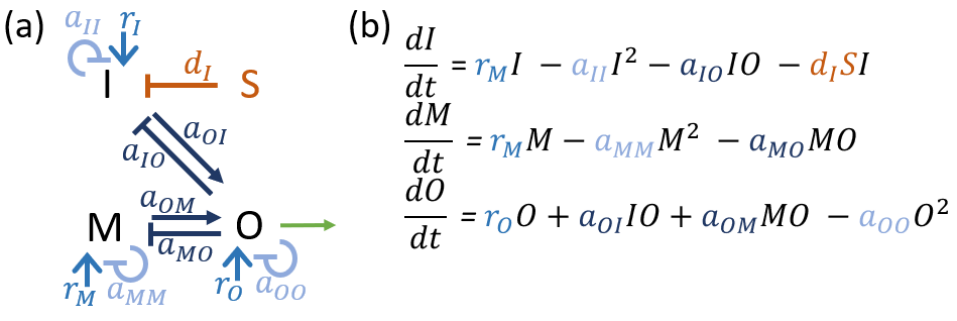
- 일반화된 Lotka-Volterra 프레임워크 하에서 가능한 모든 세 종 생태계 네트워크 구조에 대한 철저한 검색을 수행함.
- 그뢰버 기저 계산을 포함한 대수 기법을 적용하여 강건한 완전한 적응을 위한 조건을 분석적으로 규명함.
- 자극 기반의 교란 모델을 사용하여 장애를 시뮬레이션하고 원상복귀 행동을 평가함.
- 대상 종의 개체수가 매개변수 값에 관계없이 항상 장애 이전 수준으로 정확히 복귀하는 네트워크 모티프를 식별함.
- 일방향 상호작용의 연속성과 종내 경쟁 항목의 포함 여부 등 강건한 네트워크의 구조적 특징을 분석함.
- 수치 시뮬레이션을 통해 결과를 검증하여 완전한 적응 역학과 진동 행동을 확인함.
실험 결과
연구 질문
- RQ1일반화된 Lotka-Volterra 모델 하에서 어떤 세 종 생태계 네트워크 구조가 강건한 완전한 적응을 보이는가?
- RQ2생태계 시스템에서 강건한 완전한 적응과 항상 관련된 구조적 특징이나 네트워크 모티프는 무엇인가?
- RQ3일방향 상호작용와 종내 경쟁은 완전한 저항성의 메커니즘에 어떻게 기여하는가?
- RQ4모든 개체군에 동시에 영향을 주는 교란은 강건한 완전한 적응을 가능하게 하는가, 그리고 그 이유는 무엇인가?
- RQ5생화학적 네트워크에서 사용된 분석 프레임워크가 생태계 네트워크의 저항성을 식별하는 데 얼마나 적합하게 적용될 수 있는가?
주요 결과
- 20,000개 이상의 가능한 세 종 네트워크 구조 중에서 23개가 강건한 완전한 적응을 보일 수 있음.
- 모든 저항성 네트워크는 한 종이 다른 종에 영향을 주되 반대로 영향을 받지 않는 순차적 일방향 상호작용의 연속성을 포함함.
- 모든 저항성 네트워크에 종내 경쟁 항목이 존재하였으며, 이는 진동 동역학의 안정화에 결정적인 역할을 함.
- 모든 개체군에 직접 영향을 주는 교란이 있는 네트워크는 완전한 저항성을 달성할 수 없었으며, 이는 전 지구적 충격에 대한 버퍼링 한계를 시사함.
- 식별된 모티프는 매우 높은 진동성을 보였으며, 이는 후속 스토케스틱 교란에 대한 취약성을 증가시킴.
- 그뢰버 기저 계산 기반의 분석 프레임워크는 정확한 매개변수 값이 필요 없이도 저항성을 성공적으로 식별하여 생태계 모델링의 주요 실증적 과제를 극복함.
더 나은 연구,지금 바로 시작하세요
논문 읽기부터 검토까지, 연구 시간을 획기적으로 줄여보세요.
카드 등록 없음 · 무료 플랜 제공
이 리뷰는 AI가 만들고, 인간 에디터가 검토했습니다.