
[논문 리뷰] Imaging inter-valley coherent order in magic-angle twisted trilayer graphene
논문은 STM을 이용해 매직 앵글 비틀림 삼층 그래핀에서 전자 대칭성 붕괴를 관찰하고, 도핑 의존적 인터밸리 코히런트 Kekulé 순서와 그 부합하지 않는 나선형 변조를 드러낸다.
Magic-angle twisted trilayer graphene (MATTG) exhibits a range of strongly correlated electronic phases that spontaneously break its underlying symmetries. The microscopic nature of these phases and their residual symmetries stands as a key outstanding puzzle whose resolution promises to shed light on the origin of superconductivity in twisted materials. Here we investigate correlated phases of MATTG using scanning tunneling microscopy and identify striking signatures of interaction-driven spatial symmetry breaking. In low-strain samples, over a filling range of about 2-3 electrons or holes per moiré unit cell, we observe atomic-scale reconstruction of the graphene lattice that accompanies a correlated gap in the tunneling spectrum. This short-scale restructuring appears as a Kekulé supercell -- implying spontaneous inter-valley coherence between electrons -- and persists in a wide range of magnetic fields and temperatures that coincide with the development of the gap. Large-scale maps covering several moiré unit cells further reveal a slow evolution of the Kekulé pattern, indicating that atomic-scale reconstruction coexists with translation symmetry breaking at the much longer moiré scale. We employ auto-correlation and Fourier analyses to extract the intrinsic periodicity of these phases and find that they are consistent with the theoretically proposed incommensurate Kekulé spiral order. Moreover, we find that the wavelength characterizing moiré-scale modulations monotonically decreases with hole doping away from half-filling of the bands and depends only weakly on the magnetic field. Our results provide essential insights into the nature of MATTG correlated phases in the presence of strain and imply that superconductivity emerges from an inter-valley coherent parent state.
연구 동기 및 목표
- 매직 앵글 비틀림 삼층 그래핀(MATTG)에서 대칭성이 깨진 전자 상의 실공간 표식을 규명한다.
- STM 데이터에서 인터밸리 코히런트(IVC) 순서가 어떻게 나타나는지와 그것이 전자적 격차와의 관계를 규명한다.
- MATTG에서 Kekulé 유사 순서의 파벡터, 도핑 의존성, 그리고 스트레인 민감도를 결정한다.
- 가능한 IVC 시나리오(T-IVC 대 IKS)를 공간적 변조와 장/온도 의존성을 통해 구분한다.
제안 방법
- 낮은 변형의 MATTG에서 매직 각도(1.60°)에 근접한 영역에서 해상도 높은 STM/dI/dV 매핑을 수행하고, 채움 ν를 변화시키기 위해 제어된 게이팅을 적용한다.
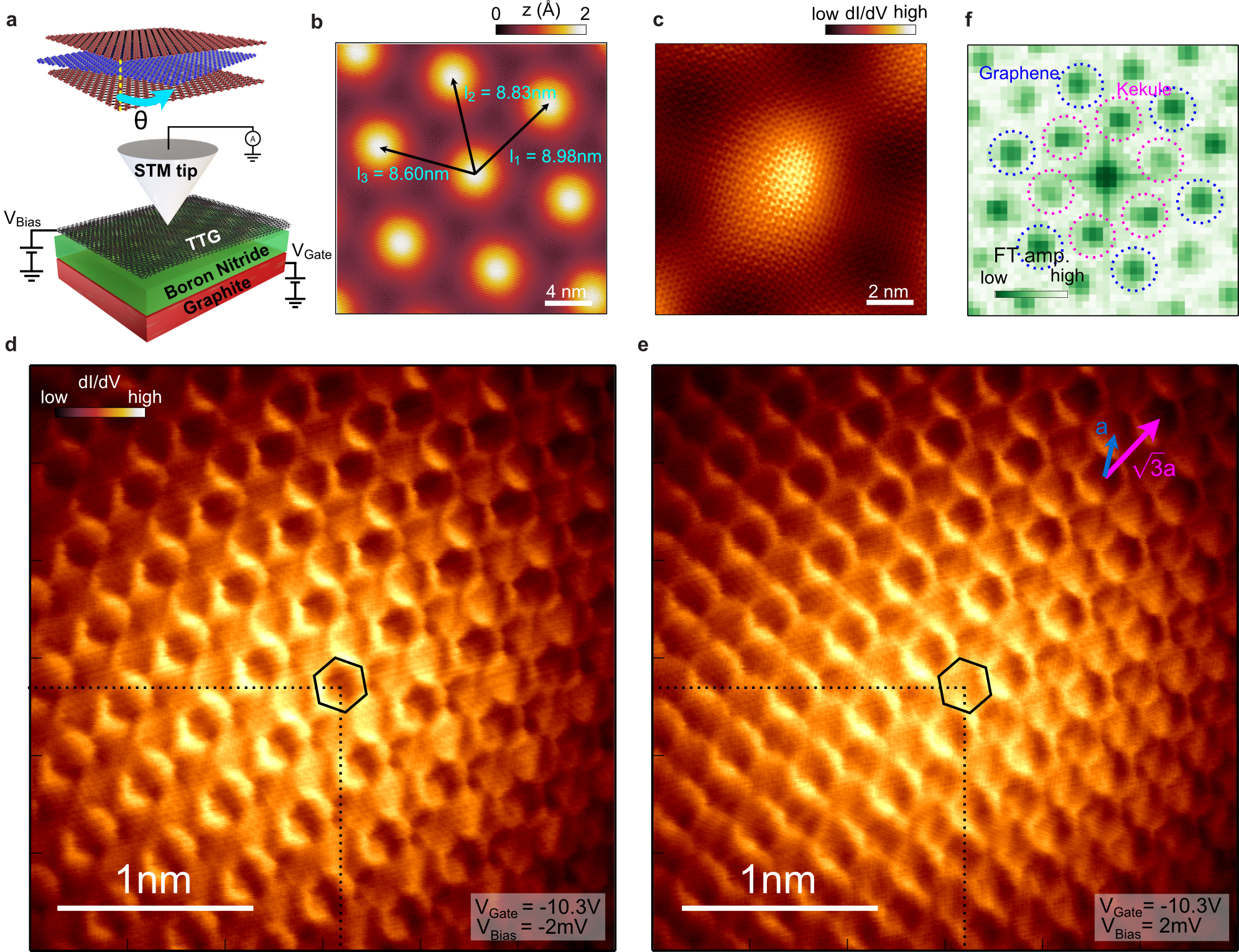
- 푸리에 분석을 사용하여 Kekulé형 단위 격자 확장을 식별하고 FT 스펙트럼의 위성 피크에서 q_Kekulé를 추출한다.
- Kekulé 자기상관 및 영역별 FT 필터링을 적용해 모이어 규모 영역 전반에 걸친 왜곡의 공간적 진화를 연구한다.
- 관찰된 파벡터와 패턴을 이론적 IKS(비일치 Kekulé 나선) 및 T-IVC 시나리오와 비교하고 이질적 스트레인을 고려한다.
- 게이트 전압, 바이어스 전압, 온도, 자기장에 대한 의존성을 조사해 재구성의 전자적 기원을 확인한다.
실험 결과
연구 질문
- RQ1MATTG가 STM LDOS 지도에서 Kekulé 유사 격자 세 배 증가로 입증되는 인터밸리 코히런트 순서를 보이나?
- RQ2q_Kekulé 파벡터와 채움, 스트레인, 자기장의 의존성은 어떻게 되며 IKS 예측과 어떻게 비교되는가?
- RQ3제로 필드 서명 및 장 의존성에 근거해 STM 측정이 MATTG의 IVC 위상들(IKS 대 T-IVC)을 구별할 수 있는가?
- RQ4이질 스트레인이 관찰된 IVC 관련 패턴과 모이어 격자와의 교성성에 어떤 영향을 미치는가?
주요 결과
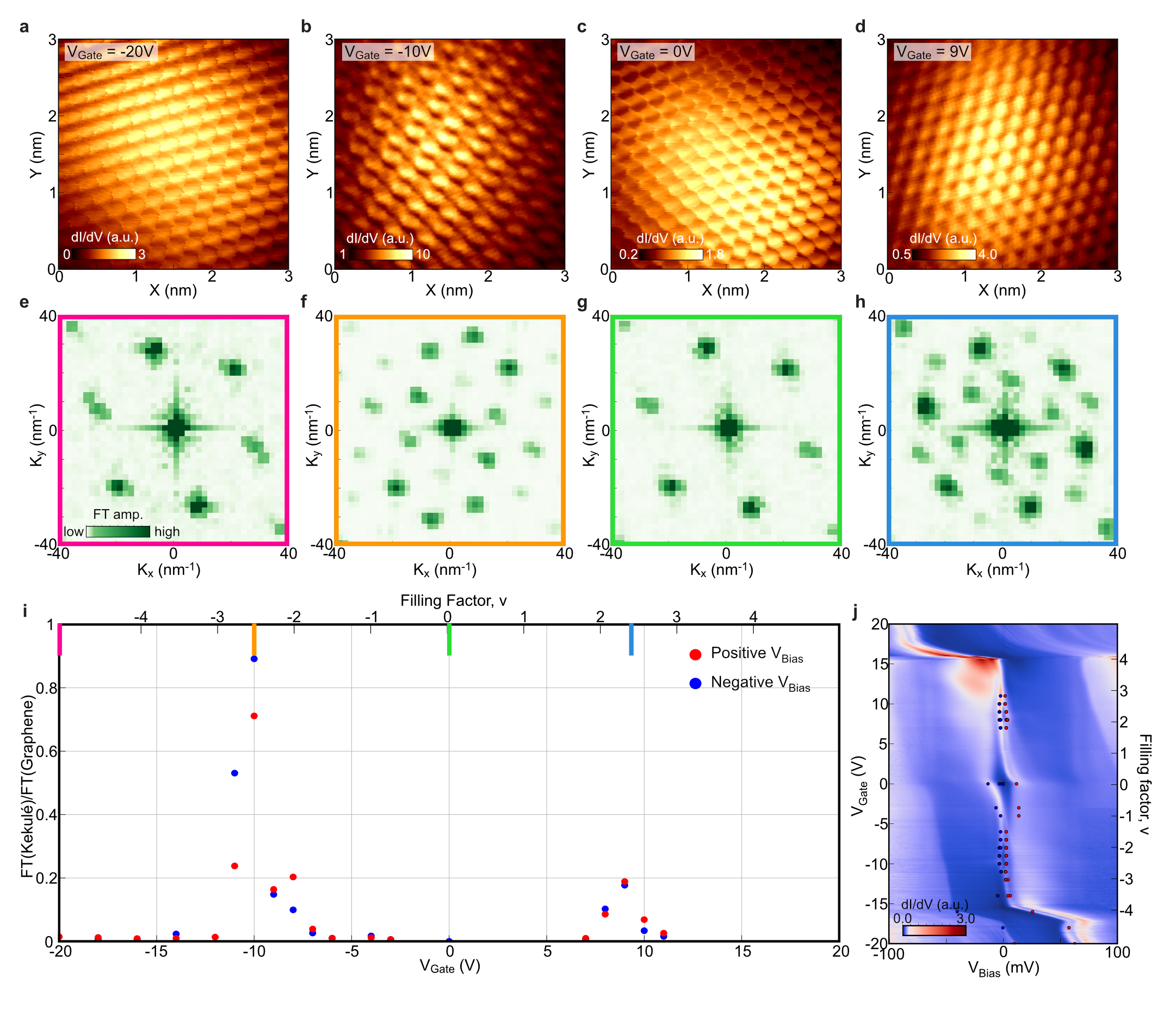
- dI/dV 맵에서 Kekulé-type 격자 삼배 패턴이 -3<ν<-2 및 2<ν<3의 충전에서 나타나 인터밸리 코히런스가 있음을 시사한다.
- Kekulé 패턴은 전하 중성 근처와 원격 밴드에서는 없고, 그 강도는 상관된 격차를 따라 진동하며 다양한 장과 온도에서 지속된다.
- 푸리에 분석은 모이어 포텐셜과 일반적으로 비일치하는 Kekulé 변조 파벡터 q_Kekulé를 드러내며, 구멍 도핑이 증가/감소함에 따라 감소/증가하고, 교정 점 근처에서 모이어 브릴루앙 구역 경계를 가로지른다.
- 자기상관 및 FT 필터링 분석은 모이어 규모의 평행대칭 파괴를 보여주고 Kekulé 패턴이 여러 모이어 단위셀에 걸쳐 천천히 진화함을 보여주며 IKS 타입의 순서를 시사한다.
- 추출된 q_Kekulé은 이질 스트레인이 포함될 때 IKS 이론과 일치하고, hole 도핑과 실험적 경향과도 일치하며 MATTG에서 초전도성의 기원으로 인터밸리 중첩에 의한 나선 순서를 지지한다.
- 추가 관찰로 FT 맵에서 줄무늬처럼 보이는 사시 특징이 C3 대칭성 파괴와 그래핀 결합의 방향성을 시사해 전하 중성 근처에서 네마틱 경향을 시사한다.
더 나은 연구,지금 바로 시작하세요
논문 읽기부터 검토까지, 연구 시간을 획기적으로 줄여보세요.
카드 등록 없음 · 무료 플랜 제공
이 리뷰는 AI가 만들고, 인간 에디터가 검토했습니다.