
[논문 리뷰] Imaging the breaking of electrostatic dams in graphene for ballistic and viscous fluids
이 연구는 나노스케일 해상도로 그래핀 내 준입자 흐름을 이미징하기 위해 스캐닝 터널링 포텐셜미터리(스팅)를 사용하여, 좁은 채널에서 비오믹 흐름 프로파일과 초구동성 도핑을 밝혀내었다. 77 K에서 점성 전자 흐름이 구동한계를 초월하며, 측정된 전자-전자 산란 길이 약 100 nm, 운동점성도 ≈2.5×10³ cm²/s로 확인되어 그래핀의 페르미 유체에서 유체역학적 거동이 확인되었다.
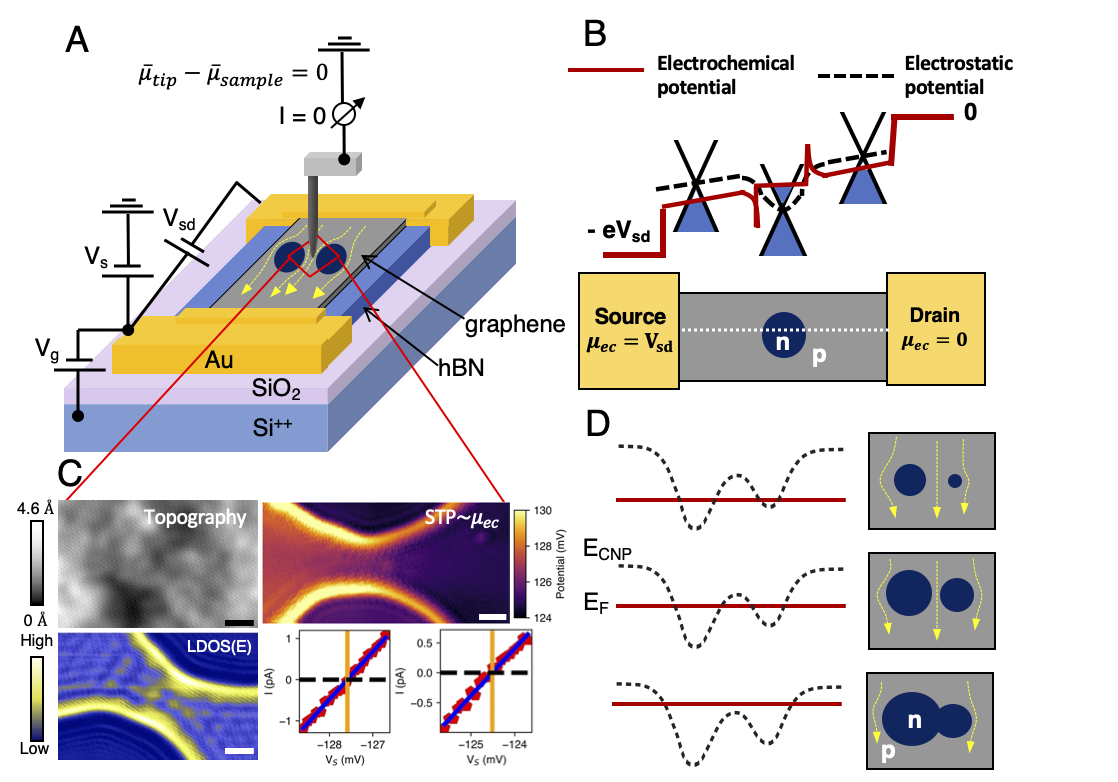
The flow of charge carriers in materials can, under some circumstances, mimic the flow of viscous fluids. In order to visualize the consequences of such effects, new methodologies must be developed that can probe the quasiparticle flow profile with nm-scale resolution as the geometric parameters of the system are continuously evolved. In this work, scanning tunneling potentiometry (STP) is used to image quasiparticle flow around engineered electrostatic barriers in graphene/hBN heterostructures. Measurements are performed as electrostatic dams - defined by lateral pn-junction barriers - are broken within the graphene sheet, and carriers move through conduction channels with physical widths that vary continuously from pinch-off to um-scale. Local, STP measurements of the electrochemical potential allow for direct characterization of the evolving flow profile, which we compare to finite-element simulations of a Stokesian fluid with varying parameters. Our results reveal distinctly non-Ohmic flow profiles, with charge dipoles forming across barriers due to carrier scattering and accumulation on the upstream side, and depletion downstream. Conductance measurements of individual channels, meanwhile, reveal that at low temperatures the quasiparticle flow is ballistic, but as the temperature is raised there is a Knudsen-to-Gurzhi regime crossover where the fluid becomes viscous and the channel conductance exceeds the ballistic limit set by Sharvin conductance. These results provide a clear illustration of how carrier flow in a Fermi fluid evolves as a function of carrier density, channel width, and temperature. They also demonstrate how STP can be used to extract key parameters of quasiparticle transport, with a spatial resolution that exceeds that of other methods by orders of magnitude.
연구 동기 및 목표
- 채널 폭과 같은 기하학적 매개변수를 연속적으로 조절하면서 그래핀 내 준입자 흐름을 나노스케일 공간 해상도로 시각화하는 것.
- 온도와 실리콘 농도를 변화시켜 그래핀 내 구동성에서 점성 전자 흐름으로의 전이를 탐구하는 것.
- 스캐닝 터널링 포텐셜미터리(STP)가 다른 방법에 비해 훨씬 높은 해상도로 전기화학적 위치 프로파일을 직접 측정할 수 있음을 입증하는 것.
- 실험적 STP 데이터에서 전자-전자 산란 길이 및 운동점성도와 같은 핵심 유체역학적 매개변수를 추출하는 것.
- 관측된 흐름 프로파일이 다양한 매개변수에서 스토크스의 법칙을 따르는 유체 모델의 유한요소 시뮬레이션과 비교 검증하는 것.
제안 방법
- 스캐닝 터널링 포텐셜미터리(STP)를 사용하여 나노미터 이하의 공간 해상도로 그래핀의 국소 전기화학적 위치를 맵핑한다.
- STM 톱의 전압 펄스를 이용해 현장에서 전기적 장벽(p-n 접합)을 형성하여 조절 가능한 구속 및 '전기적 댐'을 형성한다.
- 이 방법을 통해 채널 폭을 마이크로미터 스케일에서 완전히 차단될 때까지 연속적으로 변화시킬 수 있으며, 흐름의 진화를 실시간으로 관찰할 수 있다.
- 다양한 매개변수에서 실험적 흐름 프로파일과 비교하기 위해 스토크스의 법칙을 따르는 유체의 유한요소 시뮬레이션을 수행한다.
- 원형 p-n 접합에서 전하 밀도 및 위치의 이론적 모델링은 톰슨-페르미 근사 아래 연립 방정식의 자가일관된 해를 사용한다.
- 다양한 길이 척도에서 그래핀의 p-n 접합에서의 비선형 스크리닝 효과를 분석하여, 유체역학적 모델링의 타당성을 평가한다.
실험 결과
연구 질문
- RQ1전기적 댐이 파손되고 채널 폭이 연속적으로 변화함에 따라 그래핀 내 준입자 흐름 프로파일은 어떻게 변화하는가?
- RQ2다른 온도에서 국소 전기화학적 위치 측정에서 점성 대비 구동성 운반의 특징은 무엇인가?
- RQ3STP는 그래핀에서 전하 듀플렉스 및 초구동성 도핑과 같은 유체역학적 특징을 어느 정도 해상도로 해결할 수 있는가?
- RQ4그래핀 내 전자-전자 산란 길이 및 운동점성도는 이론적 예측 및 실험 관측치와 비교해 어떻게 되는가?
- RQ5스토크스의 법칙을 따르는 유체의 유한요소 시뮬레이션은 관측된 STP 측정 위치 프로파일을 정량적으로 재현할 수 있는가?
주요 결과
- 4.5 K에서 준입자 흐름은 구동성이며, 채널 도핑이 샤프린 도핑 한계와 일치하여 산란이 최소임을 나타낸다.
- 77 K에서 채널 도핑은 구동한계를 초월하며, 점성 흐름과 일치하는 초구동성 행동을 보여준다.
- 77 K에서 전자-전자 산란 길이는 약 100 nm로 측정되어 강한 다체 상호작용을 나타낸다.
- 전자 유체의 운동점성도는 약 2.5×10³ cm²/s로 추정되어 점성 유체역학적 운반을 확인한다.
- 상류 캐리어 축적과 하류 농도 감소로 인해 장벽을 가로질러 전하 듀플렉스가 형성되며, 이는 비오믹 흐름의 상징이다.
- STP 측정은 다른 스캔 프로브 기법보다 수 개의 주기수준으로 높은 나노스케일 공간 해상도로 위치 기울기를 해결한다.
더 나은 연구,지금 바로 시작하세요
논문 읽기부터 검토까지, 연구 시간을 획기적으로 줄여보세요.
카드 등록 없음 · 무료 플랜 제공
이 리뷰는 AI가 만들고, 인간 에디터가 검토했습니다.