
[논문 리뷰] Import options for chemical energy carriers from renewable sources to Germany
이 연구는 지리정보시스템(GIS) 기반의 재생 가능 에너지 잠재력과 시간대별 기상 데이터를 활용하여 독일으로의 수입가능한 재생 화학 에너지 운반체—수소, 메탄, 암모니아, 메탄올, 페일러-트로프쉬 연료—의 비용 경쟁력 있는 수입 옵션을 평가한다. 각 에너지 운반체에 대해 국내 생산보다 저렴한 국제 수출 경로가 적어도 하나 존재하는 것으로 나타났으며, 덴마크, 스페인, 북아프리카에서 오는 수소 파이프라인은 36–42€/MWh LHV의 가장 낮은 비용을 기록한다. 반면 암모니아나 메탄올을 통한 간접 경로는 자본 및 에너지 손실로 인해 효율성이 떨어진다.
Import and export of fossil energy carriers are cornerstones of energy systems world-wide. If energy systems are to become climate neutral and sustainable, fossil carriers need to be substituted with carbon neutral alternatives or electrified if possible. We investigate synthetic chemical energy carriers, H2, CH4, MeOH, NH3 and Fischer-Tropsch fuels (FTF), produced using electricity from RES as fossil substitutes. [...] We model the sourcing of feedstock chemicals, synthesis and transport along nine different Energy Supply Chains to Germany (DE) and compare import options for seven locations around the world against each other and with domestically sourced alternatives on the basis of their respective cost per unit of H2 and energy delivered. We find that for each type of chemical energy carrier, there is an import option with lower costs compared to domestic production in DE. No single exporting country or energy carrier has a unique cost advantage, since for each energy carrier and country there are cost-competitive alternatives. This allows exporter and infrastructure decisions to be made based on other criteria than energy and cost. The lowest cost means for importing of energy and H2 are by H2 pipeline from Denmark, Spain and Western Asia and Northern Africa starting at 36 EUR/MWhLHV to 42 EUR/MWh-LHV or 1.0 EUR/kg-H2 to 1.3 EUR/kg-H2 (in 2050, assuming 5 % p.a. capital cost). For complex energy carriers derived from H2 like CH4, NH3, MeOH or FTF, imports from Argentina by ship to DE are lower cost than closer exporters in the European Union or Western Asia and Northern Africa. For meeting H2 demand, direct H2 imports are more attractive than indirect routes using CH4, MeOH or NH3 imports and subsequent decomposition to H2 because of high capital investment costs and energetic losses. We make our model and data available under open licenses for adaptation and reuse.
연구 동기 및 목표
- 화석 연료의 기후 중립적 대체재로서 독일으로의 재생 화학 에너지 운반체 수입의 경제적 타당성을 평가하기 위해.
- 독일 내 수소, 메탄, 암모니아, 메탄올, 페일러-트로프쉬 연료의 수입 옵션을 독일 내 생산과 비교하기 위해.
- 운반 인프라—파이프라인, 선박, 합성 경로—가 전체 시스템 비용에 미치는 영향을 평가하기 위해.
- 재생 가능 전력 가용성과 물류 조건을 바탕으로 비용 경쟁력 있는 수출 지역과 에너지 운반체를 식별하기 위해.
- 비용 및 비비용 요소를 종합적으로 고려하여 정책 및 인프라 결정을 지원하기 위해 통합된 비용 비교 프레임워크를 수립하기 위해.
제안 방법
- 재분석 기상 데이터를 활용하여 글로벌 재생 가능 에너지 잠재력(태양광 및 풍력)을 GIS 기반으로 분석하고, 전력 생산을 위한 시간대별 시계열 데이터를 유도한다.
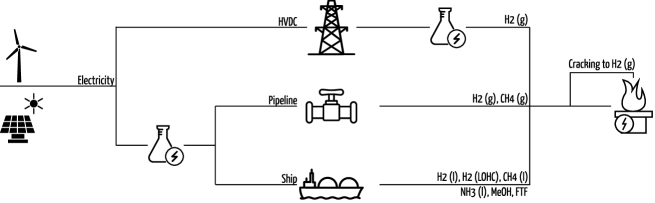
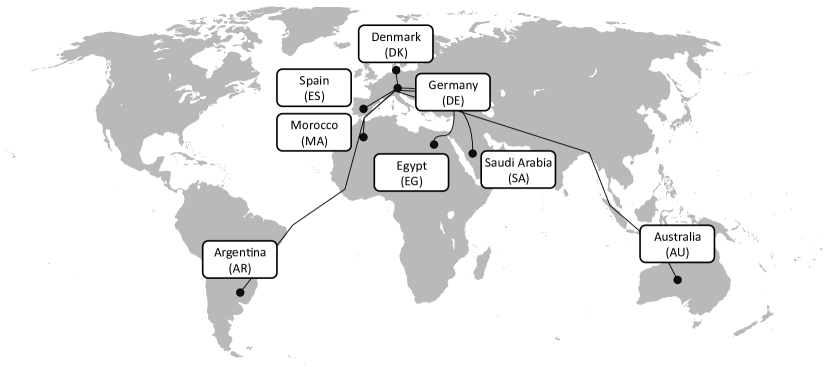
- 독일으로의 화학 에너지 운반체 수입을 위한 9개의 별도된 에너지 공급 체인(ESC) 구성 방식을 모델링하며, 7개의 글로벌 위치에서 수입 가능성을 분석한다.
- 수소 및 에너지 제공 단위당 수준화된 에너지 비용(LCOE)을 계산하기 위해 기술경제 모델을 적용하며, 합성, 운반, 인프라 비용을 포함한다.
- 파이프라인(수소) 및 선박(액체 운반체)의 세부 운반 모델링을 구현하여 에너지 손실, 기화 손실, 적재/하역 시간, 왕복 효율성을 반영한다.
- 산업 공정의 기술적 요구사항을 반영하기 위해 합성 공장에 최소 운영 용량을 유지하는 조건을 도입하여 필수 운행 제약 조건을 설정한다.
- 직접 수소 수입(파이프라인)과 암모니아, 메탄올 또는 메탄을 통한 간접 경로를 비교하기 위한 모듈식 프레임워크를 구현하며, 변환 손실 및 자본 비용을 포함한다.
실험 결과
연구 질문
- RQ1어느 국제 수출 지역에서 독일으로의 재생 수소, 메탄, 암모니아, 메탄올, 페일러-트로프쉬 연료 수입이 가장 저렴한가?
- RQ2파이프라인을 통한 직접 수소 수입 비용은 암모니아, 메탄올 또는 메탄을 수송수단으로 사용하는 간접 경로와 비교해 어떻게 다른가?
- RQ3운반 거리, 인프라 유형(파이프라인 대 선박), 에너지 손실이 수입 합성 연료의 총 비용에 어떤 영향을 미치는가?
- RQ4복잡한 에너지 운반체에 대해, 북아프리카, 남미 등 거리가 먼 수출국이 유럽 또는 북미의 가까운 공급자보다 비용상 유리한가?
- RQ5다단계 변환 과정에서 발생하는 자본 비용과 에너지 손실이 간접 수소 공급 체계의 전체 비용 효율성에 얼마나 큰 영향을 미치는가?
주요 결과
- 모든 화학 에너지 운반체에 대해 국내 수소 생산보다 저렴한 국제 수입 옵션이 적어도 하나 존재하며, 비용 측면에서 유일한 우세한 국가나 운반체는 존재하지 않는다.
- 가장 저렴한 수소 수입 옵션은 덴마크, 스페인, 북아프리카에서 오는 파이프라인 수입으로, 2050년 기준 5,000€/kW 자본 비용 가정 하에 36–42€/MWh LHV(또는 1.0–1.3€/kg H₂)의 비용을 기록한다.
- 암모니아, 메탄올, 페일러-트로프쉬 연료와 같은 복잡한 운반체의 경우, 북아프리카에서의 수입이 유럽 또는 북미의 가까운 공급자보다 저렴한 편이며, 이는 재생 가능 전력 비용이 낮기 때문이다.
- 직접 수소 수입(파이프라인)이 암모니아, 메탄올 또는 메탄을 통한 간접 경로보다 비용 효율성이 높으며, 주로 다중 변환 단계로 인한 에너지 손실 감소와 더 낮은 자본 투자 비용 덕분이다.
- 액체 수소 및 암모니아의 운송 효율성은 기화 손실과 왕복 물류로 인해 크게 감소하며, 연간 운행 빈도를 유지하기 위해 공백 시간을 고려한 조정된 외부 여정 시간이 반영된다.
- 모델 및 데이터는 개방형 라이선스 하에 공개되어 향후 에너지 시스템 계획 및 정책 분석을 위한 재사용 및 변형을 지원한다.
더 나은 연구,지금 바로 시작하세요
논문 읽기부터 검토까지, 연구 시간을 획기적으로 줄여보세요.
카드 등록 없음 · 무료 플랜 제공
이 리뷰는 AI가 만들고, 인간 에디터가 검토했습니다.