
[논문 리뷰] In or Out? Fixing ImageNet Out-of-Distribution Detection Evaluation
이 논문은 많은 ImageNet-1K OOD 데이터셋에 ID 오염이 존재함을 보이고, 64개의 OOD 클래스와 5,879장의 정제된 이미지를 가진 NINCO(No ImageNet Class Objects)를 도입하며, 다양한 아키텍처를 가로지르는 광범위한 OOD 탐지기를 분석하고, 프리트레이닝의 영향과 클래스별 평가 및 OOD 유닛 테스트의 필요성을 강조합니다.
Out-of-distribution (OOD) detection is the problem of identifying inputs which are unrelated to the in-distribution task. The OOD detection performance when the in-distribution (ID) is ImageNet-1K is commonly being tested on a small range of test OOD datasets. We find that most of the currently used test OOD datasets, including datasets from the open set recognition (OSR) literature, have severe issues: In some cases more than 50$\%$ of the dataset contains objects belonging to one of the ID classes. These erroneous samples heavily distort the evaluation of OOD detectors. As a solution, we introduce with NINCO a novel test OOD dataset, each sample checked to be ID free, which with its fine-grained range of OOD classes allows for a detailed analysis of an OOD detector's strengths and failure modes, particularly when paired with a number of synthetic "OOD unit-tests". We provide detailed evaluations across a large set of architectures and OOD detection methods on NINCO and the unit-tests, revealing new insights about model weaknesses and the effects of pretraining on OOD detection performance. We provide code and data at https://github.com/j-cb/NINCO.
연구 동기 및 목표
- Widely used ImageNet-1K OOD 테스트 데이터셋에서 ID 오염을 식별하고 정량화한다.
- 클린하고 도전적인 OOD 테스트 세트(NINCO)와 클래스별 평가를 제시하여 탐지기의 약점을 더 잘 이해한다.
- 다양한 아키텍처와 프리트레이닝 체계에서 서로 다른 OOD 탐지 방법의 성능을 분석한다.
- 자연 이미지 외의 탐지기 약점을 파헤치기 위한 OOD 유닛 테스트를 도입한다.
- 공정한 평가와 OOD 탐지기 보고를 위한 권고를 제시한다.
제안 방법
- 일반적으로 사용되는 OOD 데이터셋에서 ID 오염을 측정하기 위해 400개의 무작위 샘플에 대한 체계적 수동 검사.
- 64개의 OOD 클래스에 걸쳐 5,879장의 이미지를 포함하고 ID-free로 수동 검증된 NINCO를 구성하고, 17개의 합성 OOD 유닛 테스트를 추가로 제시한다.
- 여러 아키텍처(ViT, ConvNets)와 다양한 프리트레이닝(IN-21K, CLIP, JFT 등)을 사용하는 11개의 OOD 탐지 방법을 평가한다.
- MSP 기준선, 특징 기반 탐지기(Maha, RMaha, ViM) 및 기타 방법(MaxLogit, Energy, KL-Matching, KNN, ReAct 등)과 사전 로그이전 피처 사용 여부를 분석한다.
- 프리트레이닝이 OOD 탐지 성능에 미치는 영향과 집계 지표와 클래스별 지표의 신뢰성 차이를 평가한다.
실험 결과
연구 질문
- RQ1기존 ImageNet-1K OOD 테스트 데이터셋이 In-distribution 객체로 얼마나 오염되어 있는가?
- RQ2정리된 ID-free OOD 테스트 세트(NINCO)가 아키텍처 전반에 걸쳐 OOD 탐지기의 보다 신뢰할 만한 평가를 제공할 수 있는가?
- RQ3프리트레이닝 유형과 피처 사용이 OOD 탐지 성능에 미치는 영향은 무엇인가?
- RQ4합성 OOD 유닛 테스트가 자연 이미지 데이터셋에서 드러나지 않는 약점을 드러내는가?
- RQ5공정한 OOD 탐지기 벤치마킹을 위한 평가 관행(클래스별 분포, 유닛 테스트)은 무엇인가?
주요 결과
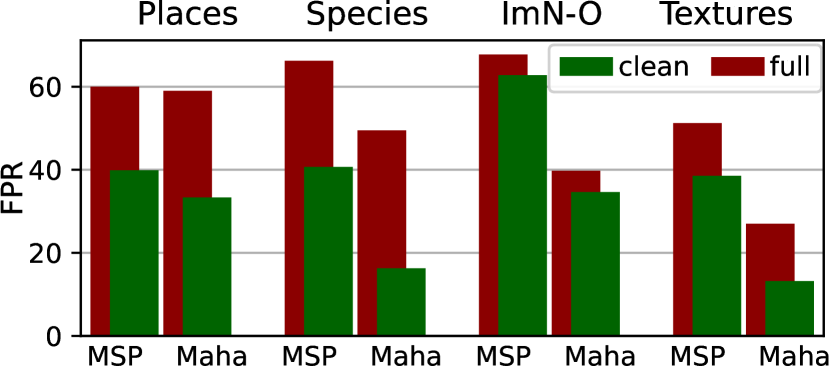
- IN-1K용으로 널리 사용되는 많은 OOD 데이터셋에서 상당한 ID 오염이 존재하며, Places와 Species 데이터셋과 같은 경우에 50% 이상인 경우가 많다.
- ID 오염은 강력한 탐지기를 불공정하게 패널티를 주고 거짓 양성을 부풀리며, 탐지기가 OOD로 간주되지 않아야 할 ID 콘텐츠를 올바르게 식별할 수 있다.
- NINCO는 64개의 수작업으로 검증된 OOD 클래스와 5,879장의 ID-free 이미지를 제공하여 탐지기의 강점과 실패 모드를 자세히 분석할 수 있게 하며, 약점을 파악하기 위한 합성 17개의 유닛 테스트를 추가로 제공한다.
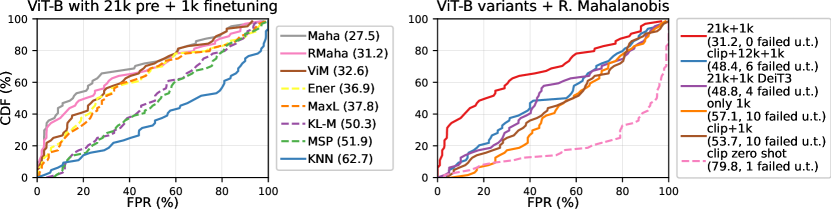
- 대형 데이터셋에 대한 프리트레이닝은 일반적으로 OOD 탐지 성능을 향상시키며, 프리-로지트 피처 기반 방법이 MSP보다 성능이 나은 경향이 있지만 그 이점은 모델과 프리트레이닝에 크게 의존한다.
- 프리로지트 피처를 명시적으로 사용하는 피처 기반 탐지기가 모델 전반에서 더 일관된 개선을 보이는 경향이 있으며, 제로샷 CLIP 기반 방법은 NINCO에서 IN-1K 분류기보다 성능이 좋지 않다.
- 고급 탐지기의 평균 FPR 개선은 NINCO에서 더 두드러지며, 클래스별 분석은 성능이 OOD 클래스에 따라 크게 달라짐을 보여준다.
더 나은 연구,지금 바로 시작하세요
연구 설계부터 논문 작성까지, 연구 시간을 획기적으로 줄여보세요.
카드 등록 없음 · 무료 플랜 제공
이 리뷰는 AI가 만들고, 인간 에디터가 검토했습니다.