
[논문 리뷰] Inference of CO2 flow patterns -- a feasibility study
이 연구는 조건부 정규화 흐름(CNF)을 사용하여 시간-반복 지반 및 웰 데이터를 융합함으로써 정규 및 누출 유형의 CO2 플룸 패턴을 추론하고, 불확실성 인식 추론을 가능하게 한다. 이 방법은 실제 오차와 강하게 상관관계가 있는 불확실성 추정치를 제공하며, 이는 탄소 포집 및 저장 시스템에서의 조기 누출 탐지 가능성을 입증한다.
As the global deployment of carbon capture and sequestration (CCS) technology intensifies in the fight against climate change, it becomes increasingly imperative to establish robust monitoring and detection mechanisms for potential underground CO2 leakage, particularly through pre-existing or induced faults in the storage reservoir's seals. While techniques such as history matching and time-lapse seismic monitoring of CO2 storage have been used successfully in tracking the evolution of CO2 plumes in the subsurface, these methods lack principled approaches to characterize uncertainties related to the CO2 plumes' behavior. Inclusion of systematic assessment of uncertainties is essential for risk mitigation for the following reasons: (i) CO2 plume-induced changes are small and seismic data is noisy; (ii) changes between regular and irregular (e.g., caused by leakage) flow patterns are small; and (iii) the reservoir properties that control the flow are strongly heterogeneous and typically only available as distributions. To arrive at a formulation capable of inferring flow patterns for regular and irregular flow from well and seismic data, the performance of conditional normalizing flow will be analyzed on a series of carefully designed numerical experiments. While the inferences presented are preliminary in the context of an early CO2 leakage detection system, the results do indicate that inferences with conditional normalizing flows can produce high-fidelity estimates for CO2 plumes with or without leakage. We are also confident that the inferred uncertainty is reasonable because it correlates well with the observed errors. This uncertainty stems from noise in the seismic data and from the lack of precise knowledge of the reservoir's fluid flow properties.
연구 동기 및 목표
- 지속 가능한 탄소 저장을 위한 지질학적 환경에서의 CO2 유량 패턴을 불확실성 정량화와 함께 기계학습 프레임워크로 추론하는 것.
- 다중 모odal 시간-반복 데이터를 활용하여 정상 및 누출 유형의 CO2 플룸 패턴 간 미세한 차이를 탐지하는 과제를 해결하는 것.
- 조건부 정규화 흐름이 노이즈가 있는 실제 세계 유사 관측치로부터 CO2 포화도 및 관련 불확실성의 신뢰할 수 있는 사후 추정치를 생성할 수 있는지 평가하는 것.
- 복잡하고 비균질한 저류에서 추론된 불확실성과 실제 재구성 오차 간의 상관관계를 평가하는 것.
- 데이터 기반 추론을 활용한 불확실성 인식 실시간 모니터링 시스템을 위한 기초를 마련하는 것.
제안 방법
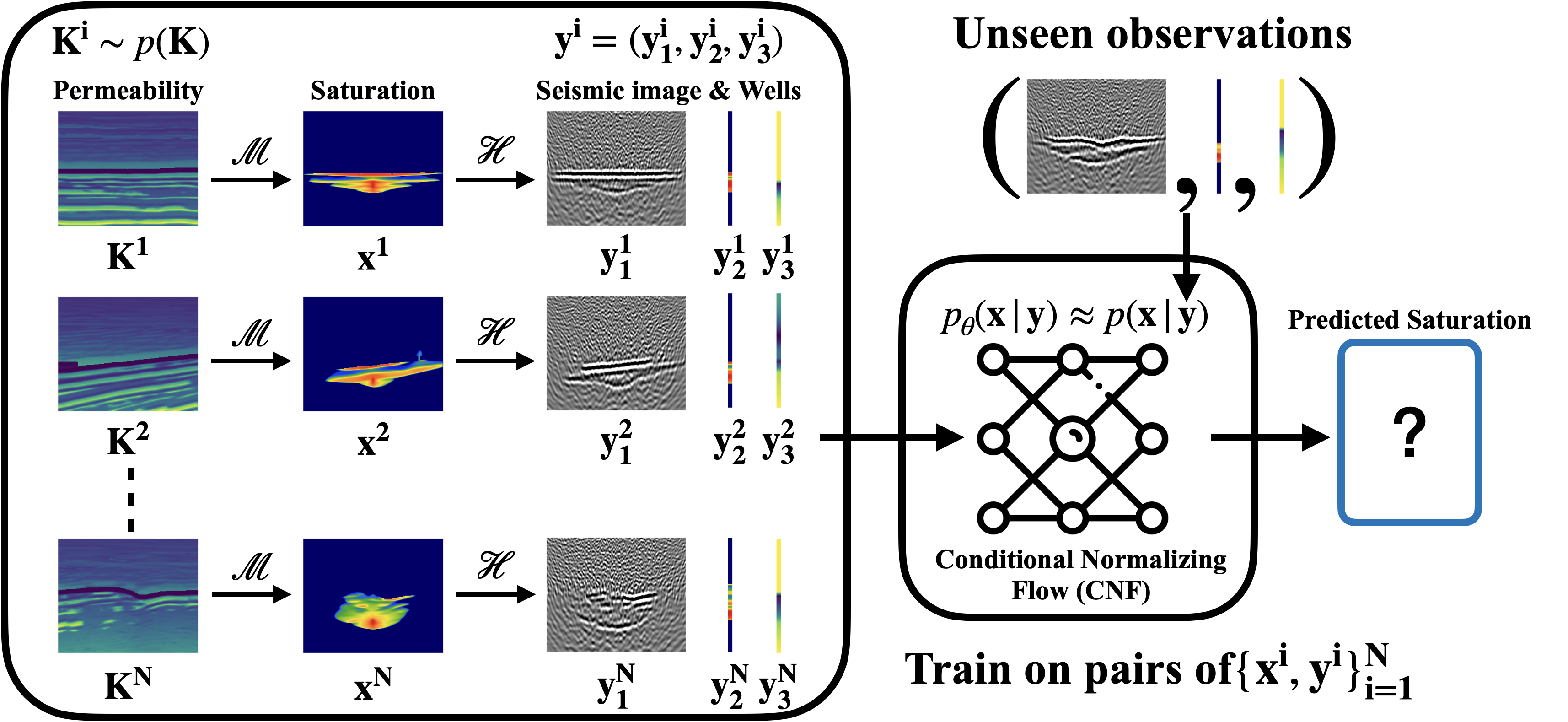
- 조건부 정규화 흐름(CNF)은 사후 분포 $ p(\mathbf{x} \mid \mathbf{y}) $ 를 모델링하도록 훈련되며, 여기서 $ \mathbf{x} $ 는 CO2 포화도 이미지이고 $ \mathbf{y} $ 는 다중 모달 관측 벡터이다.
- 관측 벡터 $ \mathbf{y} $ 는 세 가지 구성 요소를 포함한다: 지반 이미징 데이터, 웰보어 압력, 웰보어 포화도 측정치.
- 훈련 데이터는 투과도 $ \mathbf{K}^{(i)} \sim p(\mathbf{K}) $ 의 무작위 실현치를 가진 저류 시뮬레이션을 통해 생성되며, 이에 따라 CO2 포화도 $ \mathbf{x}^{(i)} $ 와 시간-반복 관측치 $ \mathbf{y}^{(i)} $ 가 유도된다.
- 시간-반복 지반 이미지는 기본 및 모니터 설문에 대해 역시간 역행 이동(RTM)을 적용하여 생성되며, 신호 대 잡음비는 8.0 dB이고, 15 Hz 리커 웨이브릿을 사용한다.
- 훈련 목표는 Kullback-Leibler 발산을 최소화하도록 하며, 손실 함수 $ \mathcal{L}(\theta) = \mathbb{E}_{\mathbf{x},\mathbf{y}}[ \frac{1}{2}||f_\theta(\mathbf{x};\mathbf{y})||_2^2 - \log|\det(\mathbf{J}_{f_\theta})| ] $ 를 통해 구현된다.
- 훈련 후, CNF는 새로운 테스트 케이스에 대해 사후 표본과 불확실성 추정치(정규화된 표준편차)를 생성한다.
실험 결과
연구 질문
- RQ1조건부 정규화 흐름은 정상 및 누출 유형의 유량 시나리오를 포함한 다중 모달 시간-반복 데이터로부터 CO2 플룸 패턴을 정확하게 추론할 수 있는가?
- RQ2지반 잡음과 저류 비균질성 존재 하에서 추론된 불확실성 추정치가 실제 재구성 오차와 얼마나 잘 상관되는가?
- RQ3모델은 거짓 양성 또는 거짓 음성 없이 누출 및 비누출 케이스를 구분할 수 있는가?
- RQ4복잡한 지질학적 환경에서 사후 평균 추정치가 실제 포화도 패턴과 어느 정도 일치하는가?
- RQ5CNF는 불확실한 저류 특성 하에서 CO2 플룸 진화의 비유일성과 비선형성을 효과적으로 다룰 수 있는가?
주요 결과
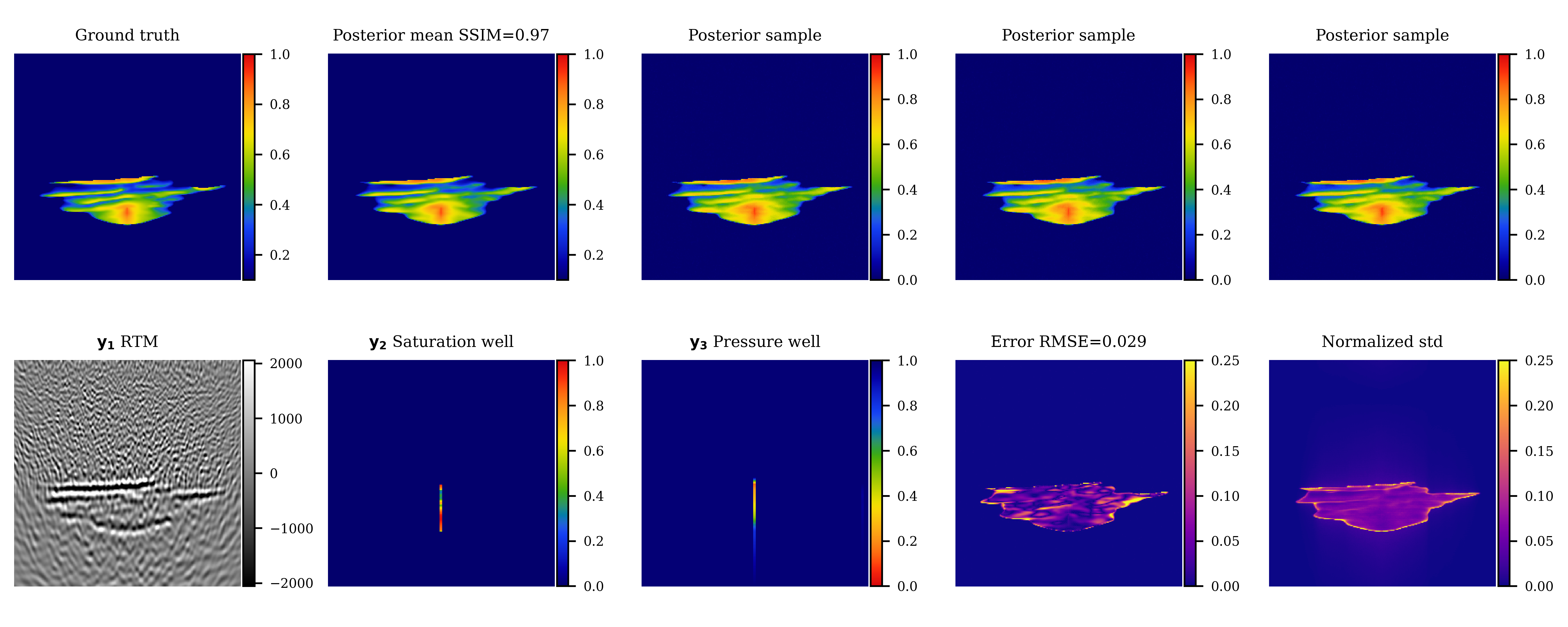
- 사후 평균 추정치는 누출 없음 케이스에서 0.97, 누출 케이스에서 0.96의 구조적 유사도 지수-SSIM를 기록하여 실제값에 매우 높은 정밀도를 보였다.
- 추론된 불확실성은 지질학적으로 복잡한 영역—특히 플룸 상단 및 균열 영역 근처에서 가장 높았으며, 실제 재구성 오차와 잘 상관관계를 보였다.
- 36개의 테스트 샘플 전반에서 거짓 양성 또는 거짓 음성 없이 모든 누출 및 비누출 시나리오를 정확히 식별하였다.
- 불확실성 추정치는 지반 데이터의 노이즈와 저류 특성에 대한 정밀한 지식 부족과 일치하여 합리성을 검증하였다.
- 소음에 의해 가려진 작은 변화가 있더라도, 정상 및 비정상 유량 패턴 간의 미세한 차이를 성공적으로 포착하였다.
- 결과적으로, CNF를 활용한 불확실성 인식 추론의 가능성을 입증하였으며, 실시간 디지털 트윈 시스템을 위한 기초를 마련하였다.
더 나은 연구,지금 바로 시작하세요
논문 읽기부터 검토까지, 연구 시간을 획기적으로 줄여보세요.
카드 등록 없음 · 무료 플랜 제공
이 리뷰는 AI가 만들고, 인간 에디터가 검토했습니다.