
[논문 리뷰] Inner-IoU: More Effective Intersection over Union Loss with Auxiliary Bounding Box
Inner-IoU는 기존 IoU 기반 손실과 통합될 때 수렴 및 일반화가 향상되도록 확장 가능한 비율의 보조 바운딩 박스를 도입하여 IoU 손실을 계산합니다.
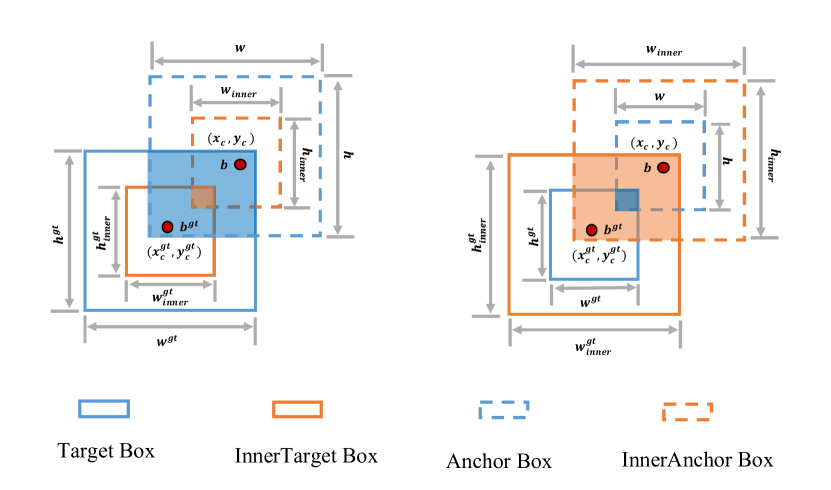
With the rapid development of detectors, Bounding Box Regression (BBR) loss function has constantly updated and optimized. However, the existing IoU-based BBR still focus on accelerating convergence by adding new loss terms, ignoring the limitations of IoU loss term itself. Although theoretically IoU loss can effectively describe the state of bounding box regression,in practical applications, it cannot adjust itself according to different detectors and detection tasks, and does not have strong generalization. Based on the above, we first analyzed the BBR model and concluded that distinguishing different regression samples and using different scales of auxiliary bounding boxes to calculate losses can effectively accelerate the bounding box regression process. For high IoU samples, using smaller auxiliary bounding boxes to calculate losses can accelerate convergence, while larger auxiliary bounding boxes are suitable for low IoU samples. Then, we propose Inner-IoU loss, which calculates IoU loss through auxiliary bounding boxes. For different datasets and detectors, we introduce a scaling factor ratio to control the scale size of the auxiliary bounding boxes for calculating losses. Finally, integrate Inner-IoU into the existing IoU-based loss functions for simulation and comparative experiments. The experiment result demonstrate a further enhancement in detection performance with the utilization of the method proposed in this paper, verifying the effectiveness and generalization ability of Inner-IoU loss. Code is available at https://github.com/malagoutou/Inner-IoU.
연구 동기 및 목표
- 표준 IoU 손실의 한계를 식별하기 위해 바운딩 박스 회귀 과정을 분석한다.
- 제어 가능한 스케일 비율을 가진 보조 바운딩 박스를 사용하는 Inner-IoU 손실을 제안한다.
- Inner-IoU를 기존 IoU 기반 손실과 결합하여 검출기/데이터셋 전반에 걸친 일반화를 입증한다.
- 기존 IoU 기반 손실과 비교하여 더 빠른 수렴 및 개선된 탐지 지표를 보여준다.
제안 방법
- 높은 IoU 샘플과 낮은 IoU 샘플에 대한 IoU 기반 회귀 동역학과 그래디언트를 분석한다.
- 비율 매개변수로 스케일된 보조 바운딩 박스로 계산된 Inner-IoU 손실를 정의한다.
- 비율 < 1이 높은 IoU 샘플 회귀에 이점이 되고 비율 > 1이 낮은 IoU 샘플에 이점을 주는 방법을 보여준다.
- L_Inner-IoU를 기존 손실(L_Inner-GIoU, L_Inner-DIoU, L_Inner-CIoU, L_Inner-EIoU, L_Inner-SIoU)와 통합한다.
- 성능 평가를 위해 표준 검출기/데이터셋에서 시뮬레이션 및 비교 실험을 수행한다.
실험 결과
연구 질문
- RQ1스케일 비율이 있는 보조 바운딩 박스가 IoU 기반 바운딩 박스 회귀의 수렴 속도를 높일 수 있는가?
- RQ2Inner-IoU가 기존 IoU 기반 손실과 결합했을 때 검출기와 데이터셋에 대해 일반화되는가?
- RQ3실무에서 고 IoU 대 저 IoU 샘플 회귀를 최적화하는 비율 설정은 무엇인가?
- RQ4Inner-IoU를 사용할 때 AP50 및 mAP50:95에서 탐지 이점이 보이는가?
주요 결과
- Inner-IoU는 높은 IoU 샘플에 대해 더 작은 보조 박스를 사용하고 낮은 IoU 샘플에 대해 더 큰 박스를 사용하여 더 빠른 수렴을 달성한다.
- CIoU 및 SIoU와 통합하면 평가 설정에서 베이스라인 대비 더 높은 AP50 및 mAP50:95를 얻는다.
- VOC에서 YOLOv7-tiny일 때 Inner-CIoU 및 Inner-SIoU가 CIoU 및 SIoU 베이스라인보다 AP50 및 mAP50:95를 개선한다.
- AI-TOD에서 YOLOv5s로, Inner-SIoU(비율 > 1)가 SIoU에 비해 AP50 및 mAP50:95를 향상시키며 작은 대상에 대한 강건성을 보여준다.
- 시뮬레이션 결과는 높은 IoU 샘플(ratio < 1)에서 더 빠른 수렴과 낮은 IoU 샘플(ratio > 1)에서 더 나은 회귀를 시사한다.
- 해당 방법은 검출기와 픽셀 크기에 걸쳐 강한 일반화를 보여주며 보고된 실험에서 sota와 같은 성능을 나타낸다.

더 나은 연구,지금 바로 시작하세요
논문 읽기부터 검토까지, 연구 시간을 획기적으로 줄여보세요.
카드 등록 없음 · 무료 플랜 제공
이 리뷰는 AI가 만들고, 인간 에디터가 검토했습니다.