
[논문 리뷰] Interplay of two $E_g$ orbitals in Superconducting La$_3$Ni$_2$O$_7$ Under Pressure
이 연구는 고압 상태의 La$_3$Ni$_2$O$_7$에서의 고온 초전도성 현상을 설명하기 위해 이중 오비탈 이중층 $t$-$J$ 모델을 제안한다. 이 모델은 $3d_{x^2-y^2}$ 오비탈이 강한 이중층 초전도 교환을 통해 $s$-파 초전도성을 이끌어내며, $3d_{z^2}$ 오비탈은 극도의 밴드 평탄화로 인해 약하게 기여한다. 이 모델은 실험적 밴드 구조를 재현하며, 전자 도핑 시 $T_c$ 향상과 홀 도핑 조건에서 BCS-BEC 전이를 예측한다.
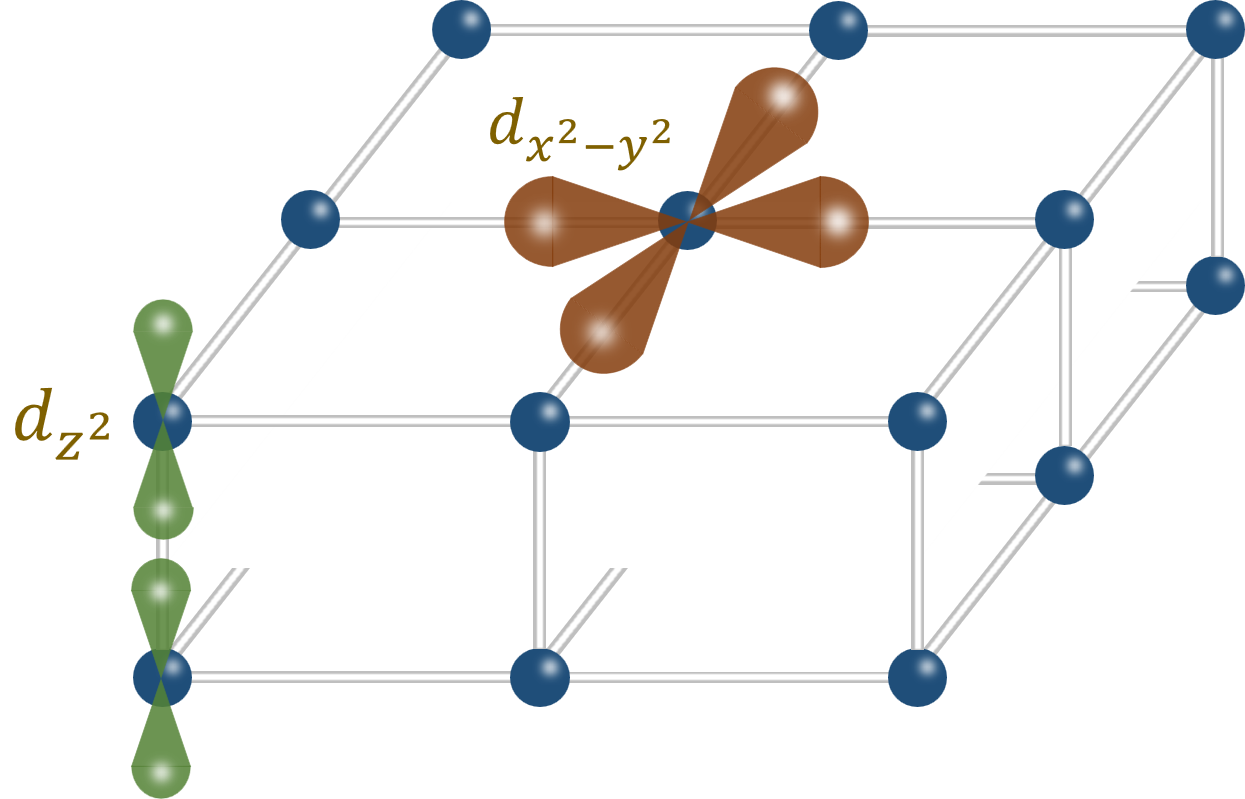
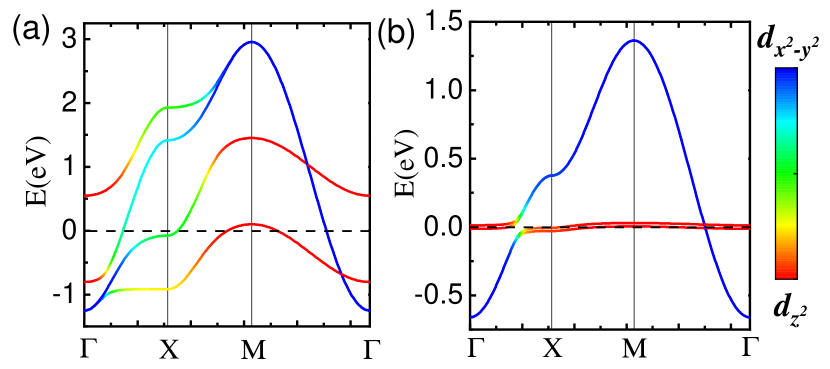
The discovery of high-$T_c$ superconductivity (SC) in La$_3$Ni$_2$O$_7$ (LNO) has aroused a great deal of interests. Previously, it was proposed that the Ni-$3d_{z^2}$ orbital is crucial to realize the high-$T_c$ SC in LNO: The preformed Cooper pairs therein acquire coherence via hybridization with the $3d_{x^2-y^2}$ orbital to form the SC. However, we held a different viewpoint that the interlayer pairing $s$-wave SC is induced by the $3d_{x^2-y^2}$ orbital, driven by the strong interlayer superexchange interaction. To include effects from both $E_g$-orbitals , we establish a two-orbital bilayer $t$-$J$ model. Our calculations reveal that due to the no-double-occupancy constraint, the $3d_{x^2-y^2}$ band and the $3d_{z^2}$ bonding band are flattened by a factor of about 2 and 10, respectively, which is consistent with recent angle-resolved-photo-emission-spectroscopy measurements. Consequently, a high temperature SC can be hardly induced in the $3d_{z^2}$-orbital due to the difficulty to develop phase coherence. However, it can be easily achieved by the $3d_{x^2-y^2}$ orbital under realistic interaction strength. With electron doping, the $3d_{z^2}$-band gradually dives below the Fermi level, but $T_c$ continues to enhance, suggesting that it is not necessary for the high-$T_c$ SC in LNO. With hole doping, $T_c$ initially drops and then rises, accompanied by the crossover from the BCS to BEC-type superconducting transitions.
연구 동기 및 목표
- 고압 상태의 La$_3$Ni$_2$O$_7$에서 고온 초전도성에 기여하는 주요 $E_g$ 오비탈이 $3d_{z^2}$인지 $3d_{x^2-y^2}$인지 규명하는 것.
- 이중 $E_g$ 오비탈 간의 상호작용과 이중층 구조를 통합된 이론적 프레임워크에 통합하는 것.
- 관측된 고 $T_c \approx 80$ K와 고압에 의한 $Fmmm$ 대칭으로의 구조 전이의 역할을 설명하는 것.
- 각 오비탈에서 관측된 강한 밴드 평탄화 현상(역행광전자분광법(ARPES) 데이터 기반)을 설명하는 것.
- 도핑에 따른 $T_c$ 의존성과 초전도 전이의 성격(BCS에서 BEC로의 전이)을 조사하는 것.
제안 방법
- 이중 오비탈 이중층 $t$-$J$ 모델을 개발하여 이중층 및 내부층 간의 터널링, 스핀 교환, 오비탈 혼합을 포함한다.
- mean-field 분해를 통해 $t$-$J$ 해밀토니안을 적용하여, $\sigma$-결합 및 $\pi$-결합 경로를 통해 홀론과 스핀론 부분을 분리한다.
- 이중점유금지 제약 조건을 활용하여 효과적인 밴드 평탄화 계수를 유도: $3d_{x^2-y^2}$의 경우 약 2, $3d_{z^2}$의 경우 약 10.
- 오비탈 혼합과 이중층 쌍결합을 모델링하기 위해 혼합항 $\chi^{xz}_{\parallel}$ 과 이중층 쌍결합 $\Delta^{x}_{\perp}$ 을 도입한다.
- mean-field 해밀토니안을 수치적으로 해결하여 $T_c$ 를 계산하고 도핑에 따른 진화를 분석한다.
- 총 전자 밀도 제약 조건을 만족시키기 위해 화학적 포텐셜 이격 $\mu_f$, $\mu_b$, 및 $\delta\mu$ 를 통합한다.
실험 결과
연구 질문
- RQ1고압 상태의 La$_3$Ni$_2$O$_7$에서 고-$T_c$ 초전도성에 기여하는 주요 $E_g$ 오비탈은 $3d_{z^2}$인지 $3d_{x^2-y^2}$인지인가?
- RQ2이중 $E_g$ 오비탈 간의 상호작용이 초전도 쌍결합 메커니즘에 어떻게 영향을 미치는가?
- RQ3강한 이중층 결합에도 불구하고, 왜 $3d_{z^2}$ 오비탈은 고-$T_c$ 초전도성을 지속하지 못하는가?
- RQ4전자 및 홀 도핑이 초전도 전이 온도 $T_c$ 에 어떤 영향을 미치는가?
- RQ5홀 도핑 조건에서 초전도 전이가 BCS에서 BEC 특성으로 변화하는가?
주요 결과
- $3d_{x^2-y^2}$ 오비탈이 강한 이중층 초전도 교환을 통해 고-$T_c$ $s$-파 초전도성을 이끌어내며, 실험적 $T_c \approx 80$ K 와 일치한다.
- $3d_{z^2}$ 오비탈은 이중점유금지 제약 조건으로 인해 약 10배의 극도의 밴드 평탄화를 보이며, 위상 일관성의 억제로 고-$T_c$ 쌍결합이 불가능하다.
- 이 모델은 ARPES 측정값에 기반한 밴드 평탄화 정도를 재현한다: $3d_{x^2-y^2}$의 경우 약 2, $3d_{z^2}$의 경우 약 10으로, 이론적 프레임워크의 타당성을 검증한다.
- 전자 도핑 조건에서 $3d_{z^2}$ 밴드가 패전 에너지 수준 이하로 떨어지더라도 $T_c$ 가 향상되며, 이는 고-$T_c$ 초전도성에 있어 $3d_{z^2}$ 오비탈이 필수적이지 않음을 시사한다.
- 홀 도핑 조건에서 BCS에서 BEC로의 전이가 발생하며, $T_c$ 는 처음에는 감소하다가 다시 증가하는 경향을 보이며, 실험에서 관측된 비단조화적 $T_c$ 경향과 일치한다.
더 나은 연구,지금 바로 시작하세요
논문 읽기부터 검토까지, 연구 시간을 획기적으로 줄여보세요.
카드 등록 없음 · 무료 플랜 제공
이 리뷰는 AI가 만들고, 인간 에디터가 검토했습니다.