
[논문 리뷰] JADES: Carbon enrichment 350 Myr after the Big Bang in a gas-rich galaxy
이 논문은 z=12.5 은하(target)에 대한 깊은 JWST/NIRSpec 분석을 보고하며, 강력한 C iii] 발현선을 밝혀내어 태양계 또는 초태양계의 C/O 및 상당한 가스 저장고를 시사하고, Cosmic Dawn의 표준 화학적 풍요화 시나리오에 도전합니다.
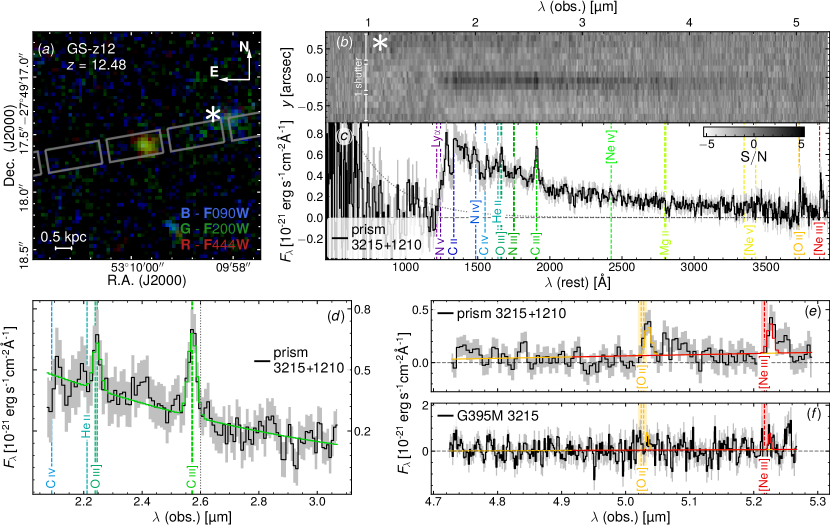
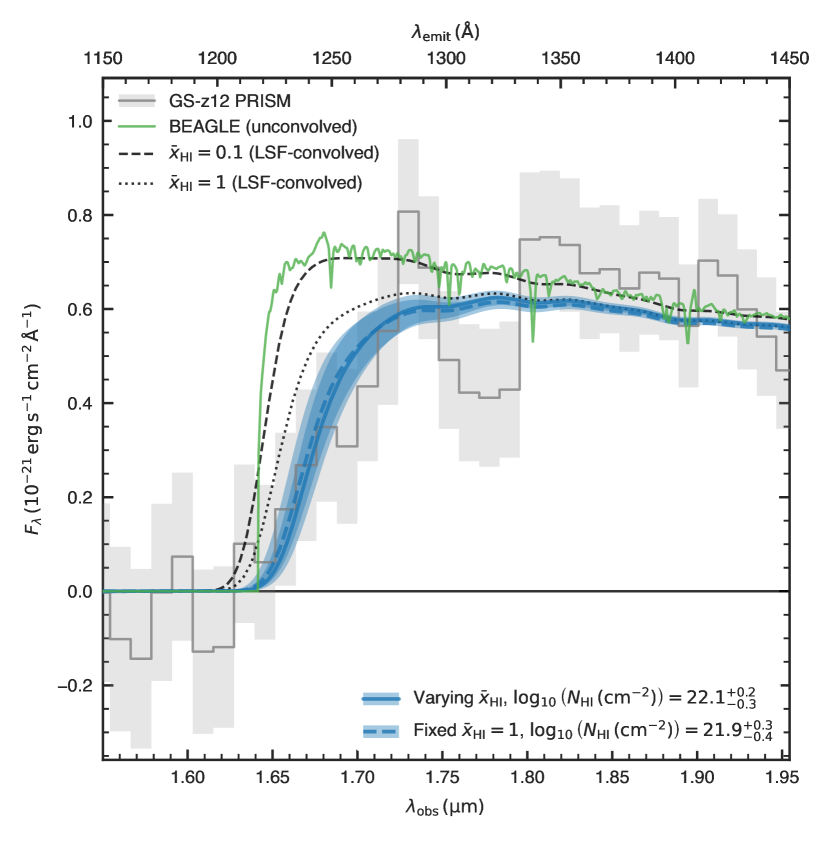
Finding the emergence of the first generation of metals in the early Universe, and identifying their origin, are some of the most important goals of modern astrophysics. We present deep JWST/NIRSpec spectroscopy of GS-z12, a galaxy at z=12.5, in which we report the detection of C III]$λλ$1907,1909 nebular emission. This is the most distant detection of a metal transition and the most distant redshift determination via emission lines. In addition, we report tentative detections of [O II]$λλ$3726,3729 and [Ne III]$λ$3869, and possibly O III]$λλ$1661,1666. By using the accurate redshift from C III], we can model the Ly$α$ drop to reliably measure an absorbing column density of hydrogen of $N_{HI} \approx 10^{22}$ cm$^{-2}$ - too high for an IGM origin and implying abundant ISM in GS-z12 or CGM around it. We infer a lower limit for the neutral gas mass of about $10^7$ MSun which, compared with a stellar mass of $\approx4 imes 10^7$ MSun inferred from the continuum fitting, implies a gas fraction higher than about 0.1-0.5. We derive a solar or even super-solar carbon-to-oxygen ratio, tentatively [C/O]>0.15. This is higher than the C/O measured in galaxies discovered by JWST at z=6-9, and higher than the C/O arising from Type-II supernovae enrichment, while AGB stars cannot contribute to carbon enrichment at these early epochs and low metallicities. Such a high C/O in a galaxy observed 350 Myr after the Big Bang may be explained by the yields of extremely metal poor stars, and may even be the heritage of the first generation of supernovae from Population III progenitors.
연구 동기 및 목표
- 깊은 JWST/NIRSpec 분광학을 이용해 z=12.5 은하에서 금속선 식별 및 특성화.
- 네발사선과 연속체 모델링을 통해 적색편이, 가스 내용물 및 금속licity를 제약.
- 초우주에서 탄소-산소 비(C/O) 공급원 및 가능한 풍부화 채널을 추론합니다.
제안 방법
- 프리즘 및 G140M/G395M 그레이팅으로 약 100시간의 적분 시간을 갖는 깊은 NIRSpec 분광 관측을 수행합니다.
- 로컬 픽셀-적분 가우시안 모델을 사용한 발현선 피팅을 수행하고 5시그마 검출 임계치를 사용하여 안전한 선을 확보합니다.
- BEAGLE을 이용해 항성 연속체, 성운 발현, 먼지 감쇠, 그리고 delayed exponential 형태의 SFH와 IMF 상한 질량 300 M_sun을 포함한 모델링을 수행합니다.
- intrinsically BEAGLE 스펙트럼과 DLA 및 IGM 흡수 모델을 결합해 Ly-알파 감쇠-wing 흡수를 제약하고 N_HI를 유도합니다.
- au_V 기반의 감쇠 및 DLA 유사 금속도 추정치를 이용해 가스 질량과 금속량을 도출하되, 소거/감쇠 처리의 체계오차를 인정합니다.
실험 결과
연구 질문
- RQ1빅뱅 이후 350 Myr에 관찰된 은하의 화학 구성을 C/O 비율은 어떠한가?
- RQ2은하의 ISM/CGM에 냉각된 금속이 풍부한 가스 저장고가 존재하는지 여부가 있는가?
- RQ3C iii] 및 기타 nebular 선들이 z>12에서 가스 질량, 금속licity, 별 형성 특성을 제약할 수 있는가?
- RQ4관찰된 원소 abundances가 Population III/초기 별의 산출로 인한 풍부화 원인에 해당하는가?
주요 결과
- 5-시그마의 C iii] 1907,1909 검출로, 현재까지 가장 먼 금속선 검출.
- 적색편성은 z = 12.482 ± 0.012로 제약되며(C iii] 만으로는 z = 12.479 ± 0.014).
- 가스상 산소 부족분은 log O/H = 7.9 ± 0.2로 추정되며, log C/O > 0.15(C/O ≳ 1.4배 태양)로 BEAGLE 적합에서 산출된 C/O가 태양보다 크다.
- ISM/CGM의 중성 수소 컬럼 밀도는 log10 N_HI(cm^-2) = 22.1^{+0.2}_{-0.3} (기준)로 추정되며, 이는 IGM 기여를 넘어서는 밀집한 중성 가스를 시사합니다.
- 원자 가스 질량 log(M_gas/M_sun) = 7.0 ± 0.25로 추정되며, 이는 가스 단계를 가정에 따라 0.1~0.5배의 별 질량에 해당하는 상당한 가스 저장고를 시사합니다.
- 증거는 매우 금속이 적은 별들로부터의 수율과 일치하는 높은 C/O 및 금속 풍부화를 시사하며, Pop III 기원체와 연결될 수 있습니다.
더 나은 연구,지금 바로 시작하세요
연구 설계부터 논문 작성까지, 연구 시간을 획기적으로 줄여보세요.
카드 등록 없음 · 무료 플랜 제공
이 리뷰는 AI가 만들고, 인간 에디터가 검토했습니다.