
[논문 리뷰] JADES NIRSpec Spectroscopy of GN-z11: Lyman-$α$ emission and possible enhanced nitrogen abundance in a $z=10.60$ luminous galaxy
요약: 이 논문은 JWST/NIRSpec 분광학으로 GN-z11을 관측한 결과, z=10.6034의 정확한 적색편이가 확인되었고 555 km/s의 편향을 보이는 Lyman-α 방출과 더불어 높은 이온화와 질소 풍부 가능성을 시사하는 자세한 rest-UV 선 진단이 드러났으며, 원천이 별 형성 혹은 AGN 활동에 의해 구동되는지 논의하고 SFR 및 금속성 같은 물리적 특성을 추정한다.
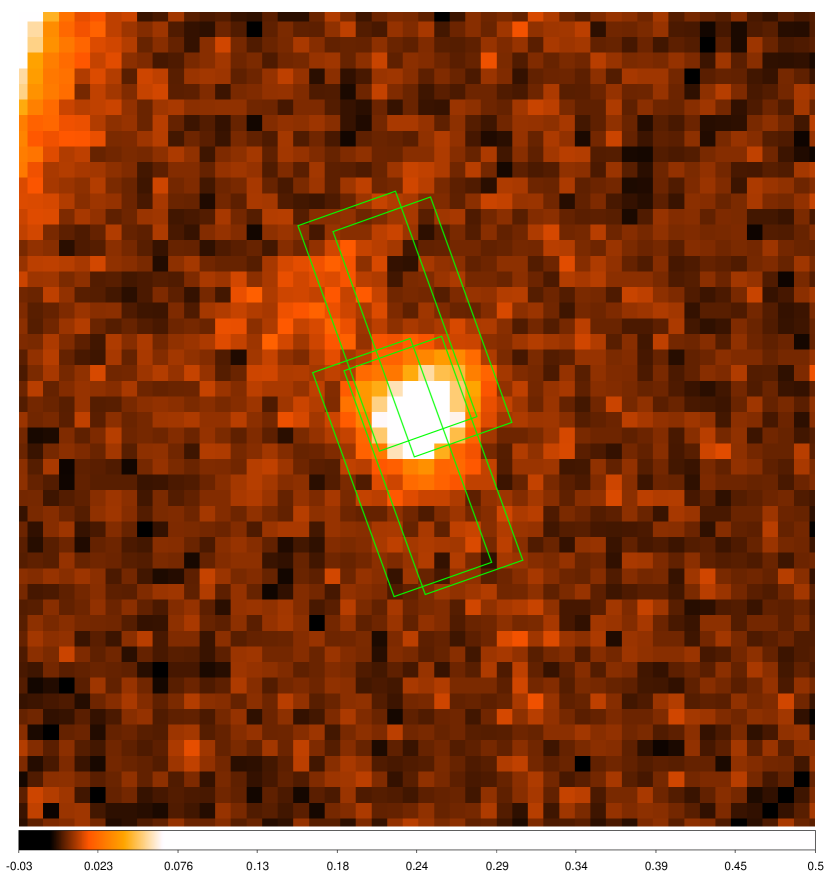
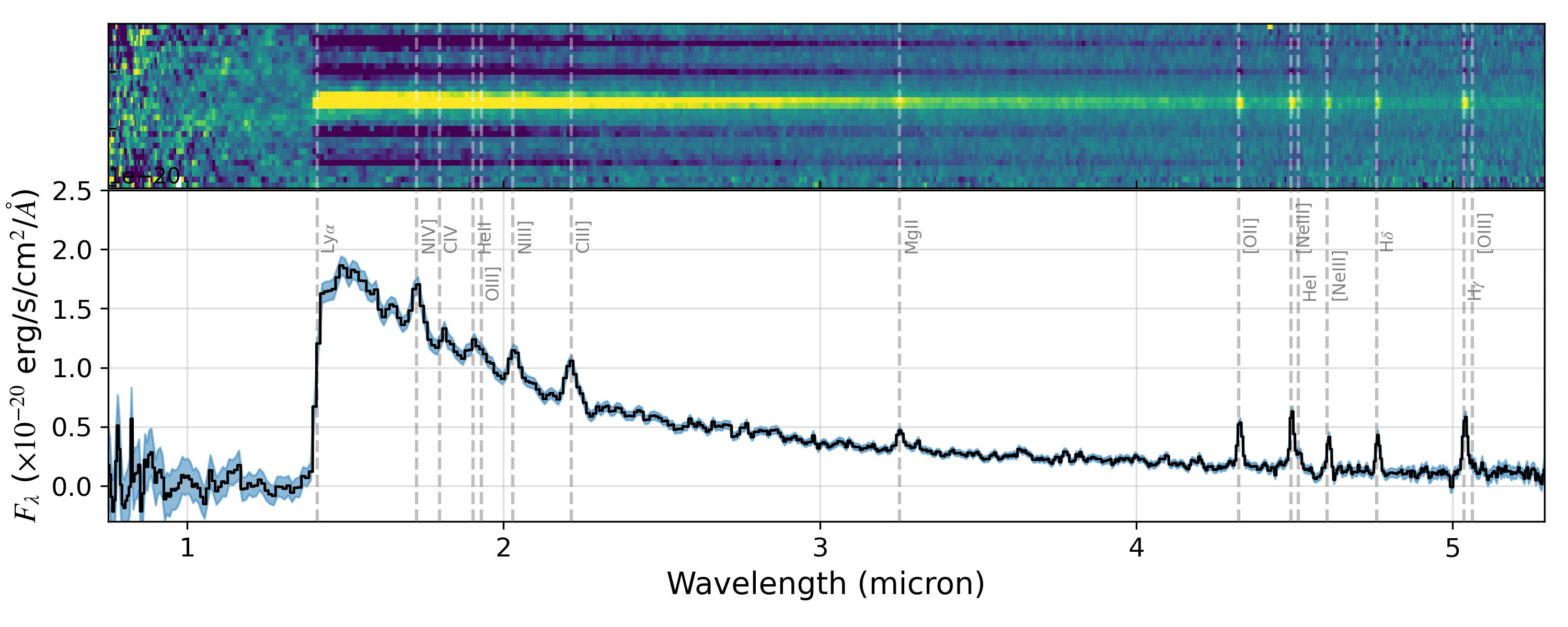
We present JADES JWST/NIRSpec spectroscopy of GN-z11, the most luminous candidate $z>10$ Lyman break galaxy in the GOODS-North field with $M_{UV}=-21.5$. We derive a redshift of $z=10.603$ (lower than previous determinations) based on multiple emission lines in our low and medium resolution spectra over $0.8-5.3 μ$m. We significantly detect the continuum and measure a blue rest-UV spectral slope of $β=-2.4$. Remarkably, we see spatially-extended Lyman-$α$ in emission (despite the highly-neutral IGM expected at this early epoch), offset 555 km s$^{-1}$ redward of the systemic redshift. From our measurements of collisionally-excited lines of both low- and high-ionization (including [O II]$\lambda3727$, [Ne III]$λ3869$ and C III]$\lambda1909$) we infer a high ionization parameter ($\log U\sim -2$). We detect the rarely-seen N IV]$\lambda1486$ and N III]$\lambda1748$ lines in both our low and medium resolution spectra, with other high ionization lines seen in the low resolution spectrum such as He II (blended with O III]) and C IV (with a possible P-Cygni profile). Based on the observed rest-UV line ratios, we cannot conclusively rule out photoionization from AGN, although the high C III]/He II and N III]/He II ratios are compatible with a star-formation explanation. If the observed emission lines are powered by star formation, then the strong N III]$\lambda1748$ observed may imply an unusually high $N/O$ abundance. Balmer emission lines (H$γ$, H$δ$) are also detected, and if powered by star formation rather than an AGN we infer a star formation rate of $\sim 20-30 M_{\odot} yr^{-1}$ (depending on the IMF) and low dust attenuation. Our NIRSpec spectroscopy confirms that GN-z11 is a remarkable galaxy with extreme properties seen 430 Myr after the Big Bang.
연구 동기 및 목표
- GN-z11의 정밀한 분광 적색편이(z) 를 JWST/NIRSpec를 이용해 0.7–5.3 μm 범위에서 확인한다.
- rest-UV 및 광학 선을 특성화하여 이온화 원천(AGN vs. 별 형성) 및 ISM 특성을 진단한다.
- Lyman-α 특성(플럭스, EW, 공간적 확장)을 측정하고 z>10에서의 IGM 전달 여부를 평가한다.
- 선 진단 및 SED 적합으로 이온화 매개변수, 금속성, 별 형성 속도 등 물리적 속성을 추정한다.
제안 방법
- MSA 모드에서 G140M, G235M, G395M, 및 PRISM/CLEAR 네 구성을 통해 심층 JWST/NIRSpec 관찰을 수행한다.
- 1D/2D 스펙트럼을 추출 및 보정하고 가우시안 프로필로 선을 맞춘 뒤 구성 간 결과를 합친다.
- 선 플럭스와 비율(C III], N III], N IV], He II, C IV, [O II], [Ne III])을 이용해 광이온화 모델(AGN vs. 별 형성)과 비교하고 이온화 조건을 평가한다.
- BEAGLE SED 피팅을 프리즘 전체 스펙트럼에 적용하여 가스 위상 금속성 및 별 형성 특성을 추정한다.
- Lyman-α 특성(플럭스, EW, 공간적 확장)을 결정하고 시스템적 적색편에 대비한 속도 편이를 측정한다.
실험 결과
연구 질문
- RQ1rest-frame 광학/UV 선으로 측정된 GN-z11의 정확한 체계적 적색편이는 무엇인가?
- RQ2rest-UV 선 비율과 고이온화 선이 GN-z11의 AGN 광이온화 또는 별 형성에 의한 이온화를 지지하는가?
- RQ3Lyman-α 특성(플럭스, EW, 공간적 확장)과 z>10에서의 IGM 전달에 무엇이 시사되는가?
- RQ4선 선들이 GN-z11의 이온화 매개변수, 금속성, 질소 증가 가능성에 대해 무엇을 밝히는가?
- RQ5주어진 자료를 고려할 때 GN-z11은 AGN-지배형인지, 아니면 별 형성 지배형인지 일치하는가?
주요 결과
- GN-z11은 grating 스펙트럼의 여덟 개의 잘 검출된 선을 바탕으로 z=10.6034 ± 0.0013에 위치한다.
- Lyman-α는 시스템적 적색편보다 555 ± 32 km s−1 만큼 빨리 적색으로 편향되어 있고 연속체를 넘어 공간적으로 확장되어 관측된다.
- 검출된 선으로는 N IV] 1486, N III] 1749, C III] 1907+1909, [O II] 3726,29, Ne III] 3869, Hδ, Hγ, C IV는 P-Cygni 형태를 보이고 He II는 O III]와 블렌드된다.
- 선 비율 진단은 GN-z11를 AGN 모델과 별 형성 모델 사이에 위치시키며 고이온화 선이 존재하지만 AGN의 지배를 결정적으로 입증하지는 못한다.
- 별 형성에 의해 구동된다면 강한 N III] 1748이 비정상적으로 높은 N/O 비를 시사할 수 있으며 Balmer 선은 SFR ≈ 20–30 M⊙ yr−1( IMF에 따라 다름) 및 낮은 먼지 감쇠를 시사한다.
- Lyman-α의 탈출 분수는 Case B 재결합 하에서 Ly-α 및 Balmer 선 플럭스를 바탕으로 약 0.038 ± 0.004로 추정된다.
더 나은 연구,지금 바로 시작하세요
연구 설계부터 논문 작성까지, 연구 시간을 획기적으로 줄여보세요.
카드 등록 없음 · 무료 플랜 제공
이 리뷰는 AI가 만들고, 인간 에디터가 검토했습니다.