
[논문 리뷰] JADES: The production and escape of ionizing photons from faint Lyman-alpha emitters in the epoch of reionization
이 연구는 JWST/JADES 데이터에서 z>5.8의 16개의 희미한 Lyman-α 방출체를 분석하여 Lyα 및 LyC 생성/탈출, 이온화 상태, 및 우주 재이온화에 대한 시사점을 측정합니다.
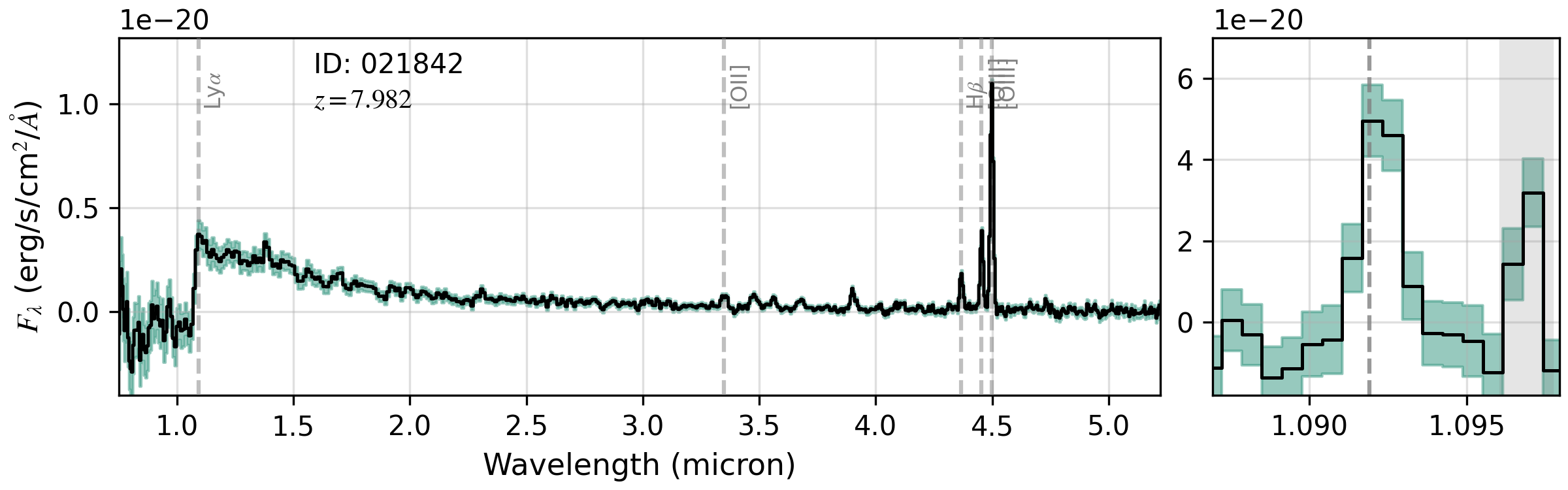
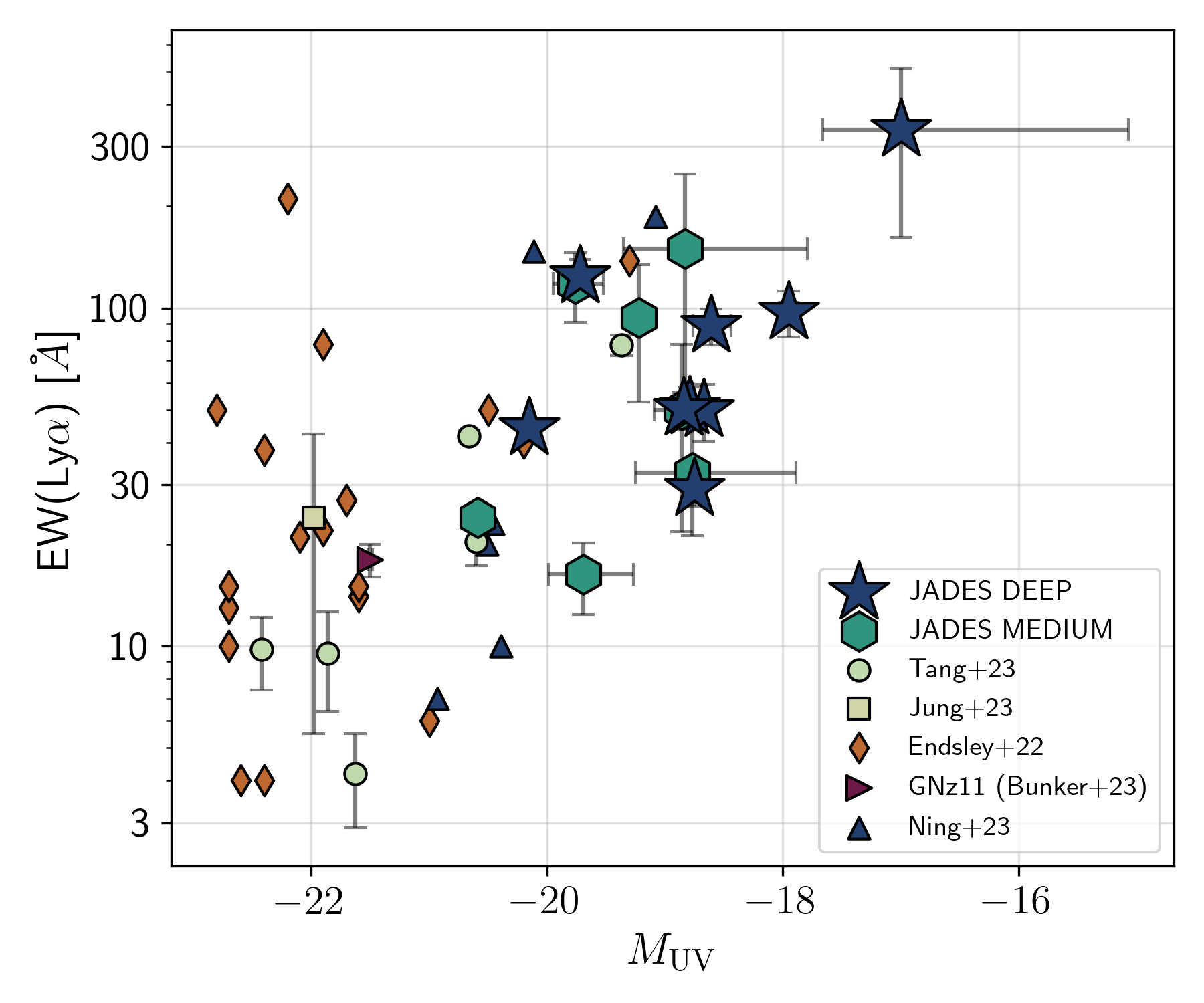
We present the properties of 17 faint Ly$α$ emitting galaxies (LAEs) at $z>5.8$ from the JWST Advanced Deep Extragalactic Survey (JADES) in the Hubble Ultra Deep Field/GOODS-S. These LAEs span a redshift range $z\approx5.8-8.0$ and a UV magnitude range $M_{UV}\approx-17$ to $-20.6$, with the Ly$α$ equivalent width (EW) in the range $\approx 25-350$ Å. The detection of other rest-optical emission lines in the spectra of these LAEs enables the determination of accurate systemic redshifts and Lyα velocity offsets, as well as the physical and chemical composition of their stars and interstellar media. These faint LAEs are consistent with metal-poor systems with high ionization parameters, similar to the general galaxy population at $z>6$. We measured an average ionizing photon production efficiency, log($ξ_ m{ion}$/erg$^{-1}$ Hz) $\approx25.57$ across our LAEs, which does not evolve strongly with redshift. We report an anti-correlation between the Ly$α$ escape fraction (f_ m{esc}) and the velocity offset from systemic redshift, consistent with model expectations. We further find that the strength and velocity offset of Ly$α$ are neither correlated with galaxy spectroscopic properties nor with $ξ_ m{ion}$. We find a decrease in $f_ m{esc}$(Ly$α$) with redshift, indicative of decreasing sizes of ionized bubbles around LAEs at high redshifts. We used a range of galaxy properties to predict Lyman continuum $f_ m{esc}$ for our LAEs, finding that the ionizing photon output into the intergalactic medium remains roughly constant across the observed Ly$α$ EW, showing a mild increase at fainter M$_{UV}$ and at higher redshifts. We derived correlations between the ionizing photon output from LAEs and $M_{UV}$, Ly$α$ EW and redshifts, which can be used to constrain the ionizing photon contribution of LAEs at $z > 6$ towards cosmic reionization.
연구 동기 및 목표
- 재이온화 시기(z ≈ 5.8–8.0) 동안 희미한 Lyman-α 방출체(LAEs)의 물리적 성질 조사.
- Rest-frame optical lines로부터 시스템적 적색편이, Lyα 속도 오프셋, 화학적 풍부도, 이온화 매개변수, 먼지 함량 결정.
- 재이온화 예산에 대한 이온화 광자 생성 효율 및 LyC 탈출 시사점 추정.
- Lyα 특성이 은하 특성과 변하는 IGM과의 관계를 탐구.
- 재이온화 모델링을 개선하기 위한 관측 기반의 상관관계 제공.
제안 방법
- JWST NIRSpec 스펙트럼을 JADES Deep 및 Medium 계층에서 사용하여 z>5.8인 16개의 LAE를 식별합니다.
- R100 및 더 높은 해상도 R1000 데이터에서 Lyα 플럭스를 측정하며, Lyα 특성에 대해 G140M 그레이팅을 우선순위로 사용합니다.
- G395M/G235M 그레이팅에서 강한 rest-frame optical 선(Hβ, [O iii], Hα)을 이용해 시스템적 적색편이를 도출합니다.
- R100 스펙트럼에서 rest-frame UV 등급(MUV))와 1340–2600 Å 구간의 연속체를 맞추어 UV 경사 β를 계산합니다.
- Balmer 감소(Hα/Hβ, 혹은 Hβ/Hγ)를 추정하여 SMC 곡선 하의 먼지 감쇠를 도출합니다.
- Balmer 선으로부터 추정된 내재 L1500 및 N(H0)에서 결정된 이온화 광자 생성 효율 ξion을 계산합니다(S Case-B, Te=10^4 K, ne=100 cm^-3).
- Case-B 재조합을 가정한 dust 보정된 Lyα/Hα 비율로부터 Lyα 탈출 분율을 결정합니다.
실험 결과
연구 질문
- RQ1rest-frame optical lines로 추적된 z>5.8의 희미한 LAEs의 이온화 상태, 금속성, 그리고 먼지 함량은 어떠한가?
- RQ2Lyα 특성(강도, 속도 편차)이 시스템적 특성 및 LyC 탈출 가능성과 어떻게 상관관계가 있는가?
- RQ3이러한 희미한 LAEs의 이온화 광자 생성 효율(ξion)은 얼마이며, 적색편이에 따라 변화하는가?
- RQ4Lyα 탈출은 적색편이에 따라 어떻게 변하며, 이는 IGM의 이온화 버블 크기에 무엇을 시사하는가?
- RQ5관측된 LAE 특성을 사용하여 현실적이고 관측 기반의 재이온화 모델을 구축할 수 있는가?
주요 결과
- LAE는 금속이 낮고 고 이온화 매개변수 유사한 조건을 보이며, 이는 z>6 은하 집단의 일반적인 특성과 일치한다.
- 샘플 전체에서 평균 이온화 광자 생성 효율은 log(ξion/erg^-1 Hz) ≈ 25.56로 나타나며, 적색편에 큰 진화가 보이지 않는다.
- 시스템적 적색편차에서의 속도 편차와 Lyα 탈출율 사이에 반상관이 관찰되며, 이론적 기대와 일치한다.
- Lyα 강도와 속도 편차는 다른 분광 특성이나 ξion과 강한 상관관계를 보이지 않는다.
- Lyα 탈출율은 적색편에 따라 감소하며, 이로 인해 이른 시점의 LAE 주변에 더 작은 이온화 버블이 존재함을 시사한다.
- 여러 은하 특성을 사용하여 LyC 탈출 예측이 이들 LAE로부터 IGM으로의 이온화 출력이 UV 등급과 Lyα EW에 비례해 대략 일정하고, 약간의 적색편이 증가가 있다.
- LAEs의 이온화 광자 출력과 UV 등급, Lyα 강도, 적색편이 사이의 상관관계에서 재이온화 모델에 정보를 제공합니다.
더 나은 연구,지금 바로 시작하세요
연구 설계부터 논문 작성까지, 연구 시간을 획기적으로 줄여보세요.
카드 등록 없음 · 무료 플랜 제공
이 리뷰는 AI가 만들고, 인간 에디터가 검토했습니다.