
[논문 리뷰] Jellyfish galaxies with the IllustrisTNG simulations -- When, where, and for how long does ram pressure stripping of cold gas occur?
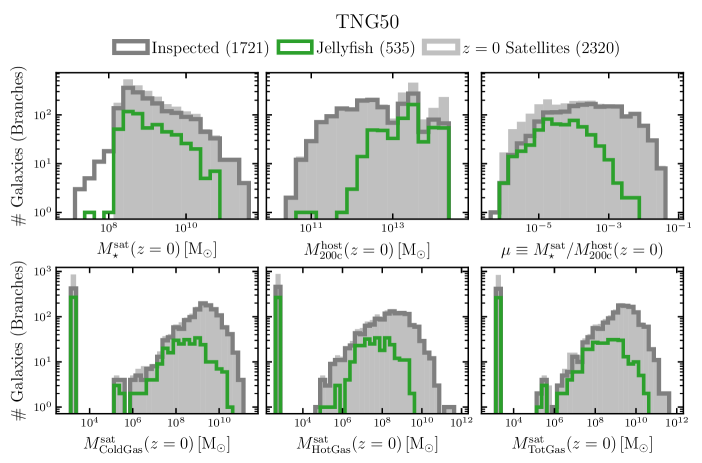
이 연구는 TNG50 천체물리 시뮬레이션을 활용해 535개의 잼피시 은하에서 램 압력 탈가스(RPS)를 분석하며, RPS가 장기간에 걸쳐 작용함을 밝혀내었다(1.5–8 Gyr). 정점 탈가스는 은하가 유입된 지 약 1 Gyr 이내에 발생하며, 0.2–2 R_200c 범위에서 최대 2 Gyr 동안 지속된다. 비록 장기간 탈가스가 지속되지만, 냉각 기체의 약 98%가 손실된 이후까지 별 형성이 계속되며, 현재 존재하는 것보다 더 많은 냉각 기체를 가시성 영역에 기여한다. 이는 은하간 기체 저축고에 있어 주요 기여자임을 시사한다.
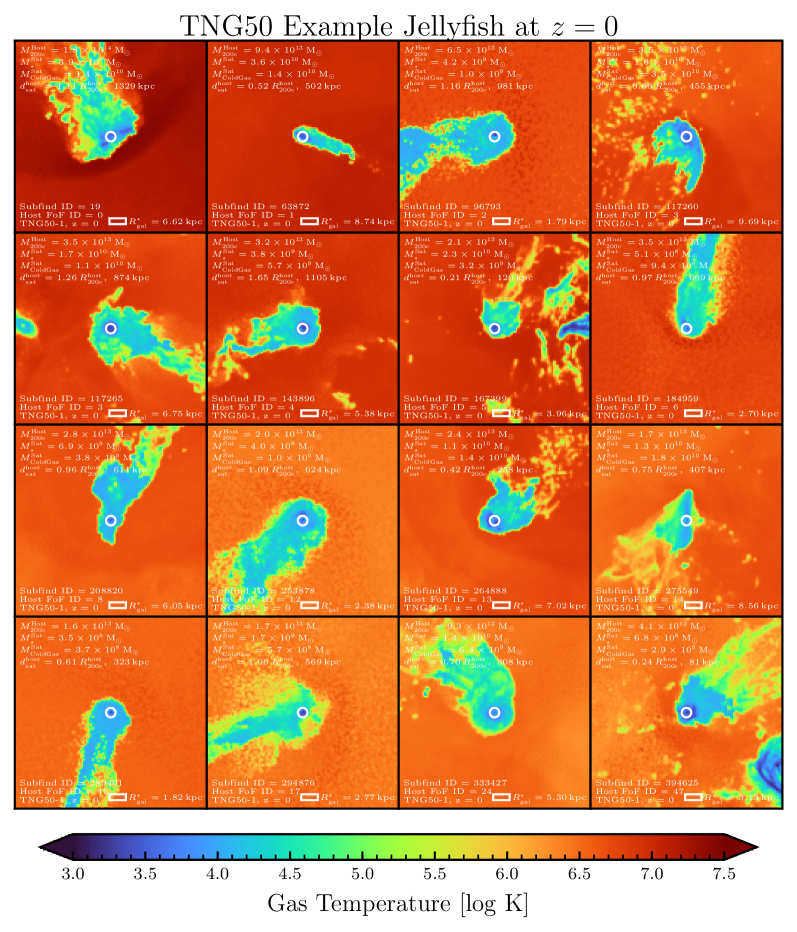
Jellyfish galaxies are prototypical examples of satellite galaxies undergoing strong ram pressure stripping (RPS). We analyze the evolution of 512 unique, first-infalling jellyfish galaxies from the TNG50 cosmological simulation. These have been visually inspected to be undergoing RPS sometime in the past 5 billion years (since $z=0.5$), have satellite stellar masses $\mstarsat\sim10^{8-10.5}\,M_\odot$, and live in hosts with $\mvir\sim10^{12-14.3}\,M_\odot$ at $z=0$. We quantify the cold gas ($T\leq10^{4.5}$ K) removal using the tracer particles, confirming that for these jellyfish, RPS is the dominant driver of cold gas loss after infall. Half of these jellyfish are completely gas-less by $z=0$, and these galaxies have earlier infall times and smaller satellite-to-host mass ratios than their gaseous counterparts. RPS can act on jellyfish galaxies over long time scales of $\approx1.5-8$ Gyr. Jellyfish in more massive hosts are impacted by RPS for a shorter time span and, at a fixed host mass, jellyfish with less cold gas at infall and lower stellar masses at $z=0$ have shorter RPS time spans. While RPS may act for long periods of time, the peak RPS period -- where at least 50 pecent of the total RPS occurs -- begins within $\approx1$ Gyr of infall and lasts $\lesssim2$ Gyr. During this period, the jellyfish are at host-centric distances $\sim0.2-2 vir$, illustrating that much of RPS occurs at large distances from the host galaxy. Interestingly, jellyfish continue forming stars until they have lost $\approx98$ percent of their cold gas. For groups and clusters in TNG50 $(\mvirhost\sim10^{13-14.3}\,M_\odot)$, jellyfish galaxies deposit more cold gas ($\sim10^{11-12}\,M_\odot$) into halos than exist in them at $z=0$, demonstrating that jellyfish, and in general satellite galaxies, are a significant source of cold gas accretion.
연구 동기 및 목표
- 냉각 기체에 대한 램 압력 탈가스(RPS)의 시기, 지속 기간, 공간 분포를 천체물리적 맥락에서 이해하기.
- 유입 이후 냉각 기체에 대한 RPS의 지속 기간을 정량화하고, 이를 연장하거나 단축시키는 조건을 규명하기.
- 잼피시 은하가 고리형 은하간 기체 매질(CGM)과 은하단 내 기체 매질(ICM)에 냉각 기체를 기여하는 역할을 평가하고, 이를 기존 기체 저축고와 비교하기.
- 특히 유입 이후 별 형성이 얼마나 오래 지속되는지, RPS 기간 동안의 별 형성 행동을 조사하기.
- RPS 지속 기간이 주 은하 질량, 위성 은하 질량, 유입 시점, 궤도 역사를 기반으로 어떻게 달라지는지 규명하기.
제안 방법
- TNG50 시뮬레이션에서 시각적 검토를 통해 535개의 고유한 잼피시 은하를 식별하였으며, 최근 5 Gyr 이내에 최초로 유입된 경우이며, 주 은하의 질량 범위는 10^12–14.3 M☉이었다.
- 냉각 기체(T ≤ 10^4.5 K)의 질량 손실를 시간에 따라 측정하기 위해 라그랑주 몬테카를로 추적 입자를 사용하였다.
- RPS의 지속 기간을 유입 시점에서 냉각 기체가 완전히 제거될 때까지의 기간으로 정의하였으며, 정점 RPS 기간은 총 탈가스의 최소 50%가 발생하는 기간으로 설정하였다.
- RPS가 가장 효과적으로 작용하는 위치를 파악하기 위해 주 은하 중심에서의 거리와 궤도 파rameter를 분석하였으며, 주로 0.2–2 R_200c 범위를 중심으로 분석하였다.
- 유입 시점의 위성 은하의 항성 질량, 주 은하의 은하질량, 냉각 기체의 초깃량에 따라 RPS의 지속 기간과 효율성을 비교 분석하였다.
- RPS 기간 동안 탈가스된 기체의 총 질량을 시간에 따라 통합하여 고리형 은하간 기체 매질(CGM)과 은하단 내 기체 매질(ICM)에 기여된 냉각 기체의 양을 정량화하였으며, z=0 시점의 현존 기체 양과 비교하였다.
실험 결과
연구 질문
- RQ1잼피시 은하의 냉각 기체에 대해 램 압력 탈가스(RPS)는 유입 이후 어떤 시간 스케일로 작용하는가?
- RQ2주 은하 중심에서의 거리 범위에서 RPS의 대부분이 발생하는가? 이는 궤도 단계와 어떻게 관련되는가?
- RQ3정점 RPS 기간 동안 얼마나 많은 냉각 기체가 탈가스되며, 이는 유입 이후 언제 발생하는가?
- RQ4잼피시 은하가 유입된 후 얼마나 오랫동안 별 형성을 계속하는가? 그리고 기체 질량 비율이 어느 정도일 때 억제가 발생하는가?
- RQ5잼피시 은하는 고리형 은하간 기체 매질(CGM)과 은하단 내 기체 매질(ICM)에 얼마나 많은 냉각 기체를 기여하는가? 이는 현재 존재하는 기체 저축고와 어떻게 비교되는가?
주요 결과
- 램 압력 탈가스(RPS)는 잼피시 은하에 대해 장기간에 걸쳐 작용하며, 평균적으로 1.5–8 Gyr 동안 지속되며, 절반 이상의 은하가 z=0 시점에 냉각 기체를 완전히 잃는다.
- 정점 RPS 기간—총 탈가스의 최소 50%가 발생하는 기간—은 유입 후 약 1 Gyr 이내에 시작되며, 최대 2 Gyr 동안 지속되며, 주로 0.2–2 R_200c 거리 범위에서 발생한다.
- 잼피시 은하는 냉각 기체 질량의 약 98%가 손실된 이후까지 별 형성을 계속하며, 최종 억제는 RPS의 약 99%가 완료된 이후에만 발생한다.
- 질량이 큰 주 은하(M_200c ~ 10^14 M☉)의 경우, 최근 5 Gyr 동안 약 10^12 M☉의 냉각 기체가 ICM에 기여되었으며, 이는 현재 ICM 내 존재하는 냉각 기체의 총량을 초과한다.
- M_200c ≥ 10^12.5 M☉인 은하의 경우, 최근 5 Gyr 동안 위성 은하(잼피시 포함)가 CGM에 약 10^10 M☉ 이상의 냉각 기체를 기여하였으며, 이는 현재 중심 은하의 항성 질량과 유사한 수준이다.
- 더 질량이 큰 주 은하에서나, 초깃값으로 냉각 기체가 적은 위성, z=0 시점의 항성 질량이 낮은 위성, 총 탈가스 시점에서 궤도 수가 적은 위성일수록 RPS의 지속 기간이 짧아진다.
이 논문 읽기
누빈트 뷰어에서 원문을 열고, 읽으면서 궁금한 곳을 바로 물어보세요.
누빈트에서 이 논문 읽기이 리뷰는 AI가 논문 원문을 바탕으로 만들었습니다. 인용하기 전에 원문을 확인해 주세요.