
[논문 리뷰] JointAI: Joint Analysis and Imputation of Incomplete Data in R
JointAI는 완전히 호환 가능한 공동 모델링 프레임워크를 사용하여 누락된 데이터에 대한 공동 베이지안 분석과 다중 착취를 가능하게 하는 R 패키지이다. 이는 비선형 효과, 상호작용, 생존, 다수준 데이터를 포함한 복잡한 모형을 지원하며, 분석 모형과 착취 모형 간의 불일치 문제를 해결함으로써 일관된 추론을 보장한다.
Missing data occur in many types of studies and typically complicate the analysis. Multiple imputation, either using joint modelling or the more flexible fully conditional specification approach, are popular and work well in standard settings. In settings involving non-linear associations or interactions, however, incompatibility of the imputation model with the analysis model is an issue often resulting in bias. Similarly, complex outcomes such as longitudinal or survival outcomes cannot be adequately handled by standard implementations. In this paper, we introduce the R package JointAI, which utilizes the Bayesian framework to perform simultaneous analysis and imputation in regression models with incomplete covariates. Using a fully Bayesian joint modelling approach it overcomes the issue of uncongeniality while retaining the attractive flexibility of fully conditional specification multiple imputation by specifying the joint distribution of analysis and imputation models as a sequence of univariate models that can be adapted to the type of variable. JointAI provides functions for Bayesian inference with generalized linear and generalized linear mixed models and extensions thereof as well as survival models and joint models for longitudinal and survival data, that take arguments analogous to corresponding well known functions for the analysis of complete data from base R and other packages. Usage and features of JointAI are described and illustrated using various examples and the theoretical background is outlined.
연구 동기 및 목표
- 비선형 효과나 상호작용을 포함한 복잡한 모형에서 분석 모형과 착취 모형 간 불일치(비호환성) 문제를 해결한다.
- 종단적, 생존, 다수준 데이터와 같은 복잡한 결과 모형에서 누락된 공변량을 통합적으로 다룰 수 있는 통합 프레임워크를 제공한다.
- 표준 다중 착취(예: FCS 및 다변량 정규성 기반 공동 모델링)의 한계를 극복하며, 선형성 가정을 내포하고 비선형 연관성이나 복잡한 결과에 대해 어려움을 겪는 문제를 해결한다.
- 모든 착취 및 분석 모형 간 호환성을 확보하기 위해 착취와 분석을 하나의 공동 모형 내에서 통합함으로써 일관된 베이지안 추론을 가능하게 한다.
- 기본 R 및 lme4 스타일 문법을 모방함으로써 R에서 간편한 사용자 구현을 가능하게 한다.
제안 방법
- 모든 변수(결과 및 공변량)의 공동 분포를 일련의 단변량 조건부 모형으로 지정하는 완전한 베이지안 공동 모델링 접근법을 사용한다.
- 공동 모형에서 유도된 완전 조건부 분포에서 샘플링하여 누락된 값을 착취함으로써 분석 모형과의 호환성을 보장한다.
- 정규, 이항, 포isson, Weibull, 코ックス 비례 위험 모형, 종단적 및 생존 데이터를 위한 공동 모형을 포함한 다양한 결과 유형을 지원한다.
- 스플라인, 다항식, 변환(예: 로그, 지수)을 통해 비선형 효과를 모델링하며, 변환된 변수를 직접 공동 모형에 포함시켜 비선형 효과를 처리한다.
- 'models' 인수를 통해 정규, 로그정규, 감마 등 다양한 분포를 사용하여 착취 모형의 유연한 설정을 가능하게 한다.
- 수학적 제약(예: 로그(x)는 x > 0에서 정의됨)을 고려하기 위해 분포의 절단을 허용하며, 'trunc' 인수를 사용한다.
실험 결과
연구 질문
- RQ1베이지안 프레임워크 내 공동 모델링이 비선형 효과나 상호작용이 존재하는 상황에서 착취 모형과 분석 모형 간 호환성을 어떻게 향상시킬 수 있는가?
- RQ2생존 또는 종단적 데이터와 같은 복잡한 결과를 포함한 설정에서 JointAI는 MICE나 다변량 정규성 기반 공동 모델링과 같은 표준 다중 착취 방법보다 얼마나 뛰어나게 성능을 발휘하는가?
- RQ3분석 모형에 변환, 스플라인, 상호작용이 포함된 경우 JointAI가 공변량의 누락된 데이터를 편향 없이 효과적으로 처리할 수 있는가?
- RQ4관측된 변수의 함수인 보조 변수를 사용할 경우 복잡한 모형에서 착취 정확도는 어떻게 향상되는가?
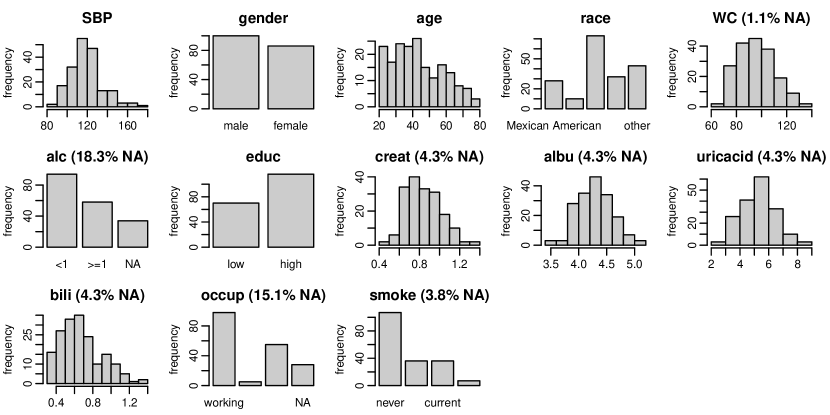
- RQ5NHANES 데이터와 같이 고차원적이거나 비정규 분포를 띠는 공변량을 포함한 실제 데이터 세트에서 JointAI의 성능은 어떠한가?
주요 결과
- JointAI는 비선형 효과, 상호작용, 다수준 구조를 포함한 복잡한 모형에서 불일치 문제 없이 누락된 데이터를 효과적으로 처리한다.
- 일관된 인터페이스를 통해 선형, 일반화선형, 혼합효과, 생존, 종단적 및 생존 데이터를 위한 공동 모형을 포함한 광범위한 모형을 지원한다.
- 변수 유형과 제약 조건(예: 로그 변환된 변수의 경우 분포 절단)을 자동으로 고려하여 착취 모형이 적절히 조정된다.
- 예: I(WC^2)와 같은 제곱항과 같은 보조 변수의 사용은 착취 과정에 관련 정보를 통합함으로써 착취 정확도를 향상시킨다.
- R에서 ilogit와 같은 함수를 정의함으로써 JAGS 문법과 호환되도록 하여 비표준 변환을 모델 수식에 원활하게 통합할 수 있다.
- 분석 모형에서 변수의 함수(예: log(uricacid))를 사용할 경우, 주 효과(예: uricacid)가 자동으로 착취 모형의 예측변수로 포함되어 모형 간 호환성이 유지된다.
더 나은 연구,지금 바로 시작하세요
논문 읽기부터 검토까지, 연구 시간을 획기적으로 줄여보세요.
카드 등록 없음 · 무료 플랜 제공
이 리뷰는 AI가 만들고, 인간 에디터가 검토했습니다.