
[논문 리뷰] JWST, ALMA, and Keck Spectroscopic Constraints on the UV Luminosity Functions at z~7-14: Clumpiness and Compactness of the Brightest Galaxies in the Early Universe
이 논문은 z~7–14에서 스펙트로스코피로 확인된 53개의 밝은 은하를 모아 UV 광도 함수(UV LF)를 제약하고 형태를 연구하며, z~7에서 클럼피하고 합병으로 유발된 구조를 발견하고 z>10에서 두 가지 서로 다른 집단(강한 선이 있는 확장형과 강한 선이 있는 콤팩트형)을 확인한다.
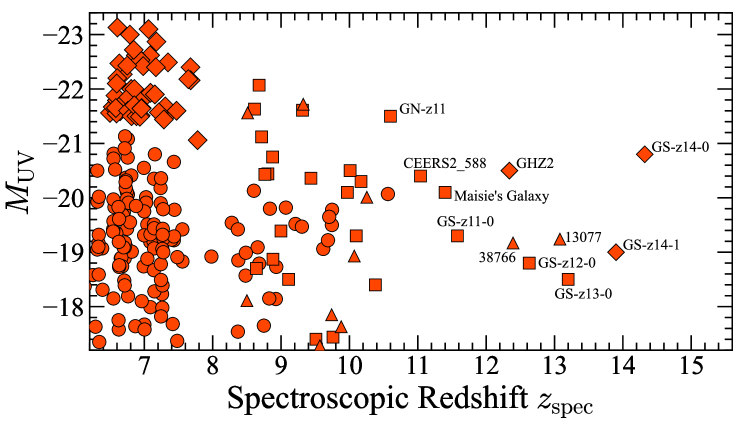
We present the number densities and physical properties of the bright galaxies spectroscopically confirmed at $z\sim7-14$. Our sample is composed of 60 galaxies at $z_\mathrm{spec}\sim7-14$, including recently-confirmed galaxies at $z_\mathrm{spec}=12.34-14.32$ with JWST, as well as new confirmations at $z_\mathrm{spec}=6.583-7.643$ with $-24< M_\mathrm{UV}< -21$ mag using ALMA and Keck. Our JWST/NIRSpec observations have also revealed that very bright galaxy candidates at $z\sim10-13$ identified from ground-based telescope images before JWST are passive galaxies at $z\sim3-4$, emphasizing the necessity of strict screening and spectroscopy in the selection of the brightest galaxies at $z>10$. The UV luminosity functions derived from these spectroscopic results are consistent with a double power-law function, showing tensions with theoretical models at the bright end. To understand the origin of the overabundance of bright galaxies, we investigate their morphologies using JWST/NIRCam high-resolution images obtained in various surveys including PRIMER and COSMOS-Web. We find that $\sim70\%$ of the bright galaxies at $z\sim7$ exhibit clumpy morphologies with multiple sub-components, suggesting merger-induced starburst activity, which is consistent with SED fitting results showing bursty star formation histories. At $z\gtrsim10$, bright galaxies are classified into two types of galaxies; extended ones with weak high-ionization emission lines, and compact ones with strong high-ionization lines including NIV]$λ$1486, indicating that at least two different processes (e.g., merger-induced starburst and compact star formation/AGN) are shaping the physical properties of the brightest galaxies at $z\gtrsim10$ and are responsible for their overabundance.
연구 동기 및 목표
- z~7–14에서 스펙트로스코피로 확인된 은하들을 사용해 밝은 끝 UV 광도함(UVLF)을 정량화한다.
- 고해상도 JWST 이미징으로 z>7에서 가장 밝은 은하들의 형태를 평가해 형성 경로를 이해한다.
- z>10에서 관측된 밝은 은하들의 과다한 수가 서로 다른 물리적 과정(합병으로 인한 별폭발 vs. 콤팩트한 별 형성/AGN)에 의해 설명되는지 여부를 조사한다.
- 고-z 선택에서의 오염 및 인터로퍼 문제와 향후 광면적 설문조사에의 함의를 평가한다.
제안 방법
- JWST, ALMA, Keck로부터 zspec ~ 6.54–14.32에 걸친 53개의 스펙트로스코피로 확인된 은하 샘플을 모으고(new confirmations 및 문헌 모음 포함).
- 밝은 끝에서의 효과적 설문 부피를 추정하여 네 가지 적색편이 구간(z~6.5–7.5, 7.5–8.5, 11.0–13.5, 13.5–15.0)에서 UV 광도함을 계산한다.
- JWST/NIRCam 이미징을 사용해 형태를 분석하고 합병으로 유발된 활동을 시사하는 다구조(clumpy, multi-component) 구조를 식별한다.
- Prospector로 SED 피팅을 수행해 밝은 z>10 은하의 별 형성 이력과 구조적 유형(확장형 vs. 컴팩트형)을 추론한다.
- 고-z 후보들을 분광 확인과 교차 대조해 낮은-z 수동적 은하로부터의 인터로퍼 오염을 평가한다.]
- 논문은 후속으로 고해상도 JWST 이미징으로도 확인되며, BRIGHT한 고-z가 장거리 설문에서의 피험으로서의 중요성을 강조한다.
실험 결과
연구 질문
- RQ1z ~ 7–14에서 밝은 끝 UV 광도함의 형태는 어떤가, 더블 파워-법칙(double power-law)으로 설명되는가 아니면 다른 형태가 필요한가?
- RQ2z ~ 7–14에서 가장 밝은 은하들의 형태와 별 형성 이력은 무엇이며, 이것이 합병으로 유발된 버스트인지 아니면 콤팩트한 형성 메커니즘을 시사하는가?
- RQ3z>10에서 밝은 은하들이 어떻게 서로 다른 물리적 인구로 나뉘며, 그들의 관측된 특성과 풍부성은 어떤 프로세스에 의해 결정되는가?
- RQ4낮은 적색편이 간섭자들이 밝은 끝의 고-z 은하 샘플에 얼마나 영향을 미치는가, 그리고 분광학은 이를 어떻게 완화하는가?
- RQ5이 발견들이 z>10에서 매우 밝은 은하를 대상으로 하는 향후 광구역 설문에 어떤 함의를 갖는가?
주요 결과
- 스펙트로스코피로 확인된 밝은 은하(N=53)는 z~6.54–14.32에 걸쳐 분포하며 z~7–14의 UV 광도함 제약을 가능하게 한다.
- 도출된 UV 광도함은 이중 파워-법칙 형태와 일치하며 밝은 끝에서 이론 모델과의 긴장이 존재한다.
- z~7의 밝은 은하 약 70%가 다구조 특성을 보이며 합병으로 유도된 별폭발 활동을 시사한다.
- z>10에서 밝은 은하들은 두 유형으로 분리되는데, 약한 고이온선이 있는 확장 시스템과 강한 고이온선(N IV] 1486 등)이 있는 컴팩트 시스템으로 구분되며(합병 구동 버스트 vs. 콤팩트한 별 형성/AGN) 다양한 형성 경로를 시사한다.
- JWST/NIRSpec 분광학은 지상 관측으로 보이는 매우 밝은 z~10–13 후보 중 일부가 실제로 z~3–4의 수동적 은하임을 보여주며, 밝은 고-z 샘플에 대한 엄격한 분광 확인과 신중한 선별의 필요성을 강조한다.
더 나은 연구,지금 바로 시작하세요
연구 설계부터 논문 작성까지, 연구 시간을 획기적으로 줄여보세요.
카드 등록 없음 · 무료 플랜 제공
이 리뷰는 AI가 만들고, 인간 에디터가 검토했습니다.