
[논문 리뷰] JWST observations of galaxy damping wings during reionization interpreted with cosmological simulations
요약: 이 논문은 JWST로 탐지된 damping wings를 고적 고도에서의 불균일 재전이 시뮬레이션(Sherwood-Relics) 및 Miralda-Escudé 모델과 비교하여, 붉은 쪽에서의 합의는 양호하지만 파란 쪽은 잔류 중성 가스가 이온화 버블 내부에 남아 발생하는 차이로 인해 불일치를 보이며, 관찰에 대한 대안 설명으로 더 작은 버블과 더 강한 본래 Lyα 방출을 제시한다.
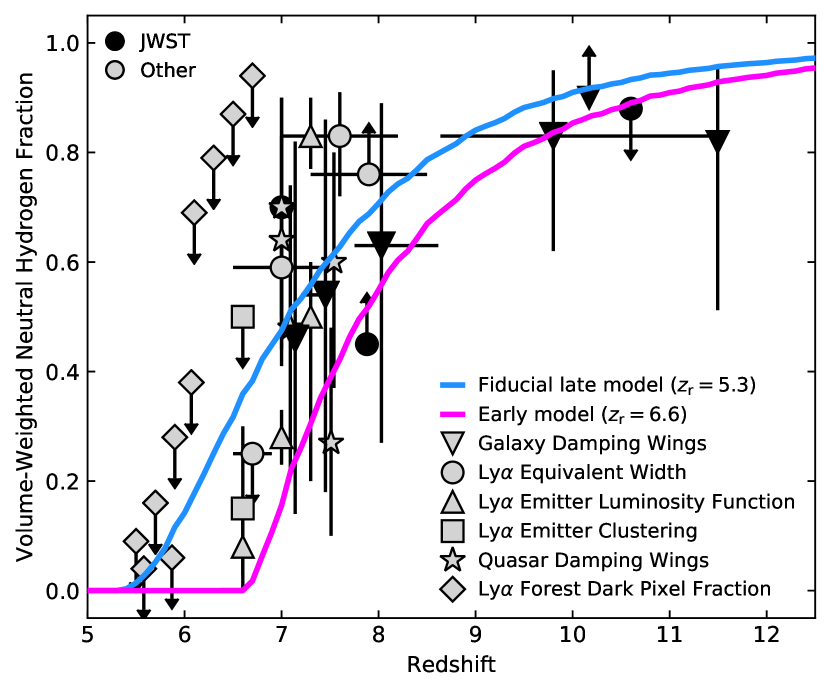
Spectra of the highest redshift galaxies taken with JWST are now allowing us to see into the heart of the reionization epoch. Many of these observed galaxies exhibit strong damping wing absorption redward of their Lyman-$α$ emission. These observations have been used to measure the redshift evolution of the neutral fraction of the intergalactic medium and sizes of ionized bubbles. However, these estimates have been made using a simple analytic model for the intergalactic damping wing. We explore the recent observations with models of inhomogeneous reionization from the Sherwood-Relics simulation suite. We carry out a comparison between the damping wings calculated from the simulations and from the analytic model. We find that although the agreement is good on the red side of the Lyman-$α$ emission, there is a discrepancy on the blue side due to residual neutral hydrogen present in the simulations, which saturates the intergalactic absorption. For this reason, we find that it is difficult to reproduce the claimed observations of large bubble sizes at z ~ 7, which are driven by a detection of transmitted flux blueward of the Lyman-$α$ emission. We suggest instead that the observations can be explained by a model with smaller ionized bubbles and larger intrinsic Lyman-$α$ emission from the host galaxy.
연구 동기 및 목표
- JWST damping wings를 이용해 재전이 동안의 IGM를 제약하려고 동기를 부여한다.
- Miralda-Escudé (1998) 해석 모델이 이질적 재전이 시뮬레이션에서 생성된 damping wings를 얼마나 잘 재현하는지 평가한다.
- 시뮬레이션 기반 damping wings가 JWST 관측의 은하 및 발표된 버블 크기 추정과 어떻게 비교되는지 조사한다.
- 이온화된 영역 내부의 잔류 중성 가스가 damping wings 형성에 미치는 역할과 대형 버블 해석에의 시사점을 강조한다.
제안 방법
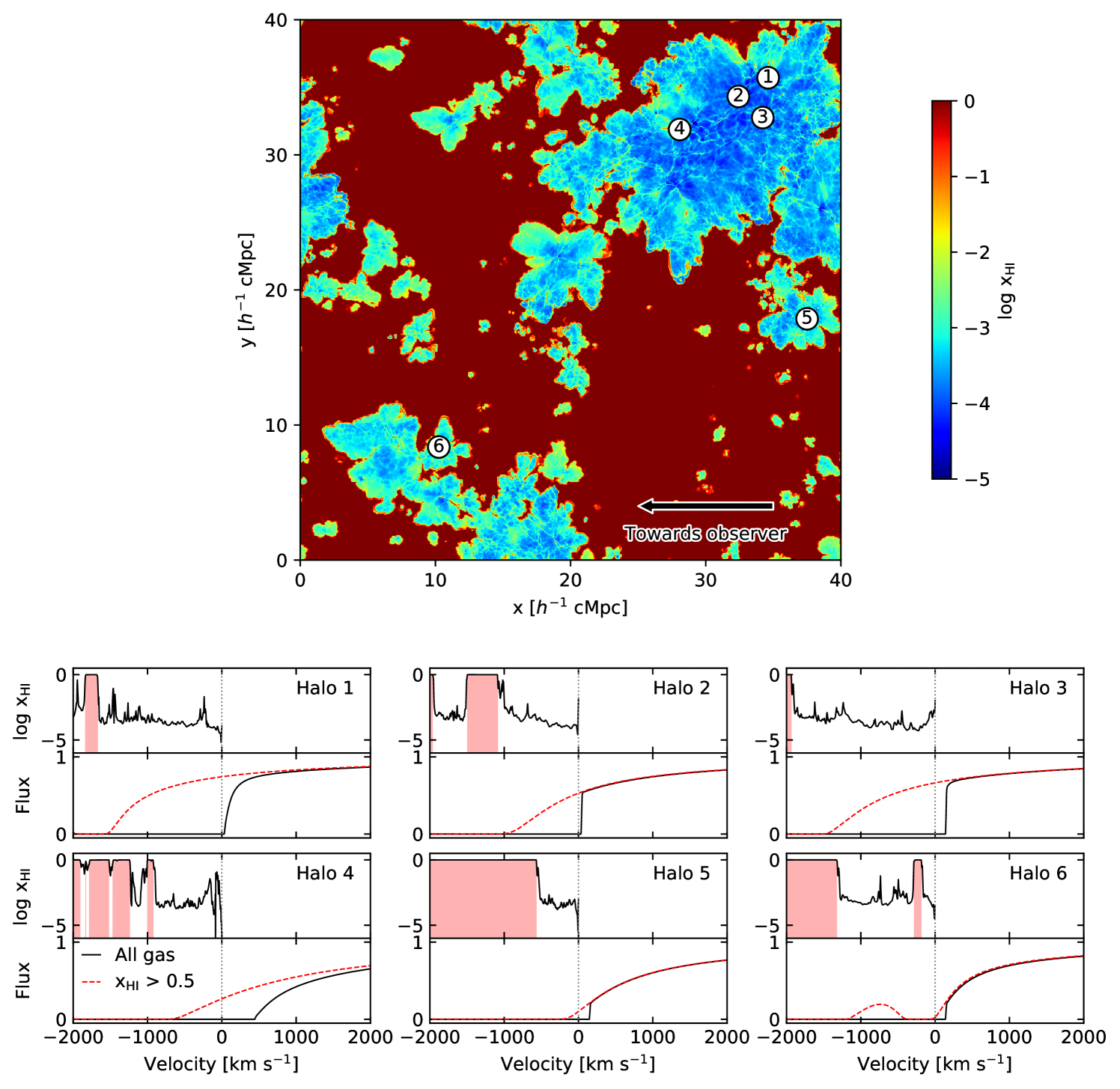
- Sherwood-Relics 코스모로나열 수치 시뮬레이션을 이용해 patchy reionization으로 z=7,8,9,10에서 질량 큰 HALO에 대한 목적으로 IGMB damping wings의 모의선을 생성한다.
- 복사전달로 후처리하여 변동하는 UV 배경을 할당하고 sightlines를 따라 Lyα 광학 깊이를 계산한다.
- IGM damping wings에 초점을 맞추기 위해 HALO 내부의 가스 제외하고, sightline을 따라 HALO의 속도와 방향에 대한 무관성 속도를 0 km/s로 renormalize 한다.
- analytic Voigt-profile 근사(Tepper-García 2006)를 사용해 damping wings를 계산하고 시뮬레이션에서 유도한 중성 분수 및 버블 크기를 사용해 Miralda-Escudé (1998) 모델과 비교한다.
- 가스의 특이 속도, 이온화 버블 내부의 잔류 중성 가스, sightline의 이온화 진화가 damping wings에 미치는 영향을 체계적으로 검토한다.
- 40h−1 Mpc와 160h−1 Mpc 시뮬레이션 박스를 비교하고, 공정한 질량 분포 비교를 위해 HALO 샘플을 재선정하는 효과를 조사한다.
실험 결과
연구 질문
- RQ1Miralda-Escudé (1998) 해석적 damping wing 모델이 이질적 재전이 시뮬레이션에서 생성된 damping wings를 재현하는지 얼마나 잘 설명하는가?
- RQ2특히 Lyα의 시스템 중심선을 좌측으로 움직일 때 시뮬레이션된 damping wings와 해석 모델 간의 불일치는 무엇으로 인해 발생하는가?
- RQ3JWST로 검출된 damping wings를 z~7에서의 큰 이온화 버블 주장과 어떻게 조화시킬 수 있는가, 아니면 더 작은 버블과 더 강한 본래 Lyα와 같은 대안이 우세한가?
주요 결과
- Miralda-Escudé (1998)은 시뮬레이션의 red-side 중간 감쇠wing을 재현하지만 버블이 완전히 이온화되지 않기 때문에 Lyα의 blueward에서의 전송을 과대예측한다.
- 이온화 버블 내부의 잔류 중성 수소는 xHI ~ 10−3에서도 강한 Lyα 흡수를 일으키며, 우리줄의 흡수를 포화시키고 분석 모델의 중앙선 blueward와의 불일치를 야기한다.
- -host 버블 내부의 잔류 중성 가스를 제거하고 특이 속도를 무시하면 시뮬레이션과 Miralda-Escudé damping wing 사이의 일치도가 향상되며, 특히 은하의 적색축선의 blueward에서 두드러진다.
- 대부분의 경우, 대규모로 관찰된 버블에서 추론되는 큰 전달 플ux보다도 blueward에서 전달되는 양이 적은 것으로 시뮬레이션은 예측하므로, z~7에서의 큰 버블 해석에 도전이 된다.
- 이 연구는 관측된 damping wings가 더 작은 이온화 버블과 호스트 은하의 더 큰 본래 Lyα 방출을 결합해서 설명될 수 있음을 시사한다.
더 나은 연구,지금 바로 시작하세요
연구 설계부터 논문 작성까지, 연구 시간을 획기적으로 줄여보세요.
카드 등록 없음 · 무료 플랜 제공
이 리뷰는 AI가 만들고, 인간 에디터가 검토했습니다.