
[논문 리뷰] JWST Reveals CH$_4$, CO$_2$, and H$_2$O in a Metal-rich Miscible Atmosphere on a Two-Earth-Radius Exoplanet
JWST 전송 분광학 TOI-270 d는 CH$_4$, CO$_2$, 및 H$_2$O 서명을 가진 매우 금속이 풍부하고 miscible HMWV-dominated 엔벨로프를 드러내어 내부 구성과 새로운 sub-Neptune 분류를 제약한다.
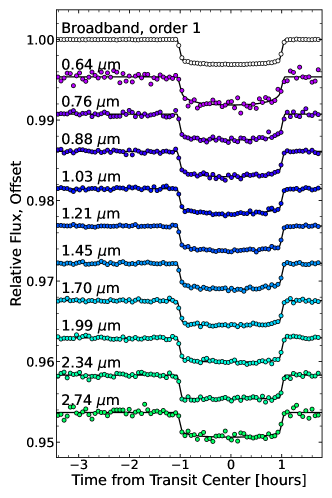
Even though sub-Neptunes likely represent the most common outcome of planet formation, their natures remain poorly understood. In particular, planets near 1.5-2.5$\,R_\oplus$ often have bulk densities that can be explained equally well with widely different compositions and interior structures, resulting in grossly divergent implications for their formation. Here, we present the full 0.6-5.2$\,μ\mathrm{m}$ JWST NIRISS/SOSS+NIRSpec/G395H transmission spectrum of the 2.2$\,R_\oplus$ TOI-270d ($4.78\,M_\oplus$, $T_\mathrm{eq}$=350-380 K), delivering unprecedented sensitivity for atmospheric characterization in the sub-Neptune regime. We detect five vibrational bands of CH$_4$ at 1.15, 1.4, 1.7, 2.3, and 3.3$\,μ$m (9.4$σ$), the signature of CO$_2$ at 4.3$\,μ$m (4.8$σ$), water vapor (2.5$σ$), and potential signatures of SO$_2$ at 4.0$\,μ\mathrm{m}$ and CS$_2$ at 4.6$\,μ\mathrm{m}$. Intriguingly, we find an overall highly metal-rich atmosphere, with a mean molecular weight of $5.47_{-1.14}^{+1.25}$. We infer an atmospheric metal mass fraction of $58_{-12}^{+8}\%$ and a C/O of $0.47_{-0.19}^{+0.16}$, indicating that approximately half the mass of the outer envelope is in high-molecular-weight volatiles (H$_2$O, CH$_4$, CO, CO$_2$) rather than H$_2$/He. We introduce a sub-Neptune classification scheme and identify TOI-270d as a "miscible-envelope sub-Neptune" in which H$_2$/He is well-mixed with the high-molecular-weight volatiles in a miscible supercritical metal-rich envelope. For a fully miscible envelope, we conclude that TOI-270d's interior is $90_{-4}^{+3}\,$wt$\,\%$ rock/iron, indicating that it formed as a rocky planet that accreted a few wt % of H$_2$/He, with the overall envelope metal content explained by magma-ocean/envelope reactions without the need for significant ice accretion. TOI-270d may well be an archetype of the overall population of sub-Neptunes.
연구 동기 및 목표
- _RADIUS 밸리 근처의 내부 구조가 열화(degenerate)된 상태에서 sub-Neptune 구성 이해를 유도한다.
- 广 JWST 파장 범위를 활용하여 ~2.2 R⊕ 행성의 상대 대기 화학을 특성화한다.
- 대기 풍부한 추정치를 통해 암석/철질 비율 및 엔벨로프 금속 함량을 제약한다.
- miscible, metal-rich 엔벨로프를 가진 sub-Neptunes에 대한 분류 프레임워크를 제안한다.
- 행성 형성 경로와 내부-내부-엔벨로프 결합에 대한 함의를 평가한다.
제안 방법
- TOI-270 d의 0.6–5.2 μm JWST 전송 스펙트럼을 NIRISS/SOSS 및 NIRSpec/G395H(0.6–2.8 μm 및 2.7–5.2 μm)로 얻는다.
- NAMELESS 및 supreme-SPOON 파이프라인으로 데이터를 감소시키고; 1/f 잡음, 배경 및 코사인-입자 보정; 분광 광 곡선을 추출한다.
- ExoTEP 및 batman 트랜지트 모델을 통한 화이트 및 분광 광곡선을 MCMC 프레임워크에서 피팅하고 시스템도 및 리드-다이징을 포함한다.
- 추출된 대기를 모델링하여 CH$_4$, CO$_2$, H$_2$O 특징과 SO$_2$ 및 CS$_2$ 신호 가능성을 확인하고 평균 분자량과 금속 함량을 추정한다.
- 대기 제약을 내부 구조 모델링과 결합하여 암석/철 비율 및 엔벨로프 구성을 추정한다.
- 구름/안개 존재 및 miscible-엔벨로프 가설에 대한 함의를 논의한다.

실험 결과
연구 질문
- RQ1TOI-270 d의 상부 대기에서 JWST 전송 분광학으로 드러난 분자 종은 무엇인가?
- RQ2행성의 엔벨로프의 평균 분자량과 금속 함량은 무엇이며, 이러한 제약이 내부 구조를 어떻게 이해시키는가?
- RQ3H/He 엔벨로프가 있더라도 고분자량 휘발성 물질과 혼합된 miscible, metal-rich 엔벨로프를 형성하는가?
- RQ4TOI-270 d의 추정된 내부 및 대기 구성에 가장 잘 맞는 형성 경로는 무엇인가?
- RQ5TOI-270 d가 반지름 밸리 근처의 넓은 sub-Neptune 분류 체계에 어떤 시사점을 제공하는가?
주요 결과
- CH$_4$의 1.15, 1.4, 1.7, 2.3, 3.3 μm에서의 진동 밴드 다섯 개 탐지(9.4σ).
- 4.3 μm 주변에서 CO$_2$ 기질 탐지(4.8σ).
- 1.4 및 1.9 μm에서 H$_2$O 흡수 탐지(2.5σ).
- 4.0 μm에서 SO$_2 가능 신호 및 4.6 μm에서 CS$_2$ 가능 신호; 전반적으로 스펙트럼은 매우 금속이 풍부한 엔벨로프를 시사.
- 평균 분자량은 5.47$_{-1.14}^{+1.25}$로 추정되며 대기 금속 질량 분율은 58$_{-12}^{+8}$%이고 C/O = 0.47$_{-0.19}^{+0.16}$이다.
- 내부 모델링은 엔벨로프가 완전히 miscible한 경우 TOI-270 d가 약 90$_{-4}^{+3}$ wt% 암석/철일 수 있음을 시사하며, 엔벨로프 금속을 설명하는 소량의 H$_2$/He 분율 및 마그마-해양-엔벨로프 상호작용이 형성에 기여했을 수 있다.
더 나은 연구,지금 바로 시작하세요
논문 읽기부터 검토까지, 연구 시간을 획기적으로 줄여보세요.
카드 등록 없음 · 무료 플랜 제공
이 리뷰는 AI가 만들고, 인간 에디터가 검토했습니다.