
[논문 리뷰] Life-Cycle Emissions of AI Hardware: A Cradle-To-Grave Approach and Generational Trends
이 preprint는 다섯 개 Google TPU의 cradle-to-grave LCA를 제시하며 Compute Carbon Intensity (CCI)를 도입하고 TPU v4i에서 v6e로의 3x CCI 개선과 24/7 청정 에너지 시나리오가 이익을 증폭한다.
Specialized hardware accelerators aid the rapid advancement of artificial intelligence (AI), and their efficiency impacts AI's environmental sustainability. This study presents the first publication of a comprehensive AI accelerator life-cycle assessment (LCA) of greenhouse gas emissions, including the first publication of manufacturing emissions of an AI accelerator. Our analysis of five Tensor Processing Units (TPUs) encompasses all stages of the hardware lifespan - from raw material extraction, manufacturing, and disposal, to energy consumption during development, deployment, and serving of AI models. Using first-party data, it offers the most comprehensive evaluation to date of AI hardware's environmental impact. We include detailed descriptions of our LCA to act as a tutorial, road map, and inspiration for other computer engineers to perform similar LCAs to help us all understand the environmental impacts of our chips and of AI. A byproduct of this study is the new metric compute carbon intensity (CCI) that is helpful in evaluating AI hardware sustainability and in estimating the carbon footprint of training and inference. This study shows that CCI improves 3x from TPU v4i to TPU v6e. Moreover, while this paper's focus is on hardware, software advancements leverage and amplify these gains.
연구 동기 및 목표
- AI 가속기 및 연결된 호스트의 전체 라이프사이클에 걸친 온실가스 배출량 정량화.
- AI 가속기에 대한 제조 배출 데이터를 최초로 공개.
- 공정하고 성능 보정된 탄소 지표로서 Compute Carbon Intensity (CCI) 도입.
- 하드웨어 설계의 광범위한 채택을 가능하게 하는 상세하고 재현 가능한 LCA 방법론 제공.
- TPU 세대 간 배출을 비교하여 성능 대 탄소의 trade-off를 이해.
제안 방법
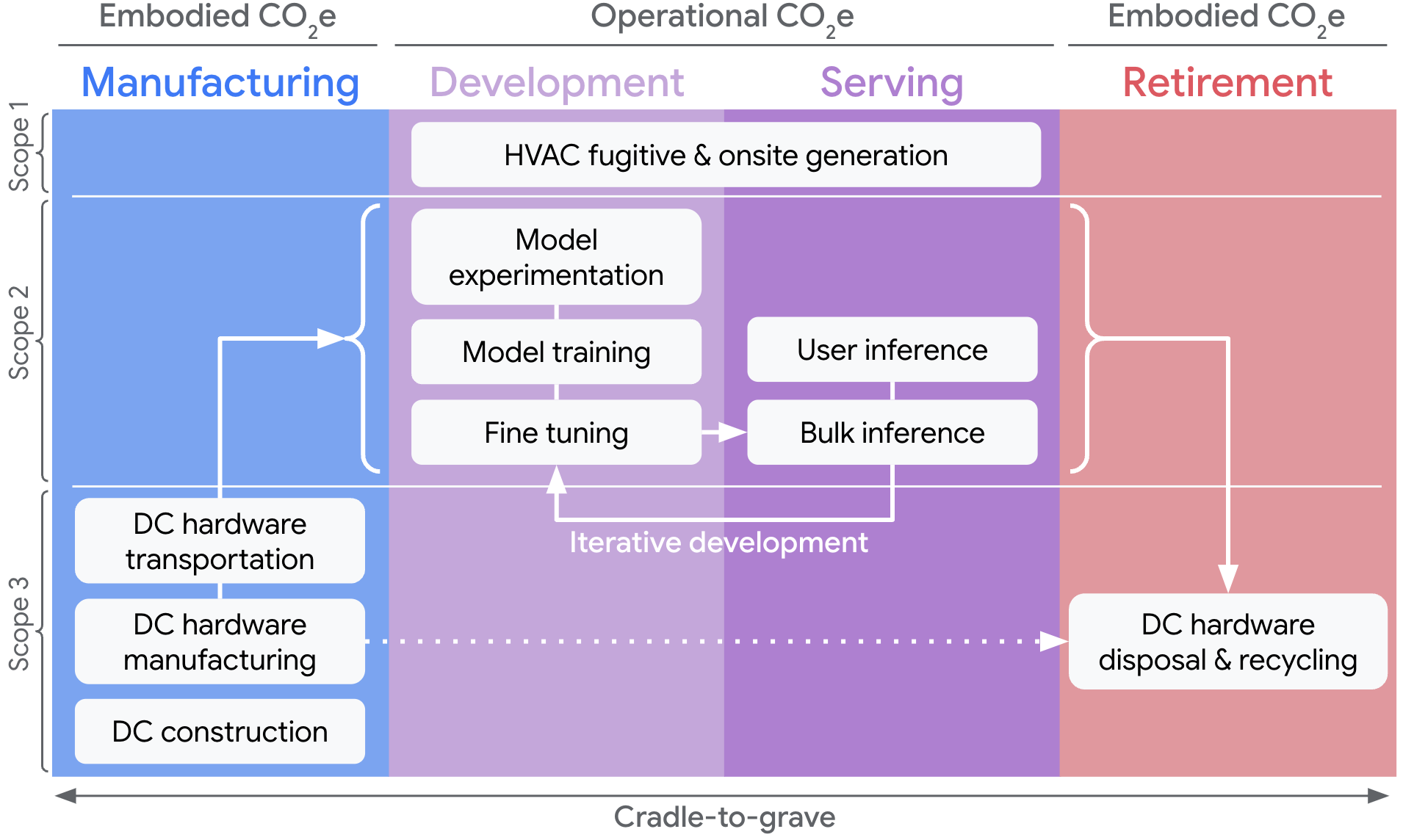
- 원재료, 제조, 데이터센터 건설, 운영(개발, 훈련, 서빙), 그리고 수명 종료에 이르는 cradle-to-grave LCA 경계 채택.
- TPU 플릿 전반의 운전 에너지 및 배출량을 측정하기 위해 Google의 1차 데이터 사용.
- embodied 및 operational 구성요소를 포함한 gCO2e per ExaFLOP (FLOPs)로서의 Compute Carbon Intensity (CCI) 정의 및 적용.
- 시장 기반(MB) 및 위치 기반(LB) 전력 계리 방식 차별화, 24/7 시각별 청정 에너지 매칭 시나리오 포함.
- 실행 중 소모 FLOPs를 런타임 카운터로 측정하고 측정 에너지를 결합하여 운용 CCI 계산.
- TPU 세대를 비교할 때 플릿 의무-주기 차이를 보정하기 위한 경향 점수 가중치 사용.
- 도구, 가정, 절차를 자세히 다룬 LCA 튜토리얼 같은 부록 제공.
실험 결과
연구 질문
- RQ1Google AI 하드웨어 가속기(TPUs) 및 연결된 호스트의 cradle-to-grave GHG 배출은 무엇인가?
- RQ2임베디드 및 운용 배출이 TPU 세대 전체 수명 주기에 걸친 총 배출량에 어떻게 기여하는가?
- RQ3정규화된 하드웨어 중심 탄소 지표(CCI)가 서로 다른 성능 수준의 AI 가속기를 공정하게 비교할 수 있는가?
- RQ4MB 대 LB 대 24/7 CFE와 같은 서로 다른 전력 계리 방법이 보고된 배출량 및 완화 전략에 어떤 영향을 미치는가?
- RQ5TPU v4i/v5e에서 v6e로의 제조, 운영, 수명 주기 성능 측면에서 배출 추세는 어떠한가?
주요 결과
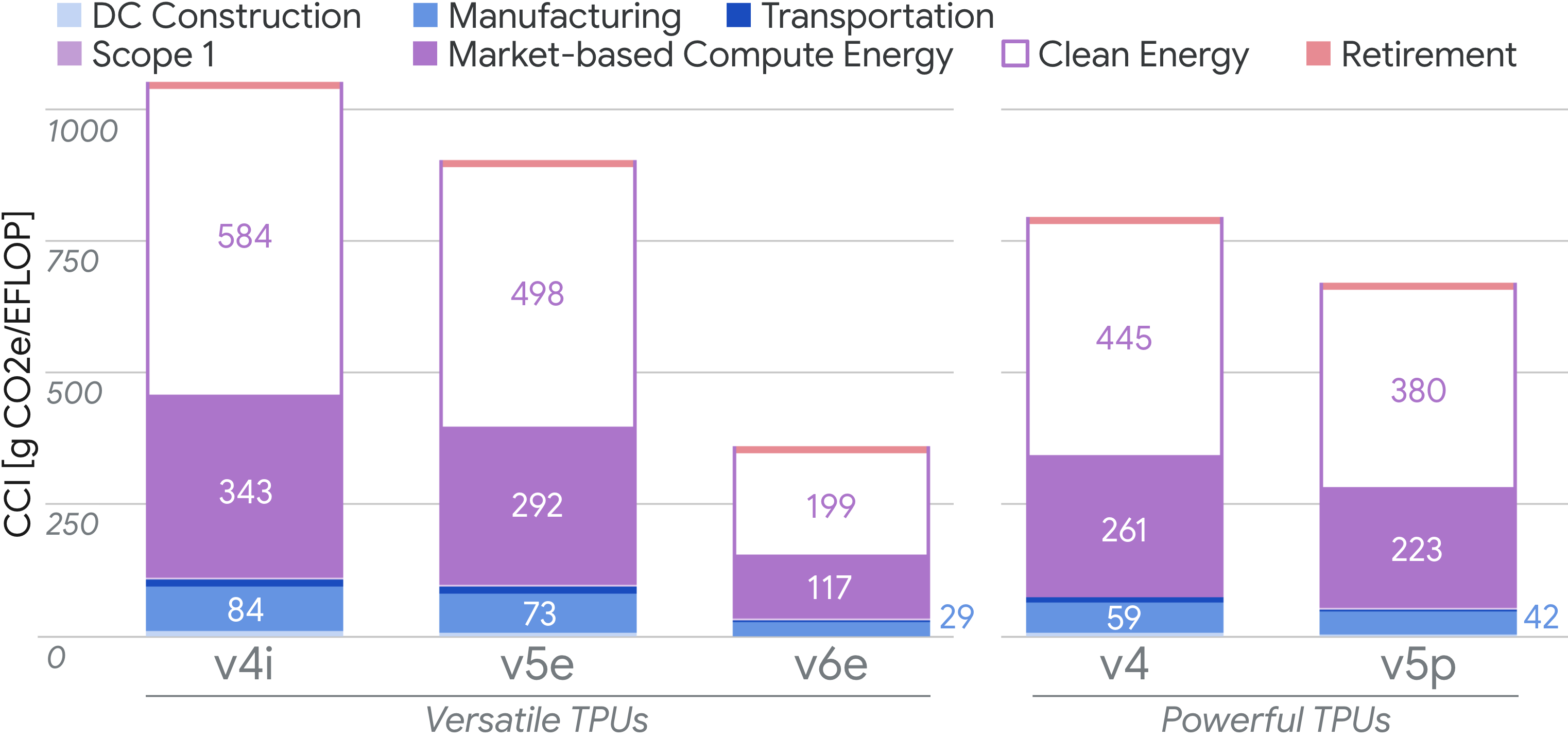
- Compute Carbon Intensity (CCI) improves 3x from TPU v4i to TPU v6e.
- Operational electricity emissions dominate embodied hardware emissions, accounting for ~70% (MB) to ~90% (LB) of lifetime emissions.
- MB accounting reduces reported operational emissions through clean-energy purchases, while 24/7 hourly CFE matching provides a more stringent, realistic mitigation picture.
- Manufacturing emissions rise with newer generations due to larger ASIC dies and increased memory, but improved performance yields lower emissions per unit of computation.
- Embodied CCI decreases as generations improve (e.g., 38–114 gCO2e/10^18 FLOPs across variants), while operational CCI also improves with hardware and energy strategies.
- In hypothetical 90% CFE scenarios, total CCI drops substantially, underscoring the impact of clean energy procurement on lifecycle emissions.
더 나은 연구,지금 바로 시작하세요
연구 설계부터 논문 작성까지, 연구 시간을 획기적으로 줄여보세요.
카드 등록 없음 · 무료 플랜 제공
이 리뷰는 AI가 만들고, 인간 에디터가 검토했습니다.