
[논문 리뷰] LLM and Simulation as Bilevel Optimizers: A New Paradigm to Advance Physical Scientific Discovery
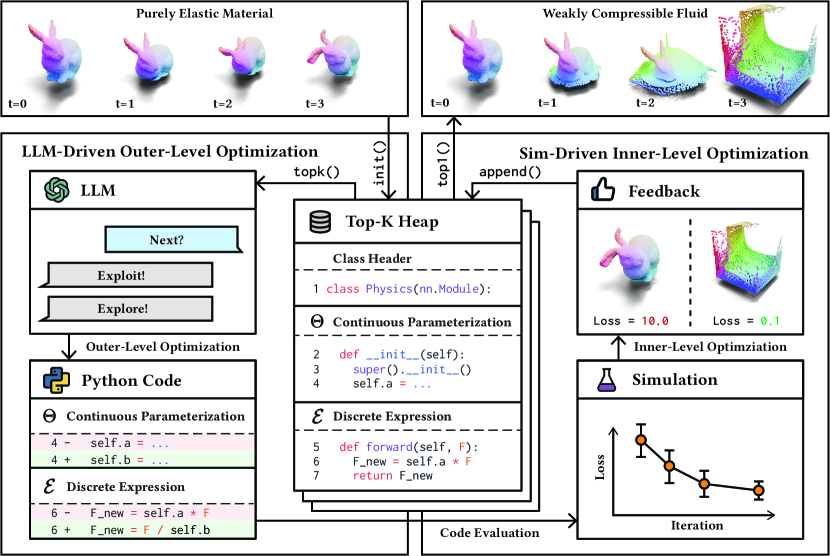
논문은 Scientific Generative Agent (SGA)를 제안합니다. 이는 LLM이离散적 가설(식)을 생성하고, 구분가능한 시뮬레이터가 연속 매개변수를 최적화하는 이중 레벨 프레임워크로 constitutive-law의 발견과 분자 설계를 가능하게 합니다.
Large Language Models have recently gained significant attention in scientific discovery for their extensive knowledge and advanced reasoning capabilities. However, they encounter challenges in effectively simulating observational feedback and grounding it with language to propel advancements in physical scientific discovery. Conversely, human scientists undertake scientific discovery by formulating hypotheses, conducting experiments, and revising theories through observational analysis. Inspired by this, we propose to enhance the knowledge-driven, abstract reasoning abilities of LLMs with the computational strength of simulations. We introduce Scientific Generative Agent (SGA), a bilevel optimization framework: LLMs act as knowledgeable and versatile thinkers, proposing scientific hypotheses and reason about discrete components, such as physics equations or molecule structures; meanwhile, simulations function as experimental platforms, providing observational feedback and optimizing via differentiability for continuous parts, such as physical parameters. We conduct extensive experiments to demonstrate our framework's efficacy in constitutive law discovery and molecular design, unveiling novel solutions that differ from conventional human expectations yet remain coherent upon analysis.
연구 동기 및 목표
- 물리 과학적 발견에 필요한 영역 특화 방법을 넘어선 지식 기반의 통합 접근법을 동기 부여한다.
- LLMs를 구분 가능 시뮬레이션과 이중 레벨 최적화와 결합해离散 가설을 탐색하고 연속 매개변수를 최적화한다.
- 구성 법칙 발견과 분자 설계에서 프레임워크를 시연해 새롭고 일관된 해를 찾아낸다.
제안 방법
- 외부 수준 탐색: 과거 시뮬레이션 결과를 근거로 LLM이离散 표현(E)와 연속 매개변수 공간(Theta)을 제시합니다; 내부 수준 최적화: 구분 가능 시뮬레이션이 Theta 내에서 연속 매개변수(theta)를 최적화하여 E를 평가합니다.
- 이중 최적화 형식: 최소화 L(y(E, Theta, theta_hat; Phi)) subject to 시뮬레이션의 유효성 G(E, Theta; Phi)≤0 및 theta_hat = argmin_theta L(y(theta; Phi, E))를 만족합니다.
- 탐색-탐사 전략: 알려진 좋은 해의 활용과 새로운 가설 탐사를 균형 있게 하기 위해 LLM 생성 온도를 조정합니다.
- 두 가지 상호작용 모드: 방정식 탐색(LLM이 방정식과 Theta를 제시) 및 엔티티 탐색(LLM이 Theta를 상수로 하는 구조를 제시)
- 구분 가능한 내부 최적화: theta에 대한 Phi의 기울기가 내부 최적화를 이끌고 LLM에 피드백 o를 제공합니다.
실험 결과
연구 질문
- RQ1LLMs와 구분 가능 시뮬레이션을 결합한 이중 레벨 프레임워크가 운동 데이터로부터 구성 법칙을 효과적으로 발견할 수 있는가?
- RQ2이 접근 방식이离散 구조와 연속 좌표를 함께 최적화하여 목표 양자 특성을 갖는 분자를 설계할 수 있는가?
- RQ3탐색-활용 균형이 물리 과학에서 발견의 효율성과 해의 질에 어떤 영향을 미치는가?
- RQ4LLMs가 프롬프트 수정 없이도 구성 법칙 발견과 분자 설계의 도메인 간에 일반화할 수 있는가?
주요 결과
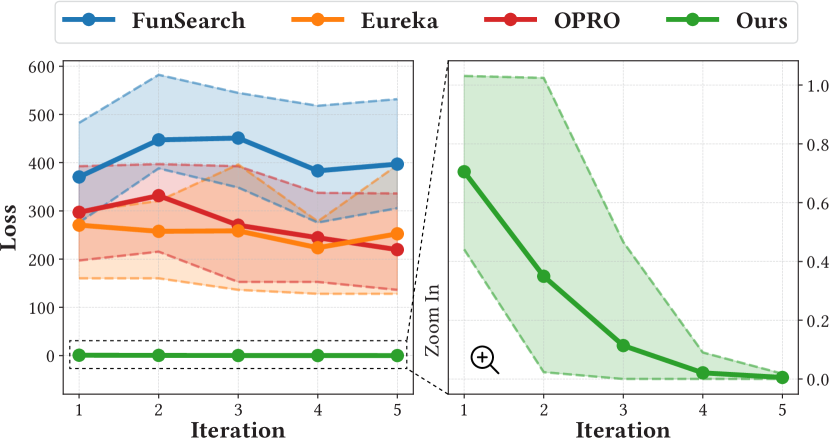
- 이 방법은 구성 법칙 발견 및 분자 설계 과제에서 여러 기준선보다 우수한 성능을 보입니다.
- 이중 최적화가 핵심이며, 이를 제거하면 성능이 저하되고, 탐사를 유지하면 결과가 개선됩니다.
- 활용-탐사 균형은 성공과 품질을 향상시키며, 1:3의 활용:탐사 비율이 어려운 과제에서 더 나은 결과를 낳습니다.
- 이 접근 방식은 전문가 검토에서 일관되고 우수한 새로운 구성 법칙과 분자 설계를 발견합니다.
- GPT-4는 일반적으로 다른 백본보다 우수하지만, 일부 오픈 소스 LLM은 특정 분자 설계 과제에서 뛰어납니다.
- 결합적 LLM-시뮬레이션 상호작용이 반복적으로 더 나은 제안을 가져옵니다.
더 나은 연구,지금 바로 시작하세요
논문 읽기부터 검토까지, 연구 시간을 획기적으로 줄여보세요.
카드 등록 없음 · 무료 플랜 제공
이 리뷰는 AI가 만들고, 인간 에디터가 검토했습니다.