
[논문 리뷰] Measurement of the $B^{0} ightarrow D^{*-} \ell^{+} ν_{\ell}$ branching ratio and $|V_{cb}|$ with a fully reconstructed accompanying $B$ meson in 2019-2021 Belle II data
이 논문은 2019–2021년 벨레 II 실험에서 확보한 189.3 fb$^{-1}$의 데이터에서 완전히 재구성된 B 메손 쌍을 사용하여 $B^0 \to D^{*-} \ell^+ \nu_\ell$ 붕괴 분율과 $|V_{cb}|$를 정밀하게 측정한다. 연구는 $\mathcal{B}(B^0 \to D^{*-} \ell^+ \nu_\ell) = (5.27 \pm 0.22_{\text{stat}} \pm 0.38_{\text{syst}})\%$를 도출하였으며, 이는 세계 평균과 일치한다. 또한 $|V_{cb}| \times 10^3 = 37.9 \pm 2.7$로 결정하여 독립적인 붕괴를 통한 CKM 행렬 원소에 대한 제약 조건을 향상시켰다.
We present a measurement of the $B^{0} ightarrow D^{*-} \ell^{+} ν_{\ell}$ ($\ell=e,μ$) branching ratio and of the CKM parameter $|V_{cb}|$ using signal decays accompanied by a fully reconstructed $B$ meson. The Belle II data set of electron-positron collisions at the $Υ(4S)$ resonance, corresponding to 189.3$\,$fb$^{-1}$ of integrated luminosity, is analyzed. With the Caprini-Lellouch-Neubert form factor parameterization, the parameters $η_{ m EW} F(1) |V_{cb}|$ and $ρ^{2}$ are extracted, where $η_{ m EW}$ is an electroweak correction, $F(1)$ is a normalization factor and $ρ^{2}$ is a form factor shape parameter. We reconstruct 516 signal decays and thereby obtain $\mathcal{B} (B^{0} ightarrow D^{*-} \ell^{+} ν_{\ell} ) = \left(5.27 \pm 0.22~ m{\left(stat ight)} \pm 0.38~ m{\left(syst ight)} ight) \%$, $η_{EW} F(1) |V_{cb}| imes 10^{3} = 34.6 \pm 1.8~ m{\left(stat ight)} \pm 1.7~ m{\left(syst ight)}$, and $ρ^{2} = 0.94 \pm 0.18~ m{\left(stat ight)} \pm 0.11~ m{\left(syst ight)}$.
연구 동기 및 목표
- e$^+$e$^-$ 충돌에서 $\Upsilon(4S)$ 공명 상태에서 발생한 완전히 재구성된 B 메손 쌍을 사용하여 $B^0 \to D^{*-} \ell^+ \nu_\ell$ 붕괴 분율을 고정밀도로 측정한다.
- 측정된 붕괴 분율을 이론적 형상 인자와 전자기적 반사 보정과 함께 조합하여 CKM 행렬 원소 $|V_{cb}|$를 결정한다.
- 신호 재구성에 몬테카를로 시뮬레이션에 의존하는 것을 최소화하기 위해 완전히 재구성된 B 메손을 태그로 사용함으로써 체계적 불확실성을 감소시킨다.
- 독립적인 반입자 붕괴 $B \to D^*\ell\nu$가 표준모형 예측의 $|V_{cb}|$와 일관된지 검증하며, 오랫동안 지속된 $B \to D^*\ell\nu$ 역설을 해결한다.
제안 방법
- 벨레 II 실험에서 $\Upsilon(4S)$ 공명 상태에서 수집한 189.3 fb$^{-1}$의 e$^+$e$^-$ 충돌 데이터를 분석에 사용한다.
- 신호 사건은 동반되는 $B^0 \bar{B}^0$ 쌍에서 재구성된 $B^0$ 메손을 통해 $B^0 \to D^{*-} \ell^+ \nu_\ell$ 붕괴로 선택된다.
- $D^{*-}$는 $D^{*-} \to \pi^- \bar{D}^0$ 및 $\bar{D}^0 \to K^+ \pi^-$로 재구성되며, 분辨도 향상을 위해 운동량 보존 조건이 적용된다.
- 빔 에너지 및 에너지 차이와 같은 운동량 및 위상 변수를 사용하여 $B^0$ 태깅 효율과 배경 억제를 향상시킨다.
- 사용자 기반 방법을 통해 체계적 불확실성을 평가하며, 이는 이벤트 수준의 선택 기준, 시뮬레이션 샘플 크기, 붕괴 분율 및 형상 인수와 같은 외부 입력을 포함한다.
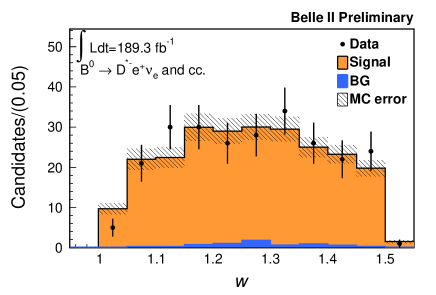
- 분산 $w = q^2$에 대한 빈도수 최대우도 피팅을 수행하여 $\eta_{\text{EW}}F(1)|V_{cb}|$와 $\rho^2$를 추출하며, 체계적 상관관계를 포함한 공분산 행렬을 사용한다.
실험 결과
연구 질문
- RQ1완전히 재구성된 B 메손을 사용하여 독립적인 $B^0 \to D^{*-} \ell^+ \nu_\ell$ 붕괴 분율을 정밀하게 측정한 결과는 무엇인가?
- RQ2측정된 $|V_{cb}|$ 값은 세계 평균과 어떻게 비교되며, $B \to D^*\ell\nu$ 갈등 문제를 해결하는가?
- RQ3검출기 효율, 시뮬레이션 샘플 크기, 외부 입력 등에서 기인한 체계적 불확실성의 영향은 무엇인가?
- RQ4측정된 $d\Gamma/dw$ 분포는 이론 모델과 얼마나 잘 일치하는가? 적합도는 어떠한가?
주요 결과
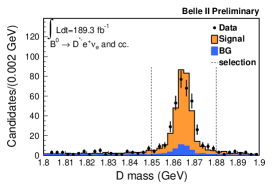
- 측정된 붕괴 분율은 $\mathcal{B}(B^0 \to D^{*-} \ell^+ \nu_\ell) = (5.27 \pm 0.22_{\text{stat}} \pm 0.38_{\text{syst}})\%$이며, 세계 평균 $(5.06 \pm 0.12)\%$과 일치한다.
- $\eta_{\text{EW}}F(1)|V_{cb}| \times 10^3 = 34.6 \pm 1.8_{\text{stat}} \pm 1.7_{\text{syst}}$는 세계 평균 $35.27 \pm 0.38$와 일치한다.
- $\eta_{\text{EW}} = 1.00662 \pm 0.00016$와 $F(1) = 0.906 \pm 0.004_{\text{stat}} \pm 0.012_{\text{syst}}$를 고려하여 $|V_{cb}|$는 $37.9 \pm 2.7$로 결정되었다.
- $d\Gamma/dw$ 분포에 대한 피팅 결과는 감소된 $\chi^2$ 값이 1.6이며, p-값은 40.7%로 이론 모델과 양호한 일치를 보였다.
- 붕괴 분율에 대한 총 체계적 불확실성은 7.3%이며, 주로 트래킹 및 레프톤 식별 효율(각각 4.1% 및 2.0%)에 의해 결정된다.
- $\eta_{\text{EW}}F(1)|V_{cb}|$와 $\rho^2$의 공분산 행렬은 $w$ 구간 간 중간 정도의 상관관계를 보이며, $\rho^2 = 0.94 \pm 0.18_{\text{stat}} \pm 0.11_{\text{syst}}$로 측정되었다.
이 논문 읽기
누빈트 뷰어에서 원문을 열고, 읽으면서 궁금한 곳을 바로 물어보세요.
누빈트에서 이 논문 읽기이 리뷰는 AI가 논문 원문을 바탕으로 만들었습니다. 인용하기 전에 원문을 확인해 주세요.