
[논문 리뷰] Measuring the Variance of the Macquart Relation in z-DM Modeling
이 논문은 z-DM Macquart 관계에서 DM 분산의 변동 매개변수 F를 자유 매개변수로 취급하는 순방향 모델링 접근법을 도입하고, FRB 데이터로 이를 피팅시키며, 국소화된 FRB 샘플의 합성으로 얻는 개선을 예측하고, H0와의 이중상관성도 함께 탐구한다.
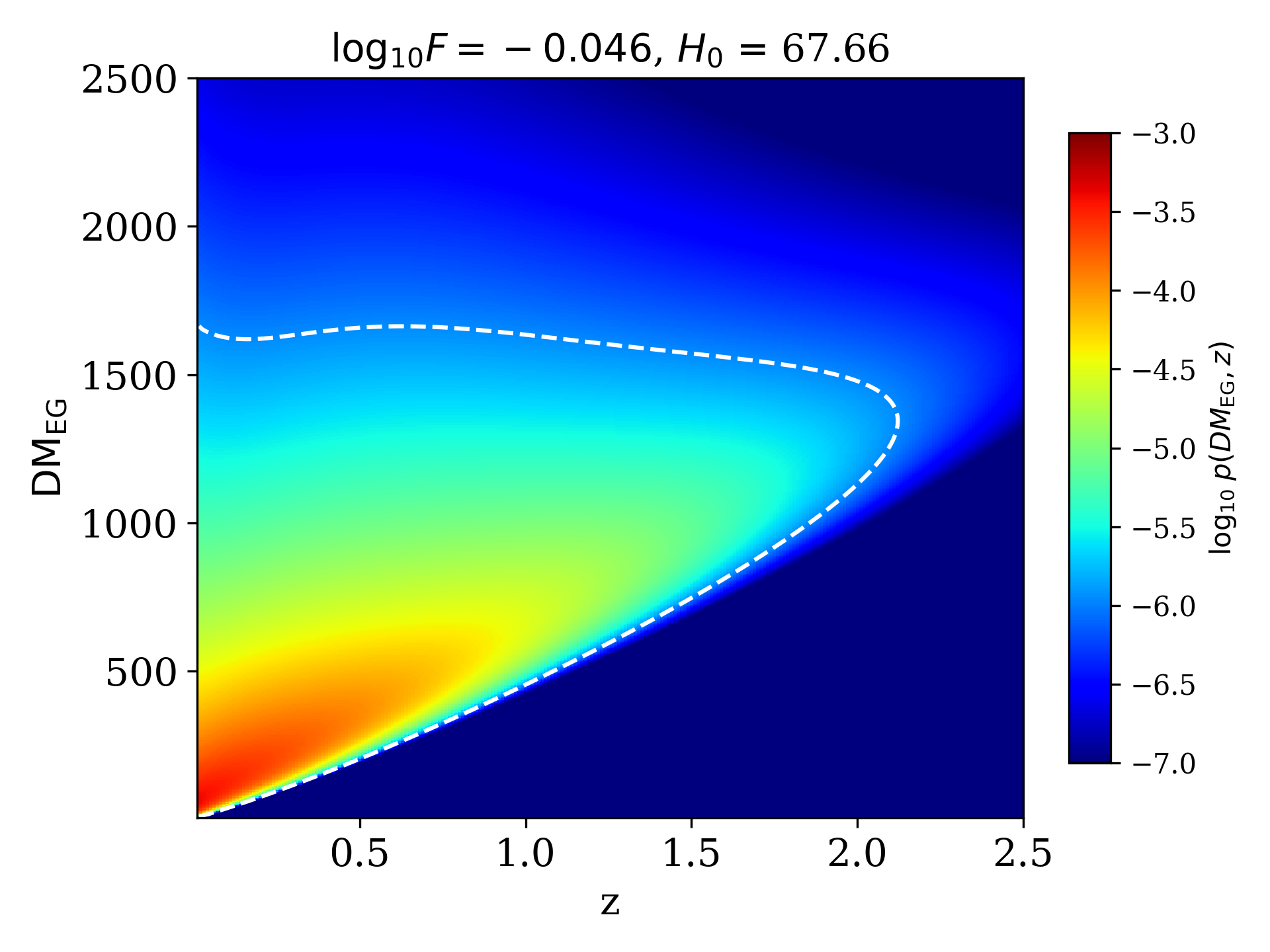
The Macquart relation describes the correlation between the dispersion measure (DM) of fast radio bursts (FRBs) and the redshift $z$ of their host galaxies. The scatter of the Macquart relation is sensitive to the distribution of baryons in the intergalactic medium (IGM) including those ejected from galactic halos through feedback processes. The width of the distribution in DMs from the cosmic web (${ m DM}_{ m cosmic}$) is parameterized by a fluctuation parameter $F$, which is related to the cosmic DM variance by $σ_{ m DM}= F z^{-0.5}$. In this work, we present a new measurement of $F$ using 78 FRBs of which 21 have been localized to host galaxies. Our analysis simultaneously fits for the Hubble constant $H_0$ and the DM distribution due to the FRB host galaxy. We find that the fluctuation parameter is degenerate with these parameters, most notably $H_0$, and use a uniform prior on $H_0$ to measure $\log_{10} F > -0.89$ at the $3σ$ confidence interval and a new constraint on the Hubble constant $H_0 = 85.3_{-8.1}^{+9.4} \, { m km \, s^{-1} \, Mpc^{-1}}$. Using a synthetic sample of 100 localized FRBs, the constraint on the fluctuation parameter is improved by a factor of $\sim 2$. Comparing our $F$ measurement to simulated predictions from cosmological simulation (IllustrisTNG), we find agreement between $0.4 < z < 2$. However, at $z < 0.4$, the simulations underpredict $F$ which we attribute to the rapidly changing extragalactic DM excess distribution at low redshift.
연구 동기 및 목표
- 은 DM의 Macquart z-DM 관계를 통해 은하간 매질(IGM)에서의 바리온 분포에 대한 제약을 동기화하고 FRB 색인에 의한 분산 측정으로 고찰한다.
- IGM에서의 우주 웹과 홀들로 인한 DM 분산을 정량화하는 변동 매개변수 F를 도입한다.
- FRB의 외부 DM 성분과 FRB 데이터에 대해 F를 측정하기 위해 H0와 함께 F를 동시에 피팅한다.
- F와 H0 사이의 이중상관성과 DM_host 파라미터와의 상관성을 평가한다.
- 더 큰 규모의 국소화 FRB 샘플이 F에 대한 제약을 어떻게 개선하는지 예측한다.
제안 방법
- z-DM 모델링 프레임워크(zdm)를 채택하여 FRB의 DM_FRB를 DM_ISM, DM_halo, 및 DM_EG로 분해한다.
- DM_EG를 DM_cosmic + DM_host로 모델링하고, DM_cosmic의 분산은 비가우시안 분포 p_cosmic(Δ)로 설명되며 σ_DM ∝ F z^-0.5인 변동 매개변수 F를 사용한다.
- host DM을 평균 μ_host와 산포 σ_host를 자유 매parameter로 하는 로그정규 분포로 표현한다.
- 그리드 탐색을 통해 정의된 매개변수 공간에서 우도(likelihood)를 얻고, F와 H0를 constrain하기 위해 redshift- localized FRB를 도입한다.
- 특히 F와 H0 사이의 이중상관성을 탐구하기 위해 H0에 대해 Planck 값과 SNe 값 사이의 균등(prior)을 적용하고 1D/2D 우도 분석을 수행한다.
- 합성 샘플 100개의 localized FRB를 사용하여 F에 대한 제약을 예측하고 F와 H0의 정밀도 향상을 연구한다.
실험 결과
연구 질문
- RQ1우주 웹과 홀에서 DM 분산을 설명하는 fluctuation 매개변수 F는 무엇이며 FRB 데이터로 이를 어떻게 제약할 수 있는가?
- RQ2z-DM EG 모델에서 F가 H0와 DM_host 매개변수와 얼마나 잘 이중상관(데네거러시)을 가지는가?
- RQ3redshift 정보를 포함하는 것이 제약(F 및 H0)에 어떤 개선을 가져오는가?
- RQ4H0에 대한 priors를 포함시키는 것이 F의 측정에 어떤 영향을 주는가?
- RQ5현 데이터와 비교할 때 국소화된 FRB의 합성 샘플이 F의 한계를 어떻게 개선하는가?
주요 결과
- 78개의 FRB(그중 21개는 redshift 보유)에서 fluctuation 매개변수는 log10 F > -0.89로 3σ에서 하한으로 제약된다.
- F를 가변으로 두면 H0 제약이 약해지며 H0를 priors 없이 두면 H0 = 85.3(-8.1,+9.4) km/s/Mpc가 된다.
- 1σ에서 uniform한 H0 priors를 적용하면 log10 F = -0.48^{+0.26}_{-0.18} 이고 3σ에서 log10 F > -0.89이다.
- 100개의 localized FRB 합성 샘플은 F 제약을 개선하고 priors를 가질 때 H0 제약을 더 촘촘하게 만든다 (예: priors를 두면 H0 ≈ 67.6^{+3.5}_{-3.4} km/s/Mpc와 같은 값).
- IllustrisTNG와의 비교는 0.4 < z < 2에서 일치하지만, z < 0.4에서 시뮬레이션은 낮은 z DM_IGM 동작으로 인해 F를 과대평가한다.
더 나은 연구,지금 바로 시작하세요
연구 설계부터 논문 작성까지, 연구 시간을 획기적으로 줄여보세요.
카드 등록 없음 · 무료 플랜 제공
이 리뷰는 AI가 만들고, 인간 에디터가 검토했습니다.