
[논문 리뷰] Mental-LLM: Leveraging Large Language Models for Mental Health Prediction via Online Text Data
이 논문은 온라인 텍스트 데이터를 사용한 정신 건강 예측 작업에서 무지-shot, 소수-shot, 그리고 지시-미세 조정 설정을 통해 여러 지시-튜닝 LLM을 평가하고, 지시 미세 조정이 성능을 크게 향상시키며 Mental-Alpaca와 Mental-FLAN-T5가 최첨단 수준의 능력에 도달함을 보여준다.
Advances in large language models (LLMs) have empowered a variety of applications. However, there is still a significant gap in research when it comes to understanding and enhancing the capabilities of LLMs in the field of mental health. In this work, we present a comprehensive evaluation of multiple LLMs on various mental health prediction tasks via online text data, including Alpaca, Alpaca-LoRA, FLAN-T5, GPT-3.5, and GPT-4. We conduct a broad range of experiments, covering zero-shot prompting, few-shot prompting, and instruction fine-tuning. The results indicate a promising yet limited performance of LLMs with zero-shot and few-shot prompt designs for mental health tasks. More importantly, our experiments show that instruction finetuning can significantly boost the performance of LLMs for all tasks simultaneously. Our best-finetuned models, Mental-Alpaca and Mental-FLAN-T5, outperform the best prompt design of GPT-3.5 (25 and 15 times bigger) by 10.9% on balanced accuracy and the best of GPT-4 (250 and 150 times bigger) by 4.8%. They further perform on par with the state-of-the-art task-specific language model. We also conduct an exploratory case study on LLMs' capability on mental health reasoning tasks, illustrating the promising capability of certain models such as GPT-4. We summarize our findings into a set of action guidelines for potential methods to enhance LLMs' capability for mental health tasks. Meanwhile, we also emphasize the important limitations before achieving deployability in real-world mental health settings, such as known racial and gender bias. We highlight the important ethical risks accompanying this line of research.
연구 동기 및 목표
- 무지샷, 소수샷, 그리고 지시 미세 조정이 온라인 텍스트 데이터를 사용하는 정신 건강 작업에서 LLM에 어떤 영향을 미치는지 평가한다.
- 다양한 데이터 세트에서 광범위한 LLM(Alpaca, Alpaca-LoRA, FLAN-T5, LLaMA2, GPT-3.5, GPT-4)을 비교한다.
- 지시 미세 조정이 다양한 작업과 데이터 세트에서 폭넓은 성능 향상을 보임을 입증한다.
- 향후 연구를 위한 오픈 소스 정신 건강 맞춤 모델 및 가이드를 제공한다.]
- method:[
제안 방법
- 네 부분 구조의 제로샷 프롬프트와 네 가지 프롬프트 전략(Basic, Context Enhancement, Mental Health Enhancement, Context & Mental Health Enhancement)을 설계한다.
- 제로샷 프롬프트에 프롬프트-레이블 시연 집합을 추가하여 소수샷 프롬 prompting 구현.
- 다양한 정신 건강 작업 간 다중 작업 처리를 가능하게 하는 다중 데이터 세트 학습을 사용한 지시 미세 조정을 수행한다.
- train/test 분할 및 외부 평가를 가진 Reddit 및 비 Reddit 데이터 세트에서 여섯 가지 작업을 평가한다.
- 정신 건강 예측 작업을 위한 오픈 소스 미세 조정 모델인 Mental-Alpaca 및 Mental-FLAN-T5를 개발하고 공개한다.
실험 결과
연구 질문
- RQ1다수의 LLM에서 정신 건강 예측 작업에 대해 제로샷 및 소수샷 프롬 prompting은 어떻게 비교되는가?
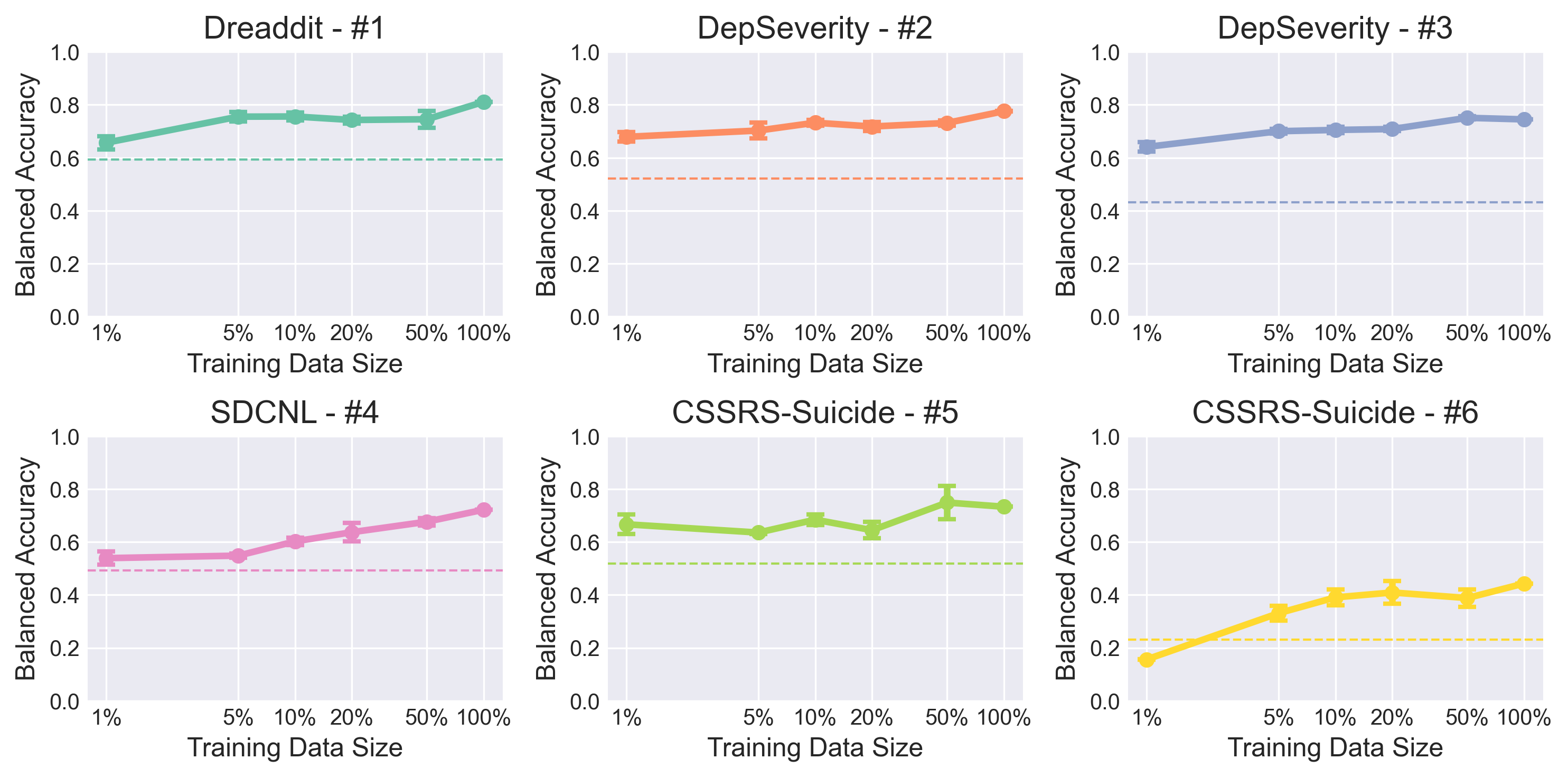
- RQ2지시 미세 조정이 다양한 정신 건강 작업 및 데이터 세트에서 성능을 얼마나 향상시킬 수 있는가?
- RQ3미세 조정된 모델이 정신 건강 예측에서 작업별 모델과 일치하거나 능가할 수 있는가?
- RQ4정신 건강 분석에 LLM을 배치할 때의 윤리적 고려사항과 편향은 무엇인가?
주요 결과
- 지시 미세 조정은 여러 정신 건강 작업과 데이터 세트에서 모델 성능을 크게 향상시킨다.
- Mental-Alpaca 및 Mental-FLAN-T5는 최고의 GPT-3.5 프롬프트 설계보다 평균 균형 정확도에서 10.9% 높은 성과를 보이며(비교적 훨씬 작음) 최상의 GPT-4 프롬프트를 평균 4.8% 이긴다.
- 미세 조정된 모델은 여러 작업에서 최첨단 작업별 Mental-RoBERTa와 동등한 성능에 도달한다.
- 제로샷 및 소수샷 프롬프트는 유망하지만 제한적 성능을 보이며, 소수샷은 평균 약 4.1%의 개선을 제공한다.
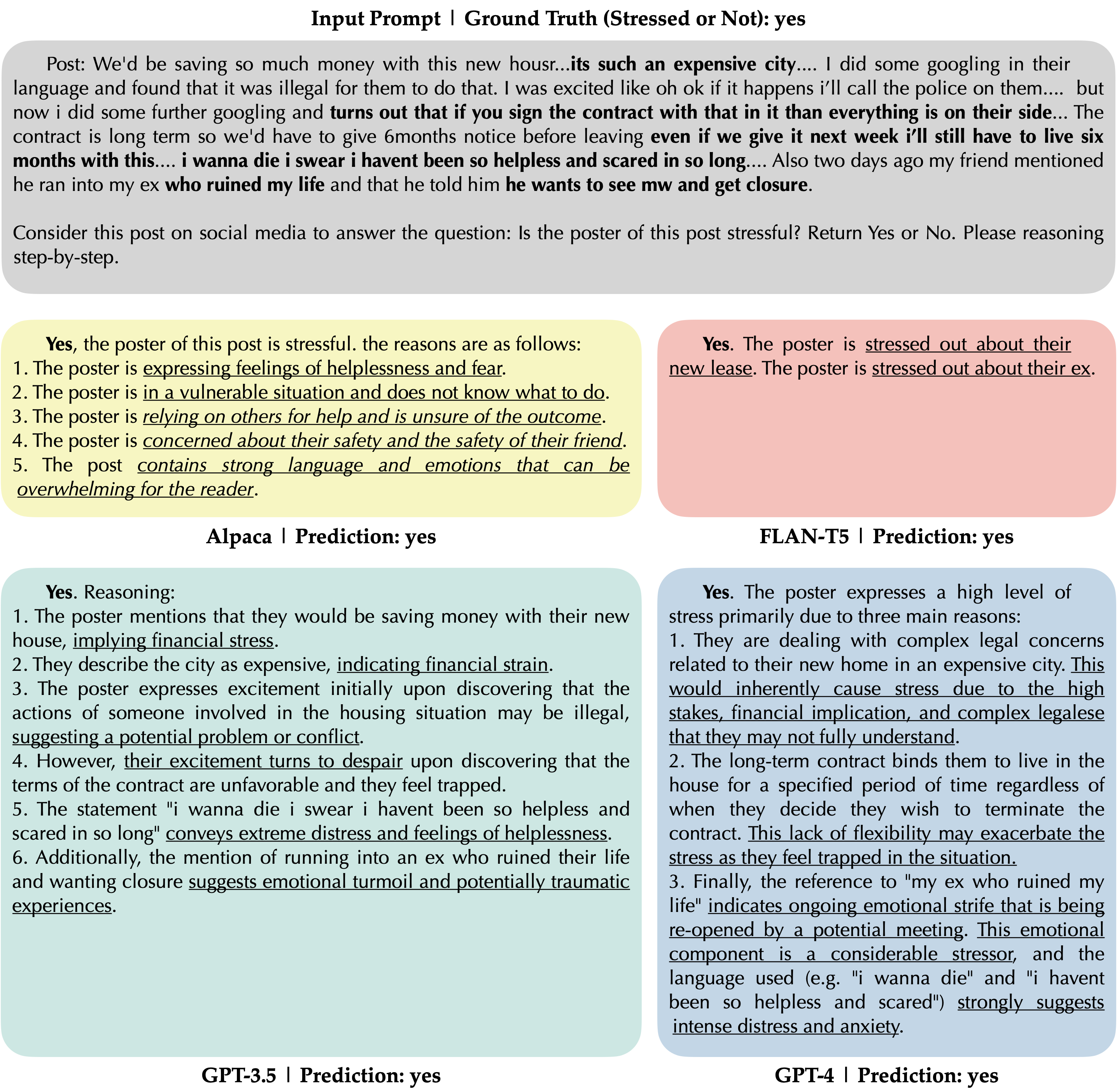
- 사례 연구는 GPT-4와 같은 모델에서 미묘한 추론 능력을 시사하고 추가 연구가 필요한 실패 사례를 강조한다.
- Mental-Alpaca 및 Mental-FLAN-T5의 오픈 소스 공개로 다중 작업 정신 건강 예측 연구를 촉진한다.
더 나은 연구,지금 바로 시작하세요
논문 읽기부터 검토까지, 연구 시간을 획기적으로 줄여보세요.
카드 등록 없음 · 무료 플랜 제공
이 리뷰는 AI가 만들고, 인간 에디터가 검토했습니다.