
[논문 리뷰] Model of Cosmic Ray Propagation in the Milky Way at the Knee
이 논문은 Milky Way에서 페페( PeV ) 우주선의 비등방성이고 시간 의존적인 전파 모델을 제시합니다. CR은 이산적 비전형 소스로 주입되고 현실적인 은하 자기장 하에서 전파되어 무릎 부근에서 지역 플럭스가 매우 비균일하게 나타납니다.
We present a new model of anisotropic cosmic ray propagation in the Milky Way, where cosmic rays are injected at discrete transient sources in the disc and propagated in the Galactic magnetic field. In the framework of our model, we show that the cosmic ray spectrum is time-dependent and space-dependent around the energy of the knee. It has a major contribution of one or a few nearby recent sources at any given location in the Galaxy, in particular at the position of the Solar system. We find that the distribution of $\sim$ PeV cosmic rays in our Galaxy is significantly clumpy and inhomogeneous, and therefore substantially different from the smoother distribution of GeV cosmic rays. Our findings have important implications for the calculation and future interpretation of the diffuse Galactic gamma-ray and neutrino fluxes at very high energies.
연구 동기 및 목표
- 은하 자기장 내 비등방 확산으로 무릎을 설명하는 전파 프레임워크를 동기부여한다.
- 페eV 에너지에서 시간-공간 의존적 CR 분포를 형성하는 이산적 비전형 소스가 어떻게 작용하는지 조사한다.
- CR 형 confinement 및 지역 플럭스 변동에 대해 규칙적인 자기장의 영향 평가한다.
- 은하의 확산성 감마선 및 중성미자 플럭스에 대한 시사점을 탐구한다.
제안 방법
- 은하 디스크의 이산적 기준 소스에서 CR를 주입하고 Jansson-Farrar 은하 자기장 모델에서 개별적으로 전파시킨다.
- 겉쪽 난류 규모 Lmax = 25 pc를 사용하고 난류장 강도를 감소시켜 B/C 제약을 만족시킨다.
- 에너지 {1, 3, 10, 30, 100} PeV에서 소스당 10^3 궤적을 시뮬레이션하고 30년에서 30 Myr에 걸쳐 위치를 기록한다.
- 은하 디스크에 격자를 두고 100 pc^3 상자 단위로 R=20 kpc 및 |z|=400 pc까지 CR 밀도를 계산한다.
- 주입 스펙트럼을 관측 데이터와 관계시키기 위해 파라미터 alpha와 Emax를 사용하고, 소스 밀도(초신성의 1.6% 대 10%)를 조정하여 무릎 영역 데이터를 맞춘다.
실험 결과
연구 질문
- RQ1은하 규칙적 자기장 내의 비등방 확산이 페V CR의 분포에 대해 등방 확산 모델과 비교하여 어떤 차이를 만들어내는가?
- RQ2가까운 최근 소수 소스들이 무릎 및 그 이상에서 지역 CR 플럭스 형성에 어떤 역할을 하는가?
- RQ3페V CR의 예측된 응집성(clumpiness)이 확산성 감마선 및 중성미자 신호에 어떤 영향을 미치는가?
- RQ4JF12 모델에서 난류장을 감소시키면 B/C 제약을 재현하면서도 현실적인 CR confinement 시간을 허용할 수 있는가?
- RQ5KASCADE, IceTop, AMS-02, DAMPE, CALET 등으로부터 무릎 영역 측정을 재현하기 위해 어떤 소스 밀도와 스펙트럼 지수를 사용하는 것이 가장 좋은가?
주요 결과
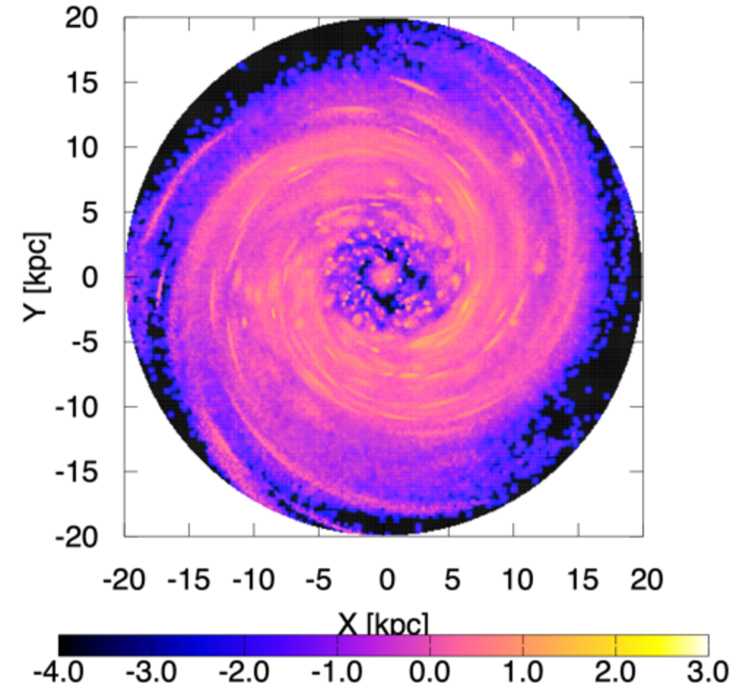
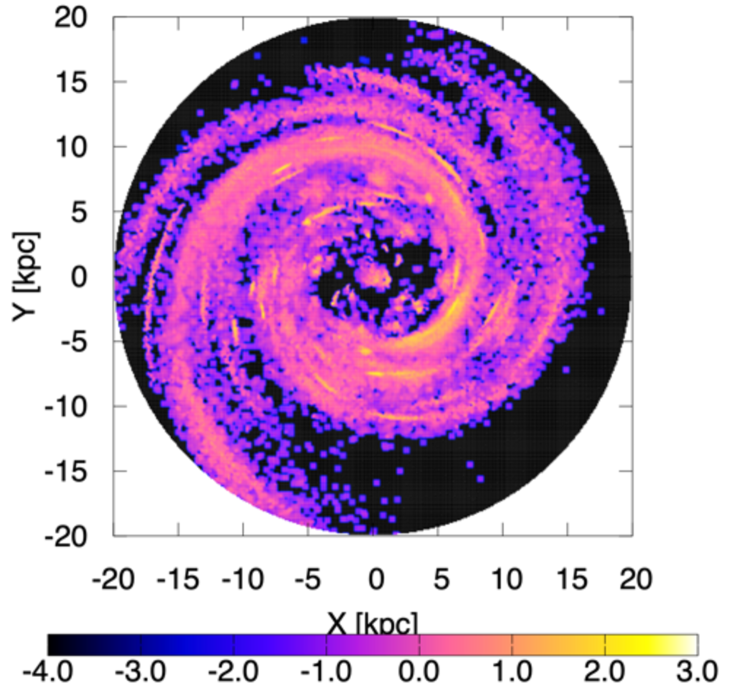
- 무릎 근처 CR 플럭스는 시간-공간 의존적이며 주어진 위치(지구를 포함)에서 하나의 근처 최근 소스에 의해 종종 지배된다.
- 1 PeV에서 플럭스 분포는 대규모 은하 전역에서 여러 차례의 차이로 매우 패치된 형태이다.
- 10 PeV 및 그 이상에서는 분포가 더 불균일해져 대부분의 위치에서 오로지 몇 개의 소스가 기여하며 지구도 포함된다.
- 지구에서 관측되는 무릎 플럭스는 수 Myr 규모의 시간도 동안 약 100개의 기여 소스에 의해 지배될 수 있으며 큰 변동은 약 100 kyr 단위에서 발생하며 소스 밀도(초신성의 1.6% 대 10%)에 따라 달라진다.
- 무릎 영역과 약 10 TeV 급 피크를 맞추려면 두 개의 소스 집단이 필요하며, alpha는 약 2.1–2.2 범위이고 에너지 범위에 따라 기여가 변한다.
더 나은 연구,지금 바로 시작하세요
연구 설계부터 논문 작성까지, 연구 시간을 획기적으로 줄여보세요.
카드 등록 없음 · 무료 플랜 제공
이 리뷰는 AI가 만들고, 인간 에디터가 검토했습니다.