
[논문 리뷰] MOPI-HFRS: A Multi-objective Personalized Health-aware Food Recommendation System with LLM-enhanced Interpretation
MOPI-HFRS는 그래프 기반 프레임워크에서 사용자 선호도, 개인화된 건강성, 영양 다양성을 함께 최적화하고 설명을 위한 LLM 강화 해석 모듈을 사용합니다.
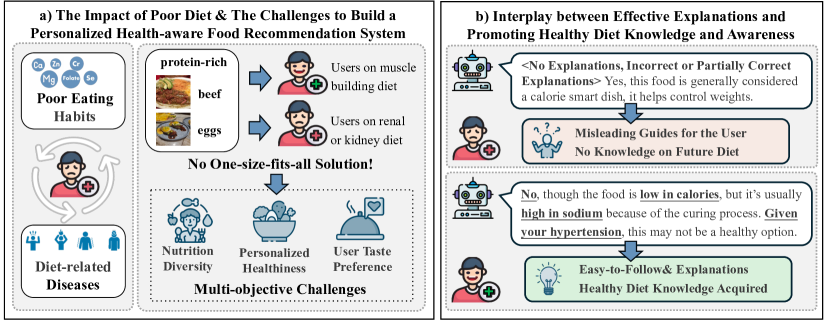
The prevalence of unhealthy eating habits has become an increasingly concerning issue in the United States. However, major food recommendation platforms (e.g., Yelp) continue to prioritize users' dietary preferences over the healthiness of their choices. Although efforts have been made to develop health-aware food recommendation systems, the personalization of such systems based on users' specific health conditions remains under-explored. In addition, few research focus on the interpretability of these systems, which hinders users from assessing the reliability of recommendations and impedes the practical deployment of these systems. In response to this gap, we first establish two large-scale personalized health-aware food recommendation benchmarks at the first attempt. We then develop a novel framework, Multi-Objective Personalized Interpretable Health-aware Food Recommendation System (MOPI-HFRS), which provides food recommendations by jointly optimizing the three objectives: user preference, personalized healthiness and nutritional diversity, along with an large language model (LLM)-enhanced reasoning module to promote healthy dietary knowledge through the interpretation of recommended results. Specifically, this holistic graph learning framework first utilizes two structure learning and a structure pooling modules to leverage both descriptive features and health data. Then it employs Pareto optimization to achieve designed multi-facet objectives. Finally, to further promote the healthy dietary knowledge and awareness, we exploit an LLM by utilizing knowledge-infusion, prompting the LLMs with knowledge obtained from the recommendation model for interpretation.
연구 동기 및 목표
- NHANES 데이터를 활용하여 건강 인식을 고려한 개인화된 식품 추천에 대한 대규모 벤치마크를 구축한다.
- 사용자 선호도, 개인화된 건강성, 영양 다양성을 함께 최적화하는 포괄적 프레임워크를 개발한다.
- 훈련 중 건강 및 설명 특성을 활용하기 위해 건강 인식 그래프 구조 학습을 도입한다.
- 경쟁 목표의 균형을 맞추기 위해 파레토 다목적 최적화를 적용한다.
- 권고에 대한 설명과 건강 지식을 제공하는 LLM 강화 해석 모듈을 도입한다.
제안 방법
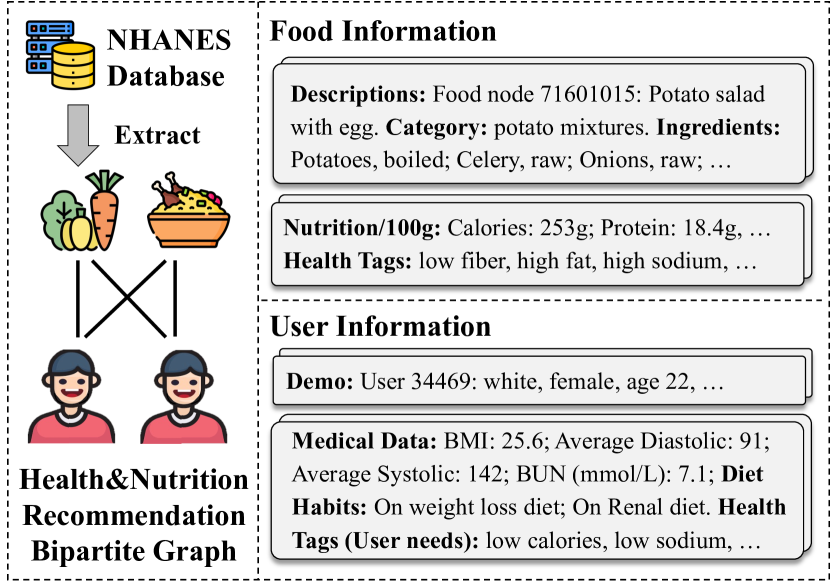
- NHANES 데이터로 건강 정보와 식품 영양 정보를 반영하는 건강·영양 추천 이분 그래프를 구성한다.
- 특성 기반 구조 학습과 건강한 엣지 구조 학습을 포함한 건강 인식 그래프 구조 학습을 개발한다.
- 그래프 구조 풀링을 활용하여 여러 그래프를 다운스트림 작업용으로 정제된 인접 행렬로 융합한다.
- 선호도(BPR), 건강 기반 손실, 다양성 손실을 포함하는 다손실 목표를 갖는 파레토 다목적 최적화를 사용하여 파레토 최적성을 달성한다.
- 도메인 정보를 반영한 프롬프트를 갖춘 지식 주입형 LLM 추론 모듈을 구현하여 권고에 대한 설명을 생성한다.
- LLM 해석을 개선하기 위해 도메인 특화 추론 전략 두 가지(정제된 식품 후보, 사용자 조건에 대한 주의) 를 제안한다.
실험 결과
연구 질문
- RQ1NHANES 기반 건강 데이터로 건강 인식 개인화 추천 시스템을 학습시켜 사용자 선호도, 건강성, 영양 다양성을 균형 있게 조정할 수 있는가?
- RQ2가중합 방식과 비교하여 파레토 최적화가 경쟁 목표 간의 균형을 개선하는가?
- RQ3LLM이 모델의 지식을 주입하여 건강 인식 추천에 대해 신뢰할 수 있는 도메인 정보를 담은 설명을 제공할 수 있는가?
- RQ4건강 인식 그래프 구조 학습과 엣지-사인 정보가 추천 품질과 건강 정합성을 향상시키는가?
주요 결과
- 제안된 벤치마크에서 MOPI-HFRS가 다목적 권장 작업에서 최첨단 기준선을 능가한다.
- 건강 정보 및 구조화된 학습의 도입은 매크로 및 전체 영양 벤치마크에서 Recall@20, NDCG@20, H-Score, 다양성 지표를 향상시킨다.
- 제안된 경사 하강 기반 업데이트를 포함한 파레토 최적화가 사용자 선호도, 건강성, 다양성 간의 파레토 최적 균형을 달성한다.
- LLM 강화 해석은 정제된 후보 세트와 조건 중심 프롬프트의 지원으로 건강성에 대한 더 풍부하고 도메인 인식이 반영된 설명을 제공한다.
- 특징 기반 구조 학습과 건강한 엣지 학습이 성능 향상에 기여한다는 제거 연구 결과를 시사한다.
더 나은 연구,지금 바로 시작하세요
논문 읽기부터 검토까지, 연구 시간을 획기적으로 줄여보세요.
카드 등록 없음 · 무료 플랜 제공
이 리뷰는 AI가 만들고, 인간 에디터가 검토했습니다.