
[논문 리뷰] Most of the photons that reionized the Universe came from dwarf galaxies
본 논문은 z~6-8에서 극미한 은하들의 최초 분광 관측을 보고하고, 높은 이온화 효율을 발견했으며, 미약한 탈출 분율로도 희미한 왜소 은하들이 우주 재이온화를 주도할 수 있음을 시사한다.
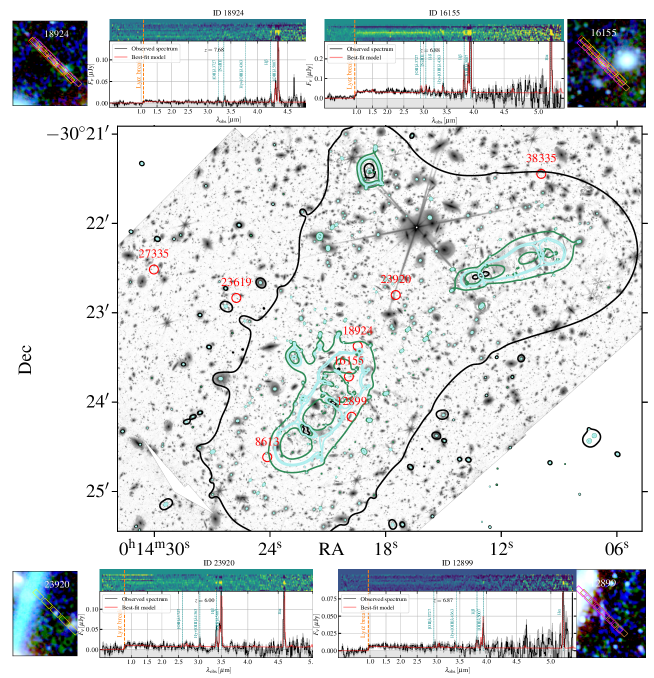
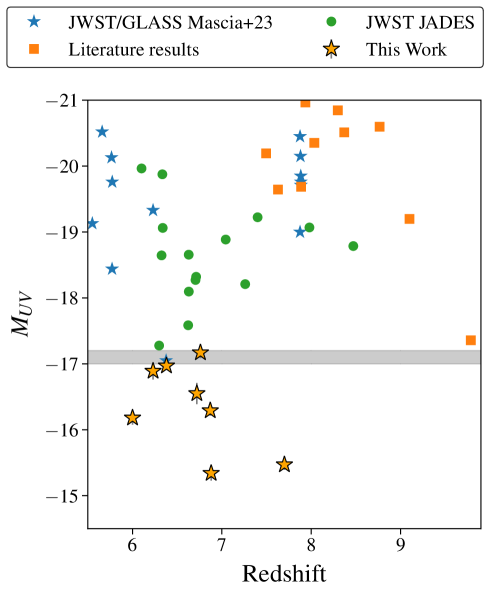
The identification of sources driving cosmic reionization, a major phase transition from neutral Hydrogen to ionized plasma around 600-800 Myr after the Big Bang (Dayal et al. 2018, Mason et al. 2019, Robertson et al. 2022), has been a matter of intense debate (Robertson et al. 2022). Some models suggest that high ionizing emissivity and escape fractions ($f_{ m esc}$) from quasars support their role in driving cosmic reionization (Madau & Haardt 2015, Mitra et al. 2018). Others propose that the high $f_{ m esc}$ values from bright galaxies generates sufficient ionizing radiation to drive this process (Naidu et al. 2020). Finally, a few studies suggest that the number density of faint galaxies, when combined with a stellar-mass-dependent model of ionizing efficiency and $f_{ m esc}$, can effectively dominate cosmic reionization (Finkelstein et al. 2019, Dayal et al. 2020). However, so far, low-mass galaxies have eluded comprehensive spectroscopic studies owing to their extreme faintness. Here we report an analysis of eight ultra-faint galaxies (in a very small field) during the epoch of reionization with absolute magnitudes between $M_{ m UV}$ $\sim -17$ to $-15$ mag (down to 0.005 $L^{\star}$. We find that faint galaxies during the Universe's first billion years produce ionizing photons with log($ξ_{\mathrm{ion}}$/ Hz erg$^{-1}$) =$25.80\pm 0.14$, a factor of 4 higher than commonly assumed values (Robertson et al. 2015). If this field is representative of the large scale distribution of faint galaxies, the rate of ionizing photons exceeds that needed for reionization, even for escape fractions of order five per cent.
연구 동기 및 목표
- 우주 재이온화에서 극히 약한 은하들의 역할을 촉진하고 정량화한다.
- z>6에서 약한 은하들의 이온화 광자 생산 효율성(xi_ion)을 측정한다.
- rest-frame UV 광도 함수(UV LF)를 제약하고 재이온화에 대한 약한 은하들의 기여를 평가한다.
- 이 시스템들의 Lyman-연속체 탈출 분율(f_esc)을 간접적으로 추정하고 금속성, 연령, sSFR를 분석한다.
제안 방법
- Abell 2744에서 MSA 구성을 이용한 8개의 극미 은하들에 대한 초깊은 NIRSpec 분광 관측.
- 개 intrinsic M_UV ~ -15 ~ -17 은하들을 탐색하기 위한 강한 중력 렌즈링(배율 mu ~ 2–27).
- z~6–8 후보를 확립하기 위한 JWST NIRCam와 HST 이미징의 색-색 컷과 EAZY SED 적합을 결합한 광형(photometric) 선택.
- Stellar masses, ages, metallicities, SFHs를 도출하기 위한 Bagpipes와 BEAGLE를 이용한 공동 분광-광형 SED 적합.
- 적색이동(z)과 이온화 광자 생산 보정을 위한 H-alpha, [NII], [OIII], H-beta, H-gamma, [OII]의 발맞춤선 분석.
- L(H-alpha)와 L_UV로 xi_ion를 계산; UV 기울기와 Sigma_SFR로 f_esc를 간접 추론하고 금속성 추정치를 보조한다.
실험 결과
연구 질문
- RQ1z>6에서 극미 은하들의 이온화 광자 생산 효율(xi_ion)은 얼마나 되는가?
- RQ2합리적인 탈출 분율을 가정했을 때 극미 은하들이 재이온화를 지속시키기에 충분한 이온화 광자를 제공하는가?
- RQ3z~7에서 M_UV ~ -15까지 UV 광도 함수가 확장되면 이온화 발광도에 어떤 영향을 미치는가?
- RQ4이 약한 시스템들의 물리적 특성(금속성, SFR, 연령, 크기)은 무엇이며 재이온화와 어떤 관련이 있는가?
주요 결과
- Faint galaxies have log(xi_ion / Hz erg^-1) = 25.8 ± 0.05, about a factor of 4 higher than canonical values.
- Total ionizing photon production by galaxies would suffice to reionize the Universe at z~7 with f_esc as low as 5%.
- Intrinsic UV magnitudes reach as faint as M_UV ≈ -15.34 (≈0.005 L* at z=7), extending the UV LF to very faint magnitudes.
- Stellar masses span log(M*/M_sun) ≈ 5.88 to 7.12, with very young ages (~a few Myr) and blue UV slopes (β ≈ -2.07 to -2.53).
- H-alpha based SFRs exceed UV-based SFRs (SFR(H-alpha)/SFR(UV) ≈ 5–60), indicating recent star-formation bursts.
- Sizes are compact (effective radii ~30–300 pc after lensing correction), consistent with a low-mass, high-sSFR population.
- Gas-phase metallicities are extremely low (12+log(O/H) ≈ 6.70–7.46; 1–6% solar), typical of metal-poor, ionizing-dominated systems.
더 나은 연구,지금 바로 시작하세요
논문 읽기부터 검토까지, 연구 시간을 획기적으로 줄여보세요.
카드 등록 없음 · 무료 플랜 제공
이 리뷰는 AI가 만들고, 인간 에디터가 검토했습니다.