
[논문 리뷰] Multimass modelling of Milky Way globular clusters -- II. present-day black hole populations
이 연구는 34개의 은하수 병렬성 군집에서 현존하는 블랙홀(BH) 인구를 추론하기 위해 다중질량 분포함수 모델을 사용하며, 다중관측 제약조건(운동학, 밀도, 질량 함수)을 활용한다. 대부분의 군집에서 BH 질량 분율은 0–1%이며, 오직 ω Cen만 약 5%로 이례적이다. 블랙홀 함량과 질량 분리 현상 사이에 반비례 관계가 발견되었고, 잔여 질량 분율과 천체역학적 연령 사이에 상관관계도 확인되었다.
Populations of stellar-mass black holes (BHs) in globular clusters (GCs) influence their dynamical evolution and have important implications on one of the main formation channels for gravitational wave sources. Inferring the size of these populations remains difficult, however. In this work, multimass models of 34 Milky Way GCs, first presented in Dickson et al., are used to explore the present-day BH populations. Direct constraints on both the total and visible mass components provided by several observables allow these models to accurately determine the distribution of the dark mass (including BHs) within clusters, as we demonstrate in a proof-of-concept fitting of the models to mock observations extracted from Monte Carlo cluster models. New constraints on the BH population retained to the present-day in each cluster are inferred from our models. We find that BH mass fractions ranging from 0 to 1 per cent of the total mass are typically required to explain the observations, except for Omega Cen, for which we infer a mass fraction above 5 per cent, in agreement with previous works. Relationships between the dark remnant populations and other cluster parameters are examined, demonstrating a clear anti-correlation between the amount of BHs and mass segregation between visible stars, as well as a correlation between remnant mass fractions and the dynamical age of clusters. Our inferred BH populations are in good agreement overall with other recent studies using different methodologies, but with notable discrepancies for individual clusters.
연구 동기 및 목표
- 다양한 은하수 병렬성 군집(GCs)의 현존하는 블랙홀(BH) 인구를 다중질량 천체역학 모델을 통해 추론하기.
- 자기운동, 선속도, 표면 밀도, 질량 함수 등 다양한 관측 자료를 통합하여 어두운 잔여체, 특히 별질량 블랙홀의 분포와 총 질량을 제약 조건으로 설정하기.
- BH 함량과 질량 분리 및 천체역학적 연령 등의 군집 천체역학적 성질 간의 관계를 조사하기.
- 이전에 중간질량 블랙홀(IMBHs)이 존재한다고 주장한 군집들에서 관측된 운동학적 및 구조적 자료가 실제로 IMBH의 존재를 요구하는지 테스트하기.
- 다른 방법론(예: 제인스 모델링, N-body/Monte Carlo 시뮬레이션)의 결과와 비교하여 추론된 BH 인구의 일관성 평가하기.
제안 방법
- 34개의 은하수 병렬성 군집에서 다중관측 자료—자기운동, 선속도, 표면 빛 밀도 프로파일, 질량 함수—를 동시에 적합하는 다중질량 분포함수(DF) 모델을 사용한다.
- 베이지안 추론을 사용하며, 내장 샘플링(dynesty)을 활용해 모델 파라미터의 사후 확률 분포를 탐색한다. 이 파라미터에는 총 BH 질량, BH 수, 질량 분율 등이 포함된다.
- 특히 고질량 영역(>1 M⊙)에서의 별 초기 질량 함수(IMF) 제약 조건을 포함하고, 금속성 의존성도 고려한다.
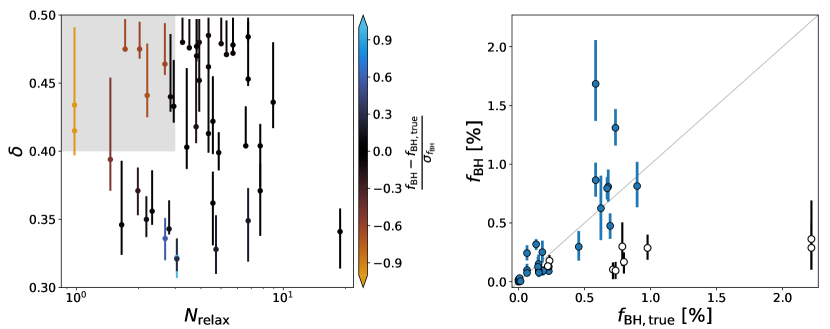
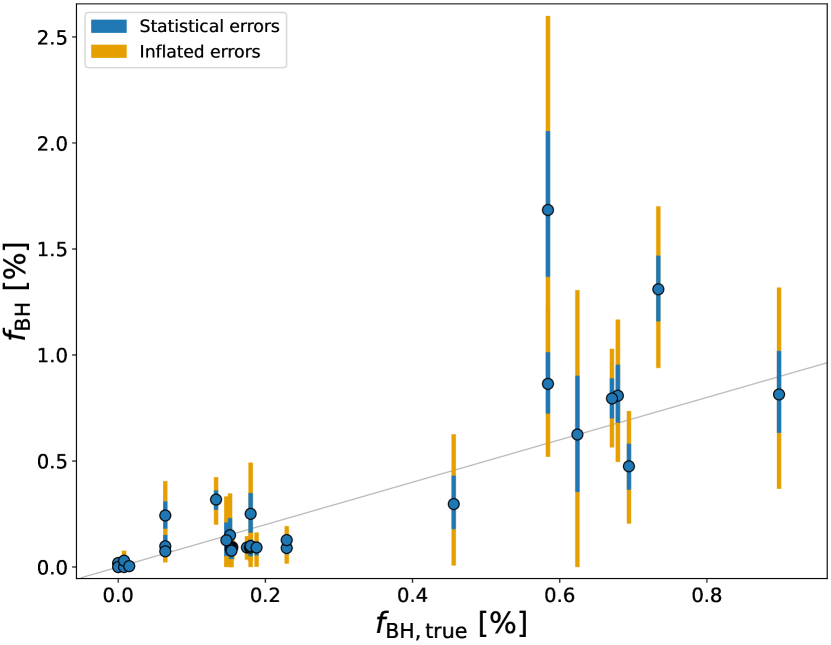
- 몬테카를로 군집 시뮬레이션에서 추출한 가짜 관측 자료를 사용해 모델링 프레임워크의 타당성을 검증하였으며, 어두운 질량 분포를 회복하는 데 있어 강건함을 입증하였다.
- 추론된 어두운 질량 분포를 바탕으로 블랙홀, 중성자별, 백색왜성의 기여를 분리하며, 블랙홀은 별도의 질량 중심 성분으로 모델링한다.
- 통계적 피팅 기법을 적용하여 모델 예측과 관측된 운동학적 및 구조적 자료 간의 일치를 도모하고, 모든 데이터셋에서 잔차를 최소화한다.
실험 결과
연구 질문
- RQ1연구된 34개의 은하수 병렬성 군집 각각에서 현존하는 블랙홀 질량 분율은 얼마인가?
- RQ2블랙홀의 존재는 질량 분리(δ 파라미터로 측정됨) 및 군집의 천체역학적 연령과 어떻게 관련되어 있는가?
- RQ3이전에 IMBH가 존재한다고 주장한 군집들에서 관측된 운동학적 및 구조적 자료는 실제로 중간질량 블랙홀(IMBHs)의 존재를 어느 정도 요구하는가?
- RQ4다른 방법론(예: 제인스 모델링, N-body/Monte Carlo 시뮬레이션)의 결과와 비교했을 때 추론된 BH 인구는 어떻게 다른가?
- RQ5총 잔여 질량 분율과 군집의 진화 상태, 특히 천체역학적 진화와 질량 분리의 관점에서 어떤 관계가 있는가?
주요 결과
- 은하수 병렬성 군집 대부분에서 추론된 블랙홀 질량 분율은 총 군집 질량의 0%에서 1% 사이이며, 오직 ω Cen만 약 5%의 질량 분율이 필요하다.
- BH 질량 분율과 δ 파라미터 사이에 명확한 반비례 관계가 발견되었으며, 이는 블랙홀 인구가 더 두드러진 군집에서는 가시성 있는 별들의 질량 분리 현상이 감소함을 시사한다.
- 본 샘플에서 가장 천체역학적으로 진화가 진행된 군집들은 약 70%까지 잔여 질량 분율(블랙홀, 중성자별, 백색왜성 포함)을 가지며, 이 중 블랙홀이 중요한 기여를 한다.
- 모델 결과는 다른 최근 연구들과 양호한 일치를 보였지만, 특히 작은 또는 큰 BH 인구를 가진 시스템에서 일부 상당한 이질성이 존재한다.
- 이전에 IMBH가 존재한다고 주장한 군집들에서는 중간질량 블랙홀에 대한 증거를 발견하지 못하였으며, 관측 자료는 별질량 블랙홀 인구만으로도 잘 설명된다.
- 모델의 사후 분포는 M15에서 총 BH 질량 약 80 M⊙(90% 신뢰구간 50–130 M⊙)을 나타내며, 이는 이전 추정과 일치하지만 일부 제인스 모델링 결과보다 약간 낮고, 일치하는 CMC 시뮬레이션 결과와도 부합한다.
더 나은 연구,지금 바로 시작하세요
논문 읽기부터 검토까지, 연구 시간을 획기적으로 줄여보세요.
카드 등록 없음 · 무료 플랜 제공
이 리뷰는 AI가 만들고, 인간 에디터가 검토했습니다.