
[논문 리뷰] NAPA: Intermediate-level Variational Native-pulse Ansatz for Variational Quantum Algorithms
NAPA는 NISQ 장치에서 게이트 분해에 의존하지 않고 펄스 진폭과 주파수를 직접 최적화함으로써 변량 양자 알고리즘을 위한 네이티브 펄스 앤사츠 생성기를 제안한다. 이로 인해 평균적으로 회로 지연 시간이 86% 감소하고, VQE 작업에서 최대 99.895%의 정확도를 달성한다. 비기울기 최적화기와 점진적 앤사츠 성장을 통해 하이르베르트 공간 탐색 능력과 노이즈에 대한 내성을 향상시킨다.
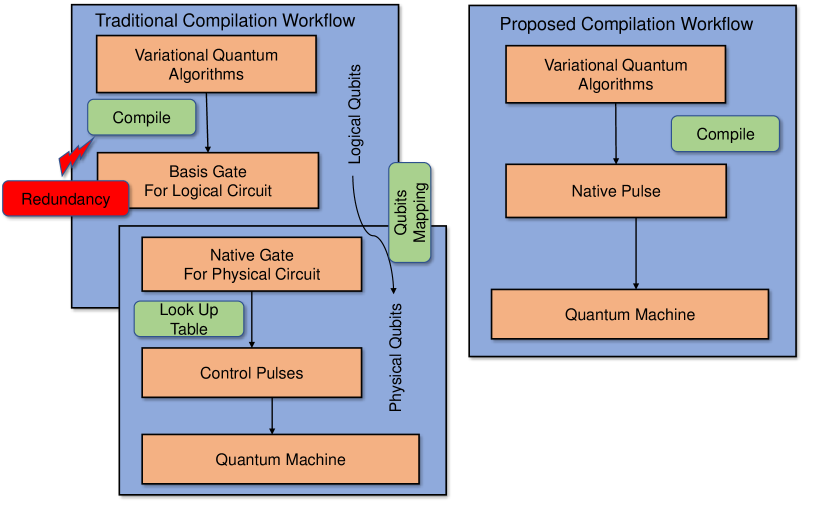
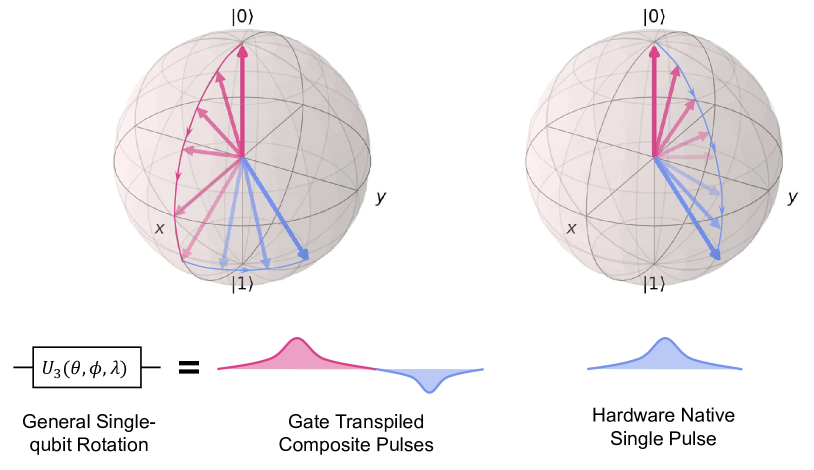
Variational quantum algorithms (VQAs) have demonstrated great potentials in the Noisy Intermediate Scale Quantum (NISQ) era. In the workflow of VQA, the parameters of ansatz are iteratively updated to approximate the desired quantum states. We have seen various efforts to draft better ansatz with less gates. Some works consider the physical meaning of the underlying circuits, while others adopt the ideas of neural architecture search (NAS) for ansatz generator. However, these designs do not exploit the full advantages of VQAs. Because most techniques target gate ansatz, and the parameters are usually rotation angles of the gates. In quantum computers, the gate ansatz will eventually be transformed into control signals such as microwave pulses on superconducting qubits. These control pulses need elaborate calibrations to minimize the errors such as over-rotation and under-rotation. In the case of VQAs, this procedure will introduce redundancy, but the variational properties of VQAs can naturally handle problems of over-rotation and under-rotation by updating the amplitude and frequency parameters. Therefore, we propose NAPA, a native-pulse ansatz generator framework for VQAs. We generate native-pulse ansatz with trainable parameters for amplitudes and frequencies. In our proposed NAPA, we are tuning parametric pulses, which are natively supported on NISQ computers. Given the limited availability of gradient-based optimizers for pulse-level quantum programs, we choose to deploy non-gradient optimizers in our framework. To constrain the number of parameters sent to the optimizer, we adopt a progressive way to generate our native-pulse ansatz. Experiments are conducted on both simulators and quantum devices for Variational Quantum Eigensolver (VQE) tasks to evaluate our methods.
연구 동기 및 목표
- NISQ 장치에서 게이트 기반 컴파일 과정으로 인해 발생하는 지연과 부족함을 해결하기 위해.
- 게이트 각도가 아닌 펄스 수준의 파rameter(진폭 및 주파수)를 직접 조정하여 VQA의 본질적 노이즈 내성 특성을 극대화하기 위해.
- 점진적 앤사츠 생성 전략을 통해 최적화기에 전송되는 파rameter 수를 줄이기 위해.
- 양자 화학 및 최적화 작업을 위한 실제 NISQ 하드웨어에서 성능 향상과 회로 지속 시간 단축을 입증하기 위해.
- 게이트 추상화 계층을 건너뛰고 펄스 수준 제어를 VQA 워크플로우에 직접 통합할 수 있도록 하기 위해.
제안 방법
- NISQ 하드웨어에서 훈련 가능한 진폭 및 주파수 파rameter를 직접 갖는 네이티브 펄스 앤사츠를 생성하는 NAPA 프레임워크를 제안한다.
- 펄스 수준 프로그램에 대해 기울기 기반 방법의 가용성이 제한되어 있어 비기울기 최적화기를 사용한다.
- 점진적 학습 전략을 통해 앤사츠를 점차적으로 확장함으로써 최적화 안정성과 하이르베르트 공간 커버리지 향상을 도모한다.
- 변량 파rameter를 초전도 큐비트의 마이크로파 펄스 제어 신호에 직접 매핑함으로써 게이트 분해 오버헤드를 제거한다.
- VQE 및 maxcut 작업을 위해 시뮬레이터와 실제 양자 장치(예: ibmq_montreal, ibmq_jakarta)에서 앤사츠를 검증한다.
- 에너지 분포 전역을 커버함을 보장하기 위해 에너지 경로의 변화를 확인하기 위해 펄스 딜루닝 실험을 수행한다.
실험 결과
연구 질문
- RQ1NISQ 장치에서 펄스 수준 파rameter(진폭 및 주파수)를 직접 최적화하는 것이 게이트 기반 앤사츠에 비해 VQA 성능과 지연 시간에서 뛰어난 성능을 보일 수 있는가?
- RQ2점진적 앤사츠 생성 전략은 펄스 기반 VQA에서 최적화 수렴성과 하이르베르트 공간 탐색 능력을 어떻게 향상시키는가?
- RQ3실제 하드웨어에서 양자 화학 및 최적화 작업을 수행할 때 네이티브 펄스 앤사츠는 회로 지속 시간을 얼마나 줄이고 정확도를 향상시킬 수 있는가?
- RQ4변량 학습을 통해 펄스 수준 조정이 NISQ 장치에서 과도한 로테이션 및 부족한 로테이션 오류를 자연스럽게 완화할 수 있는가?
- RQ5NAPA는 실제 노이즈 조건 하에서 다양한 VQA 응용 분야(예: VQE 및 maxcut)에 일반화될 수 있는가?
주요 결과
- NAPA는 게이트 기반 대비 NISQ 장치에서 평균적으로 86%의 회로 지연 시간 감소를 기록했다.
- H2 분자에 대해 NAPA는 VQE 작업에서 96.482%의 정확도를 달성했으며, HeH+는 99.336%의 정확도를 기록했다.
- 중간 크기의 양자 화학 작업(예: CO2, H2O, NaH)에서 NAPA는 평균 97.27%의 정확도를 달성했다.
- 3-정규 6노드 maxcut 문제에서 NAPA는 게이트 수준 TwoLocal 앤사츠에 비해 근사 비율을 3.4% 향상시켰다.
- 펄스 딜루닝 실험 결과, 에너지 추정치가 넓고 민감하게 변화함을 확인하여 하이르베르트 공간의 효과적 커버리지가 이루어졌음을 입증했다.
- 점진적 학습 전략은 FCI 에너지 값에서의 편차를 평균 약 40% 감소시켰으며, H2와 HeH+에 대해 각각 24% 및 48% 향상이 관찰되었다.
더 나은 연구,지금 바로 시작하세요
논문 읽기부터 검토까지, 연구 시간을 획기적으로 줄여보세요.
카드 등록 없음 · 무료 플랜 제공
이 리뷰는 AI가 만들고, 인간 에디터가 검토했습니다.