
[논문 리뷰] Near-Field Wideband Beamforming for Extremely Large Antenna Arrays
본 논문은 extremely large antenna arrays에서의 근거리-필드 wideband 빔 분할을 완화하기 위해 piecewise-far-field 채널 모델을 갖춘 위상 지연 포커싱(phase-delay focusing) 방법을 제안하고, 실용적인 근거리 필드 지표로서 'effective Rayleigh distance'를 도입한다.
The natural integration of extremely large antenna arrays (ELAAs) and terahertz (THz) communications can potentially achieve Tbps data rates in 6G networks. However, due to the extremely large array aperture and wide bandwidth, a new phenomenon called "near-field beam split" emerges. This phenomenon causes beams at different frequencies to focus on distinct physical locations, leading to a significant gain loss of beamforming. To address this challenging problem, we first harness a piecewise-far-field channel model to approximate the complicated near-field wideband channel. In this model, the entire large array is partitioned into several small sub-arrays. While the wireless channel's phase discrepancy across the entire array is modeled as near-field spherical, the phase discrepancy within each sub-array is approximated as far-field planar. Built on this approximation, a phase-delay focusing (PDF) method employing delay phase precoding (DPP) architecture is proposed. Our PDF method could compensate for the intra-array far-field phase discrepancy and the inter-array near-field phase discrepancy via the joint control of phase shifters and time delayers, respectively. Theoretical and numerical results are provided to demonstrate the efficiency of the proposed PDF method in mitigating the near-field beam split effect.Finally, we define and derive a novel metric termed the "effective Rayleigh distance" by the evaluation of beamforming gain loss. Compared to classical Rayleigh distance, the effective Rayleigh distance is more accurate in determining the near-field range for practical communications.
연구 동기 및 목표
- beam split로 인한 ELAA-THz wideband 시스템의 근거리-필드 빔포밍 문제를 자극한다.
- 대형 어레이를 부분 어레이로 분할하여 간섭-및 군집 내 위상 효과를 구분하는 tractable한 채널 모델을 제안한다.
- 위상 시프터와 시간 지연을 이용한 PDF 방법을 개발하여 far-field intra-array 간 간섭과 near-field inter-array 차이를 보상한다.
- 실용적인 근거리 경계로서 효과적인 Rayleigh distance를 도출하고 대역폭에 걸친 빔포밍 이득을 분석한다.
제안 방법
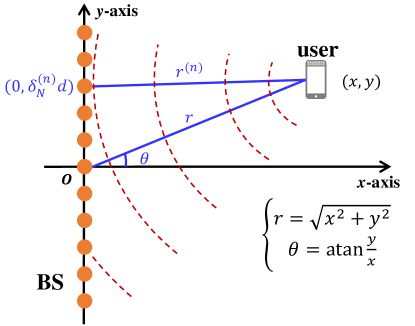
- ELAA를 P개의 안테나를 가진 K개의 부분 어레이로 분할하여 piecewise-far-field 채널 모델을 도입한다.
- 채널 위상을 inter-array의 near-field와 intra-array의 far-field 구성요소로 분해하여 빔 분할의 지배 소스를 식별한다.
- 인터-어레이 위상 보상을 위해 시간지연을 갖춘 delay-phase precoding(DPP) 아키텍처를 적용하고, intra-array 위상 정렬을 위해 phase shifter를 사용한다.
- 특정 조건하에서 r_k' = L - r_k를 만족시키며 대역폭 전반에 걸친 빔포밍 이득를 최대화하도록 하게 하는 서브캐리어들 간의 대역폭 넓은 이득을 최적화하는 문제를 수식화하고 해를 구한다.
- Xi_P Dirichlet sinc 함수들을 이용한 빔포밍 이득 표현을 도출하고 대역폭에 따른 이론적 이득 손실 bounds를 제공한다.
실험 결과
연구 질문
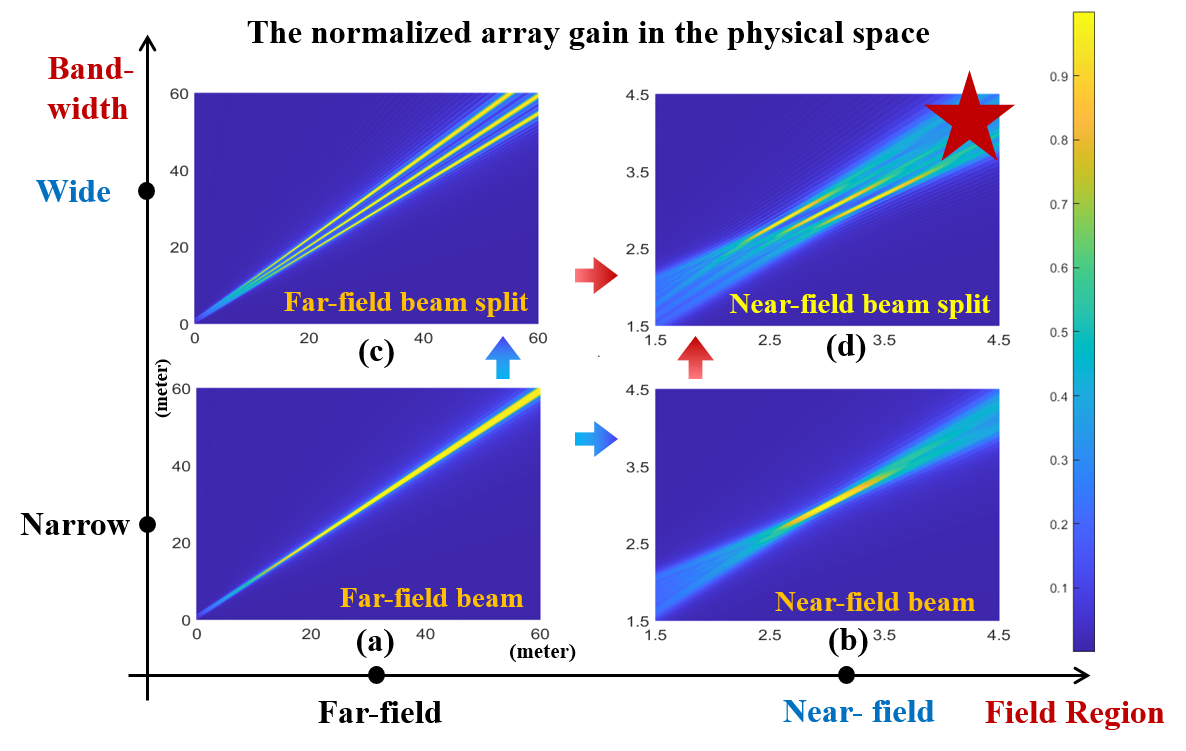
- RQ1극소(near-field) 빔 분할이 극대 배열에서 넓은 대역폭에서 어떻게 나타나는가?
- RQ2piecewise-far-field 모델이 ELAA의 근거리-필드 wideband 채널을 근사적으로 정확하게 표현할 수 있는가?
- RQ3PS와 TD 구성요소를 갖춘 phase-delay focusing이 서브캐리어들 간의 근거리 빔 분할을 어떻게 완화하는가?
- RQ4제안된 PDF 방법이 대역폭 전체에 걸친 평균 빔포밍 이득에 어떤 영향을 미치는가?
- RQ5실용적인 ELAA 기반 통신을 위한 근거리 영역 정의에 적합한 지표는 무엇인가?
주요 결과
- 근거리-필드 빔 분할은 서로 다른 주파수의 빔이 서로 다른 위치를 초점으로 삼게 하여 중심 주파수에서 벗어난 위치에서 이득을 감소시킨다.
- 부분 어레이로 배열을 나누어 근거리-필드 채널을 근사하면 inter-와 intra-array 위상 차이를 각각 독립적으로 처리할 수 있어 근거리-필드의 빔 분할을 완화한다.
- PS 기반 서브어레이와 TD 요소를 갖춘 PDF 방법은 주파수 전반에 걸쳐 inter-array 위상을 보상하고 높은 빔포밍 이득을 유지시킨다.
- 적절한 조건에서 TD 기반 거리 매개변수 r_k'는 r_k' = L - r_k로 설정하여 서브캐리어별 빔포밍 이득을 최대로 할 수 있다.
- 해석적 결과는 대역폭, 기하학, 어레이 크기와 연계된 평균 빔포밍 이득 손실 계수를 wideband 손실 gamma(B,f_c,P)와 기하 손실 xi(r,theta,D)의 곱으로 설명할 수 있음을 보인다.
더 나은 연구,지금 바로 시작하세요
논문 읽기부터 검토까지, 연구 시간을 획기적으로 줄여보세요.
카드 등록 없음 · 무료 플랜 제공
이 리뷰는 AI가 만들고, 인간 에디터가 검토했습니다.