
[논문 리뷰] Non-Coplanar Magnetic Orders in Classical Square-Kagome Antiferromagnets
이 논문은 정사각형-카가메 격자에서의 고전적 헤이젠베르크 모델에 대한 비공면 자성 순서를 조사하여 광범위한 디세너지, 순서에 의한 질서 효과, 그리고 비공면 스핀 나선과 편향 상태를 포함하는 풍부한 상도도를 밝혀냈다. 광범위한 수치적 시뮬레이션을 통해 다단계 특성열 비정상성과 같은 주요 열역학적 서명을 규명하였으며, 비공면 순서의 대칭 기반 분류를 제공하여 S=1/2 시스템에서의 양자 유사체인 편향 스핀 액체와 스핀 네마틱의 기초를 마련하였다.
Motivated by the recent synthesis of a number of Mott insulating square-kagome materials, we explore the rich phenomenology of frustrated magnetism induced by this lattice geometry, also referred to as the squagome or shuriken lattice. On the classical level, square-kagome antiferromagnets are found to exhibit extensive degeneracies, order-by-disorder, and non-coplanar ordering tendencies, which we discuss for an elementary, classical Heisenberg model with nearest-neighbor and cross-plaquette interactions. Having in mind that upon introducing quantum fluctuations non-coplanar order can melt into chiral quantum spin liquids, we provide detailed information on the multitude of non-coplanar orders, including some which break rotational symmetry (possibly leading to nematic quantum orders), as well as a number of (incommensurate) spin spiral phases. Using extensive numerical simulations, we also discuss the thermodynamic signatures of these phases, which often show multi-step thermal ordering. Our comprehensive discussion of the classical square-kagome Heisenberg model, often drawing comparisons to the conventional kagome antiferromagnet, sets the stage for future explorations of quantum analogs of the various phases, either conceptually such as in quantum spin-1/2 generalizations of our model or experimentally such as in the Cu-based candidate materials.
연구 동기 및 목표
- 정사각형-카가메 헤이젠베르크 반자성체의 고전적 자성 상도도를 최근접 이웃 상호작용과 플라켓을 가로질러서 일어나는 상호작용를 포함하여 체계적으로 탐색하기.
- 대칭 분석을 이용하여 비공면 자성 순서, 특히 편향 및 네마틱 상태를 식별하고 분류하기.
- 다단계 특성열 전이와 엔트로피 플랫폼과 같은 열역학적 서명을 특성화하기.
- 저스핀 시스템에서의 양자 유사체, 즉 편향 스핀 액체와 스핀 네마틱을 이해하기 위한 기초 마련하기.
- 화학적 경로를 통해 플라켓을 가로질러서 일어나는 상호작용을 강화함으로써 재료 합성에 도움을 주기.
- method
제안 방법
- 주기적 경계 조건을 가진 유한 크기의 정사각형-카가메 격자에서 몬테카를로 및 히트백 알고리즘을 사용한 수치적 시뮬레이션.
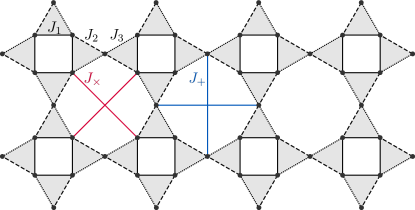
- 최근접 이웃 상호작용 J+와 대각선 방향의 플라켓 간 상호작용 J×를 포함하는 고전적 헤이젠베르크 해밀토니안의 구현.
- 열역학적 관측량 계산: 특성열, 스칼라 스핀 편향, 및 구조 인자로서 비공면 질서를 탐지.
- 비공면 상태를 분류하기 위한 스핀 구조의 대칭 분석, 시간 역전 위반 및 네마틱 순서 매개변수 포함.
- 순서 매개변수 분석 및 유한 크기 스케일링을 통한 상전이 및 교차 행동 식별.
- 기존의 카가메 격자와의 비교를 통해 정사각형-카가메 기하학의 고유한 특징을 부각하기.
- research_questions
실험 결과
연구 질문
- RQ1크로스-플라켓 상호작용를 포함하는 고전적 정사각형-카가메 헤이젠베르크 모델에서 어떤 종류의 비공면 자성 순서가 나타나는가?
- RQ2특성열 비정상성과 같은 열역학적 서명은 서로 다른 자성 상을 어떻게 구분하는가?
- RQ3어떤 비공면 상태가 회전 대칭을 위반하며, 양자화 시 편향 및 네마틱 양자 스핀 액체로 이어질 수 있는가?
- RQ4정사각형-카가메 격자와 기존의 카가메 격자의 상도도는 디세너지와 순서에 의한 질서 효과 측면에서 어떻게 다를까?
- RQ5어떤 화학적 수정이 플라켓을 가로질러서 일어나는 상호작용을 강화하여 실제 물질에서 편향 스핀 액체 상을 안정화시키는가?
주요 결과
- 모델은 광범위한 고전적 디세너지와 순서에 의한 질서 효과를 보이며, 고전적 한계에서 장거리 질서가 없음에도 불구하고 비공면 스핀 구조를 안정화시킨다.
- 우산 모양의 이중 콘 상태와 같은 다양한 비공면 상태가 식별되었으며, 이는 반자성과 8각형 질서 사이를 연결하는 상태로, 유한한 스칼라 스핀 편향을 가진다.
- 비공면 스핀 나선 상이 발견되었으며, 이는 변형된 구조 인자와 특징적인 특성열 비정상성으로 특징지어진다.
- 열역학적 서명으로는 다단계 특성열 피크가 있으며, 이는 순차적인 질서 전이를 나타내며, 협동적 패라자성 상을 암시하는 엔트로피 플랫폼이 포함된다.
- 대칭 분석 결과, 일부 비공면 상태는 시간 역전 대칭과 회전 대칭을 위반하며, S=1/2 시스템에서 편향 및 네마틱 양자 스핀 액체로 이어질 가능성이 있다.
- Na를 Cs로 대체하거나 SO₄²⁻를 SeO₄²⁻로 대체하는 등의 화학적 경로를 통해 J× 상호작용을 강화할 수 있으며, 이는 후보 물질에서 편향 질서를 촉진할 것이다.
![Figure 2: The nearest-neighbor model. (a) Zero-temperature phase diagram as a function of nearest-neighbor couplings $J_{2}$ and $J_{3}$ , reproduced from Ref. [ 26 ] . (b) Specific heat traces for three representative points along the $J_{2}=J_{3}$ diagonal in the phase diagram of panel (a). The on](https://ar5iv.labs.arxiv.org/html/2302.04171/assets/x2.png)
더 나은 연구,지금 바로 시작하세요
논문 읽기부터 검토까지, 연구 시간을 획기적으로 줄여보세요.
카드 등록 없음 · 무료 플랜 제공
이 리뷰는 AI가 만들고, 인간 에디터가 검토했습니다.