
[논문 리뷰] Observational Signatures of Supermassive Black Hole Binaries
이 챕터는 sub-parsec 초대질량 블랙홀 이진(SMBHB)을 식별하기 위한 전자기 관측 방법을 개관하고, 매크로 규모의 증거와 시그니처를 검토하며, 시간도메인 설문과 중력파 탐지기를 포함한 향후 전망에 대해 논의한다.
Despite solid theoretical and observational grounds for the pairing of supermassive black holes (SMBHs) after galaxy mergers, definitive evidence for the existence of close (sub-parsec) separation SMBH binaries (SMBHBs) approaching merger is yet to be found. This chapter reviews techniques aimed at discovering such SMBHBs in galactic nuclei. We motivate the search with a brief overview of SMBHB formation and evolution, and the gaps in our present-day theoretical understanding. We then present existing observational evidence for SMBHBs and discuss ongoing efforts to provide definitive evidence for a population at sub-parsec orbital separations, where many of the aforementioned theoretical gaps lie. We conclude with future prospects for discovery with electromagnetic (primarily time-domain) surveys, high-resolution imaging experiments, and low-frequency gravitational-wave detectors.
연구 동기 및 목표
- Close SMBHBs 탐색의 동기를 부여하고 현재 이론의 간극을 개관한다.
- 다양한 규모에서 SMBHB에 대한 기존 관측 증거를 요약한다.
- 전자기 식별 기법의 장단점을 평가하고 비교한다.
- SMBHB 인구 예측을 관측 가능한 시그니처 및 설문 전략과 연결한다.
- 다가오는 EM 및 GW 시설의 향후 전망을 개관한다.
제안 방법
- EM-밝힌 SMBHB와 퀘이사 인구를 연결하는 연속성 프레임워크(Eq. 2–3)를 통해 SMBHB 인구를 모델링한다.
- 퀘이사의 광도를 분포(=축적율 분포)로 연결하여 이진 질량과의 관계를 설명한다(Eq. 3).
- 관측 가능한 SMBHB 분율에 대한 간단한 거주 시간 기반 추정치를 도출한다(Eq. 6).
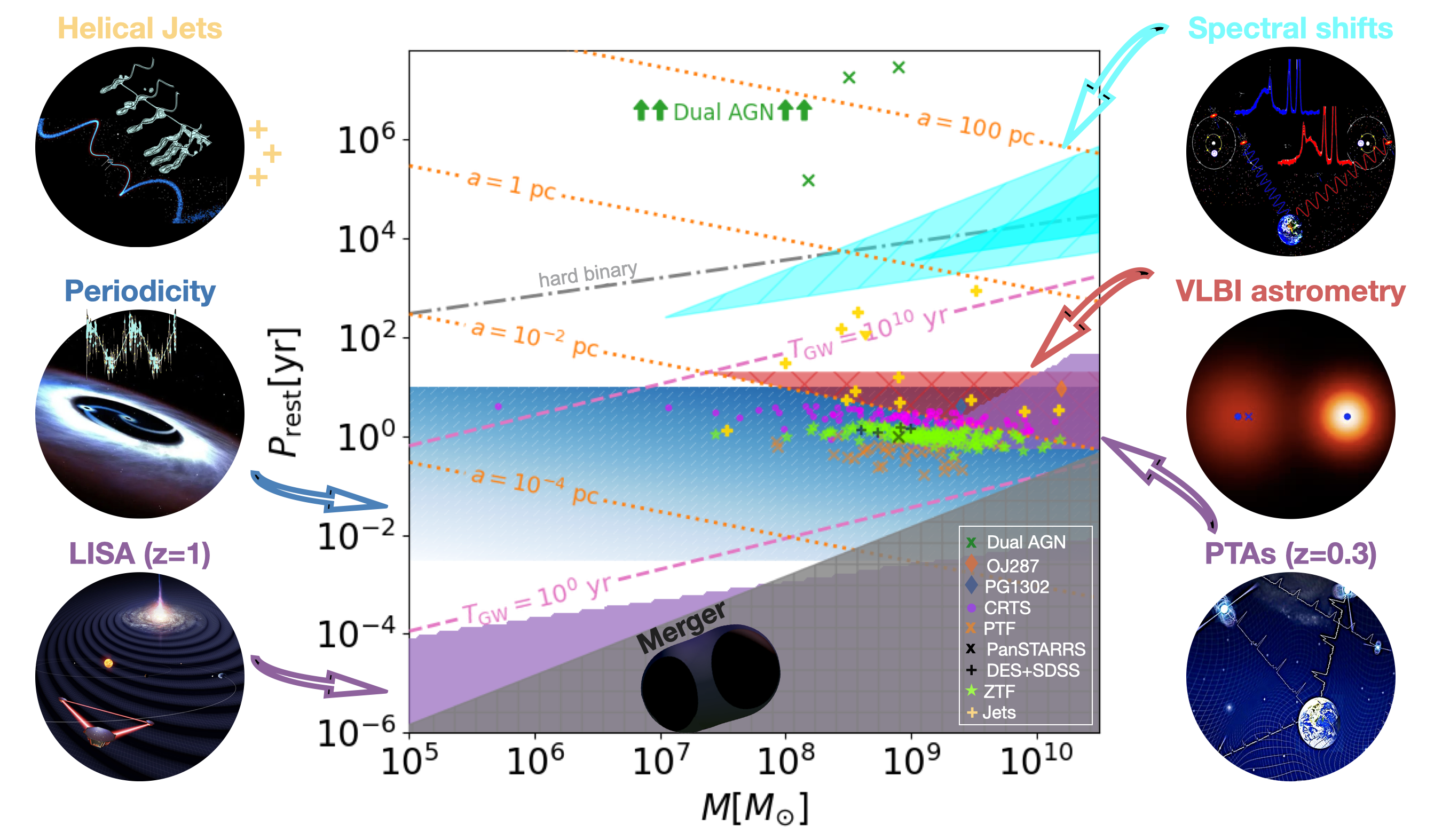
- 두 개의 AGN, 코어드 엘립셀(Gcore Ellipticals)에서의 특징, 분광 특성, 시간 도메인 신호 등 스케일 전반의 관측 시그니처를 논의한다.
- 킬로파섹에서 파섹 스케일 접근법, 분광선 분석, 직접 영상화/측천 측정 등 탐지 방법을 기술하고 비교한다.
- 향후 관측 경로(예: LSST, Roman, ngVLA, EHT, GRAVITY+)를 SMBHB 발견에 중점적으로 제시한다.
실험 결과
연구 질문
- RQ1다른 규모에서 SMBHB로서 보편적이고 고유하게 식별될 수 있는 관측 시그니처는 무엇인가?
- RQ2전자기 설문이 SMBHB 인구와 궤도 감소 과정을 어떻게 제약할 수 있는가?
- RQ3주기가, 질량, 적색편이에 따라 SMBHB를 호스트하는 퀘이사의 기대 분율은 얼마인가?
- RQ4거대 규모(듀얼 AGN, 코어드 엘립셀) 대 미시 규모(스펙트럴, 광변이, 위치측정, 제트 기반) SMBHB 탐색 방법의 상대적 강점과 한계는 무엇인가?
- RQ5다가오는 EM 및 GW 설비가 서브-파섹 SMBHB의 확정 탐지를 어떻게 개선할 것인가?
주요 결과
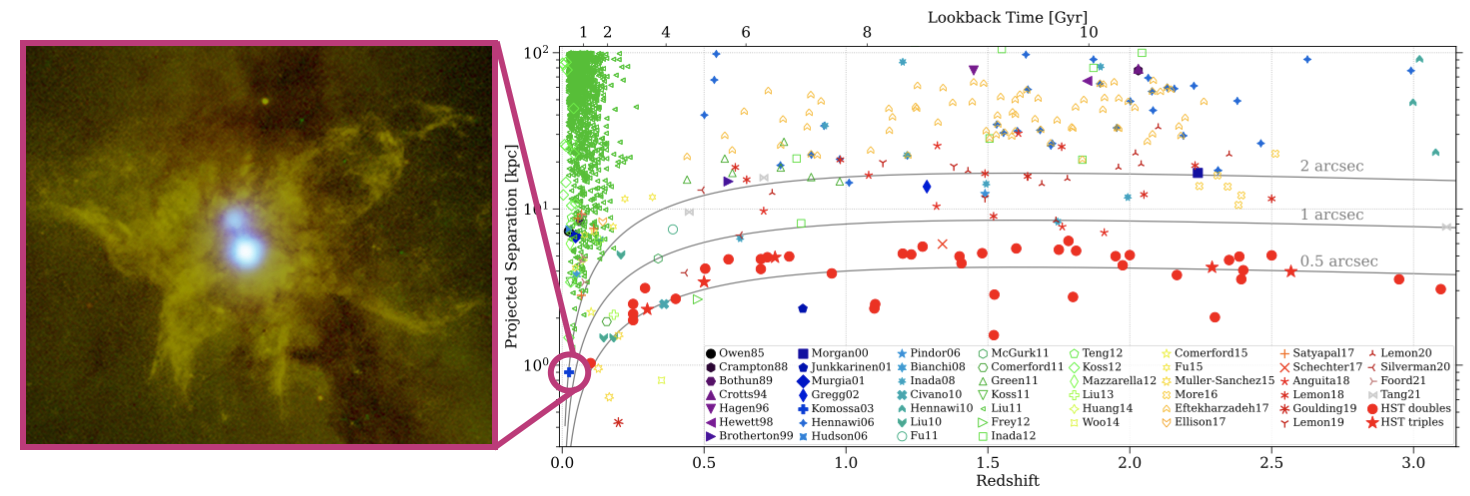
- 수십 개의 듀얼 AGN이 여러 파장대에서 관찰되었고, 고해상도 영상화 및 IFU 분광학으로 확인되었다.
- 코어드 엘립셀은 이진 스케어링 시나리오와 일치하는 질량 결손 및 코어 특성을 보인다.
- VLBI는 로컬 우주에서 약 10 pc까지 듀얼 AGN을 해상하며, X-선 및 광학 방법은 더 넓지만 얕은 설문을 제공한다.
- 직접 궤도 추적은 몇 개의 근거리 시스템에서만 가능하며(예: 기록적인 7.3 pc 간격), 관측 한계가 존재한다.
- 합성 인구 모델링은 SMBHB를 퀘이사 인구에 연결하고, 거주 시간과 퀘이사 수명(Eq. 6)을 통해 SMBHB 분율의 추정을 가능하게 한다.
- 최종-parsec 문제는 서브 파섹 분리에서 SMBHB에 대한 결정적 증거와 상세한 환경 상호작용의 필요성으로 재구성되고 있다.
더 나은 연구,지금 바로 시작하세요
연구 설계부터 논문 작성까지, 연구 시간을 획기적으로 줄여보세요.
카드 등록 없음 · 무료 플랜 제공
이 리뷰는 AI가 만들고, 인간 에디터가 검토했습니다.