
[논문 리뷰] On-chip quantum interference between independent lithium niobate-on-insulator photon-pair sources
이 논문은 주기적으로 폴링된 산화물 위의 리튬니오브산나트륨(LNOI) 웨이브가이드 기반의 독립적인 광자 쌍 소스 간의 칩 내 양자 간섭을 실험적으로 구현한다. 고빛기 밝기의 SPDC 소스와 프로그래머블 맥스-지너 간섭계를 통합함으로써, 저자들은 96.8(3.6)%의 시야도를 달성한 양자 간섭을 구현하였으며, 이는 높은 일치성과 밝기를 갖춘 확장 가능한 칩 통합 양자 광학 회로를 가능하게 한다.
Generating and interfering non-classical states of light is fundamental to optical quantum information science and technology. Quantum photonic integrated circuits provide one pathway towards scalability by combining nonlinear sources of non-classical light and programmable circuits in centimeter-scale devices. The key requirements for quantum applications include efficient generation of indistinguishable photon-pairs and high-visibility programmable quantum interference. Here, we demonstrate a lithium niobate-on-insulator (LNOI) integrated photonic circuit that generates a two-photon path-entangled state, and a programmable interferometer for quantum interference. We generate entangled photons with $\sim2.3 imes10^8$ pairs/s/mW brightness and perform quantum interference experiments on the chip with $96.8\pm3.6\%$ visibility. LNOI is an emerging photonics technology that has revolutionized high-speed modulators and efficient frequency conversion. Our results provide a path towards large-scale integrated quantum photonics including efficient photon-pair generation and programmable circuits for applications such as boson sampling and quantum communications.
연구 동기 및 목표
- 고빛기 밝기의 광자 쌍 생성과 프로그래머블 양자 간섭을 조합하여 확장 가능한 칩 통합 양자 광학 회로를 가능하게 하기.
- 실리콘 및 실리콘 카바이드 플랫폼의 한계를 극복하기 위해 리튬니오브산나트륨-온-인슐레이터(LNOI)의 강력한 비선형성과 전기광학 성질을 활용하기.
- 독립적으로 생성된 광자들 간의 높은 시야도 간섭을 칩 내 간섭계를 통해 실현함으로써, 보존 샘플링 및 양자 통신에서의 양자 우위를 위한 핵심 조건을 충족하기.
- LNOI 기술이 단일 통합 플랫폼에서 효율적인 광자 쌍 생성과 고정밀도 양자 간섭을 동시에 지원할 수 있음을 실험적으로 입증하기.
제안 방법
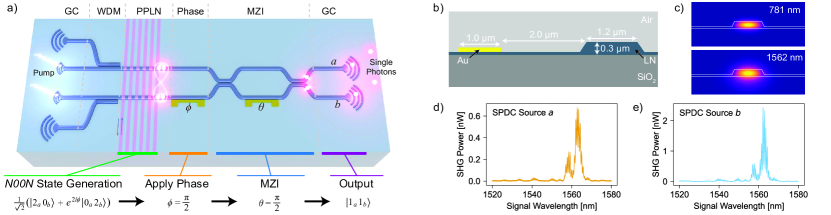
- 칩은 자발적 파라메트릭 다운컨버전(SPDC)을 위한 두 개의 동일한 주기적 폴링된 LNOI 웨이브가이드를 통합하여 경로 entangled N00N 상태를 생성한다.
- 열광학적 위상 시프터를 갖춘 맥스-지너 간섭계(MZI)는 두 출력 모드 간의 조절 가능한 양자 간섭을 가능하게 한다.
- 광자 쌍 생성은 781 nm 파장의 펌프 레이저에 의해 유도되며, 유형-II 위상 일치 조건을 통해 1562 nm 파장의 상관 관계를 갖는 광자 쌍을 생성한다.
- 칩 내 밝기는 약 ~2.3×10⁸ 쌍/s/mW로 측정되었으며, 일반적인 부피 SPDC 소스보다 뚜렷이 높다.
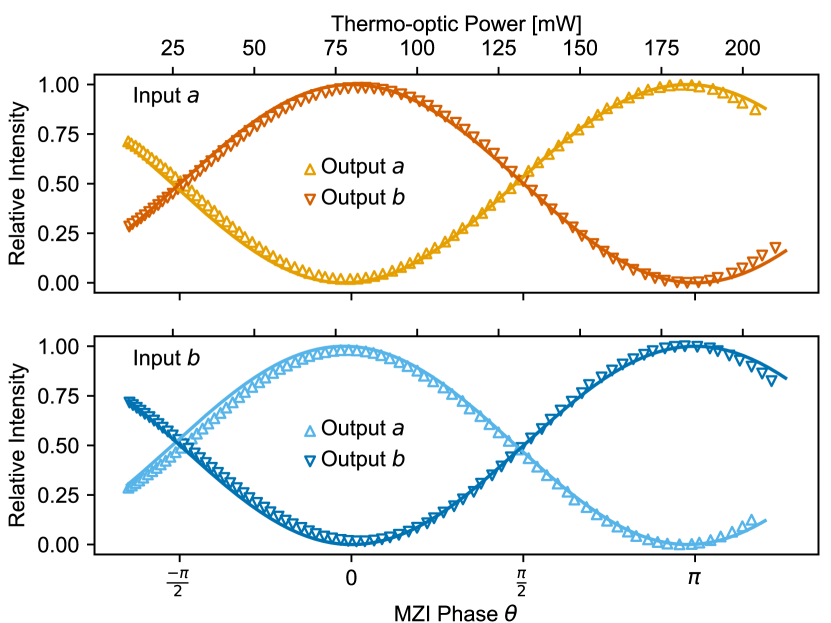
- 양자 간섭의 시야도는 N00N 상태와 MZI의 제어된 위상 스윕을 통해 측정되었으며, 출력 상태는 단일 광자 탐지기로 측정되었다.
- 칩 외부에서의 홍-오우-만드(Hong-Ou-Mandel, HOM) 실험을 통해 광자의 일치성을 검증하였으며, 83.2±0.1%의 시야도와 71.9(0.5) fs의 딤프 폭을 측정하였다.
실험 결과
연구 질문
- RQ1독립적인 LNOI 기반 칩 내 광자 쌍 소스가 고시야도의 양자 간섭을 달성할 수 있는가?
- RQ2주기적 폴링된 LNOI 웨이브가이드에서 SPDC 소스의 칩 내 밝기는 얼마인가?
- RQ3단일 LNOI 칩에서 고효율 광자 쌍 생성과 프로그래머블 간섭계를 통한 양자 간섭을 통합할 수 있는가?
- RQ4칩 내 간섭의 시야도는 광자의 일치성을 측정하는 칩 외부 HOM 측정과 비교하여 어떻게 다른가?
- RQ5LNOI 기술이 근접한 양자 우위를 위한 확장 가능한 통합 양자 광학 회로를 얼마나 잘 지원할 수 있는가?
주요 결과
- 독립적으로 생성된 광자들 간의 칩 내 양자 간섭에서 96.8(3.6)%의 높은 시야도를 달성하여 높은 일치성을 입증하였다.
- 칩 내 광자 쌍 밝기는 약 ~2.3×10⁸ 쌍/s/mW에 도달하였으며, 일반적인 자유공간 SPDC 소스(예: ppKTP 기반 소스 포함)를 뛰어넘었다.
- 홍-오우-만드 실험을 통해 광자의 일치성을 확인하였으며, 83.2±0.1%의 시야도를 측정하였으며, 이는 광섬유 비트 스플리터의 대역폭에 의해 제한되었다.
- 광섬유 커플링 이후 광자의 스펙트럼 대역폭은 약 ~50 nm로 추정되었으며, 이는 71.9(0.5) fs의 HOM 딤프 폭과 일치하였다.
- 측정된 시야도는 칩 내 간섭보다 낮았으며, 이는 제한된 대역폭과 칩 외부 구성 요소의 정렬 오차에 기인한 것으로 분석되었다.
- SPDC 소스와 프로그래머블 간섭계를 단일 LNOI 칩에 통합함으로써, 보존 샘플링 및 양자 미세측정과 같은 양자 정보 작업을 위한 확장 가능한 플랫폼을 제공하였다.
더 나은 연구,지금 바로 시작하세요
논문 읽기부터 검토까지, 연구 시간을 획기적으로 줄여보세요.
카드 등록 없음 · 무료 플랜 제공
이 리뷰는 AI가 만들고, 인간 에디터가 검토했습니다.