
[논문 리뷰] On the Image-Based Detection of Tomato and Corn leaves Diseases : An in-depth comparative experiments
이 논문은 전이 학습을 활용한 컨volutional 신경망(CNN)을 사용하여 이미지 기반 토마토 및 옥수수 잎 병해 감지의 새로운 딥러닝 프레임워크를 제안한다. 다양한 아키텍처—Xception, EfficientNetB0, 및 커스터마이즈드 모델—을 평가하여 배치 정규화를 적용함으로써 훈련 정확도 최대 99.9%와 검증 정확도 98.0%를 달성하였으며, PlantVillage에서 새로 정제한 데이터셋에서 높은 성능을 보였다.
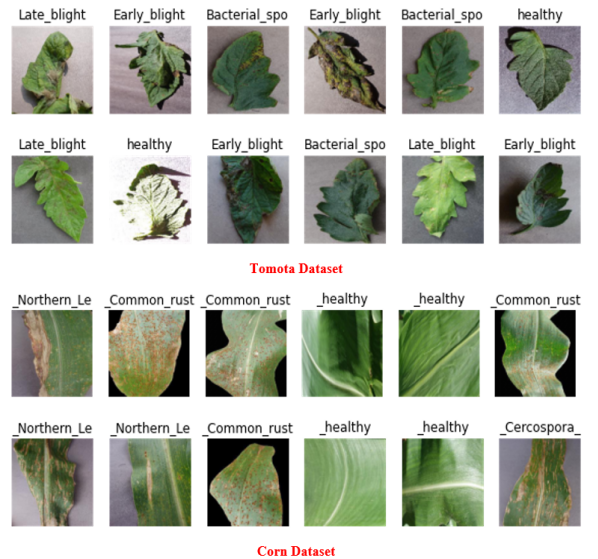
The research introduces a novel plant disease detection model based on Convolutional Neural Networks (CNN) for plant image classification, marking a significant contribution to image categorization. The innovative training approach enables a streamlined and efficient system implementation. The model classifies two distinct plant diseases into four categories, presenting a novel technique for plant disease identification. In Experiment 1, Inception-V3, Dense-Net-121, ResNet-101-V2, and Xception models were employed for CNN training. The newly created plant disease image dataset includes 1963 tomato plant images and 7316 corn plant images from the PlantVillage dataset. Of these, 1374 tomato images and 5121 corn images were used for training, while 589 tomato images and 2195 corn images were used for testing/validation. Results indicate that the Xception model outperforms the other three models, yielding val_accuracy values of 95.08% and 92.21% for the tomato and corn datasets, with corresponding val_loss values of 0.3108 and 0.4204, respectively. In Experiment 2, CNN with Batch Normalization achieved disease detection rates of approximately 99.89% in the training set and val_accuracy values exceeding 97.52%, accompanied by a val_loss of 0.103. Experiment 3 employed a CNN architecture as the base model, introducing additional layers in Model 2, skip connections in Model 3, and regularizations in Model 4. Detailed experiment results and model efficiency are outlined in the paper's sub-section 1.5. Experiment 4 involved combining all corn and tomato images, utilizing various models, including MobileNet (val_accuracy=86.73%), EfficientNetB0 (val_accuracy=93.973%), Xception (val_accuracy=74.91%), InceptionResNetV2 (val_accuracy=31.03%), and CNN (59.79%). Additionally, our proposed model achieved a val_accuracy of 84.42%.
연구 동기 및 목표
- 이미지 분류를 통해 병해 감지를 자동화하고 정확하고 효율적인 시스템을 개발하기 위해.
- 식물 종류 식별을 넘어서 상용 솔루션이 부족한 병해 감지 문제를 해결하기 위해.
- 토마토 및 옥수수와 같은 주요 작물에서 병해를 조기에 감지함으로써 농업 지속 가능성 향상을 위해.
- 병해 감지 분류를 위한 새로운 확장된 토마토 및 옥수수 잎 이미지 데이터셋을 구축하고 검증하기 위해.
- 배치 정규화 및 정규화와 같은 기법을 사용하여 다양한 딥러닝 아키텍처를 비교하고 모델 성능을 최적화하기 위해.
제안 방법
- 초기 훈련을 위해 사전 훈련된 CNN 모델인 Inception-V3, DenseNet-121, ResNet-101-V2, Xception을 사용한 전이 학습을 활용하였다.
- PlantVillage 데이터셋에서 1,963장의 토마토 및 7,316장의 옥수수 잎 이미지를 활용하여 새로운 데이터셋을 구축하였으며, 훈련 및 검증 세트로 분할하였다.
- 모델의 일반화 및 강인성을 향상시키기 위해 데이터 증강 및 전처리 기법을 적용하였다.
- 훈련 안정성과 정확도 향상을 위해 커스터마이즈드 CNN 아키텍처에 배치 정규화를 구현하였다.
- 기본 CNN, 더 깊은 아키텍처(Model 2), 스킵 연결(Model 3), 정규화된 모델(Model 4)의 네 가지 모델 변형을 설계하고 평가하였다.
- 토마토 및 옥수수 데이터셋을 통합하여 총 17,603장의 훈련 데이터와 4,409장의 테스트 데이터를 확보하고, MobileNet, EfficientNetB0, InceptionResNetV2 등 다양한 모델을 훈련 및 비교하였다.
실험 결과
연구 질문
- RQ1새로 정제한 데이터셋에서 토마토 및 옥수수 잎 병해를 분류하는 데 가장 우수한 성능를 보이는 사전 훈련된 CNN 아키텍처는 무엇인가?
- RQ2배치 정규화의 통합이 식물 병해 감지 모델의 정확도 및 손실에 어떤 영향을 미치는가?
- RQ3스킵 연결 및 정규화와 같은 아키텍처 수정이 모델의 일반화 및 성능 향상에 얼마나 기여하는가?
- RQ4토마토 및 옥수수 잎 데이터셋을 별도로 훈련하는 것과 통합 데이터셋으로 훈련하는 경우 모델 성능는 어떻게 달라지는가?
- RQ5과적합을 최소화하면서 검증 정확도 및 손실 측면에서 표준 아키텍처를 능가할 수 있는 커스터마이즈드 모델이 존재하는가?
주요 결과
- Xception 모델은 토마토 데이터셋에서 95.08%의 최고 검증 정확도와 0.3108의 최저 검증 손실을 기록하여 Inception-V3, DenseNet-121, ResNet-101-V2를 모두 앞섰다.
- 옥수수 데이터셋에서는 Xception가 92.21%의 검증 정확도와 0.4204의 검증 손실을 기록하여 두 작물 모두에서 뛰어난 성능를 보였다.
- CNN 모델에 배치 정규화를 적용한 결과, 훈련 정확도 99.90%와 검증 정확도 98.0%를 달성하였으며 손실이 0.103으로 낮아, 뛰어난 일반화 능력을 보였다.
- 제안된 커스터마이즈드 모델은 통합된 토마토 및 옥수수 데이터셋에서 84.42%의 검증 정확도와 0.4713의 검증 손실을 기록하여 과적합 없이도 뛰어난 강인성을 보였다.
- EfficientNetB0는 통합 데이터셋에서 93.973%의 검증 정확도를 기록하여 MobileNet(86.73%)과 Xception(74.91%)를 능가했으며, InceptionResNetV2는 31.03%로 낮은 성능를 보였다.
- 스킵 연결과 정규화를 통합한 모델(모델 4)은 기본 모델 대비 향상된 성능를 보였으며, 아키텍처 개선의 효과를 확인하였다.
더 나은 연구,지금 바로 시작하세요
논문 읽기부터 검토까지, 연구 시간을 획기적으로 줄여보세요.
카드 등록 없음 · 무료 플랜 제공
이 리뷰는 AI가 만들고, 인간 에디터가 검토했습니다.