
[논문 리뷰] Origin and magnitude of 'designer' spin-orbit interaction in graphene on semiconducting transition metal dichalcogenides
이 논문은 반도체 전이 금속 디칼코제나이드(TMD) 위의 그래핀에서 초강력하고 내구성 있으며, 인터페이스에 의해 유도되는 스핀-오비트 상호작용(SOI)이 관찰되며, 스핀 회복 시간이 약 ~0.2 ps로 매우 짧다는 것을 보여준다. 이 SOI는 불순물에 기인하는 것이 아니라 밴드 구조의 변화에 기인하며, ~10 meV의 분리가 관측되는 게이트 조절 가능 Shubnikov-de Haas 진동을 통해 확인된다. 이에 따라 그래핀/TMD는 스핀-홀 및 밴드-홀 효과를 실현하기 위한 유망한 플랫폼이 된다.
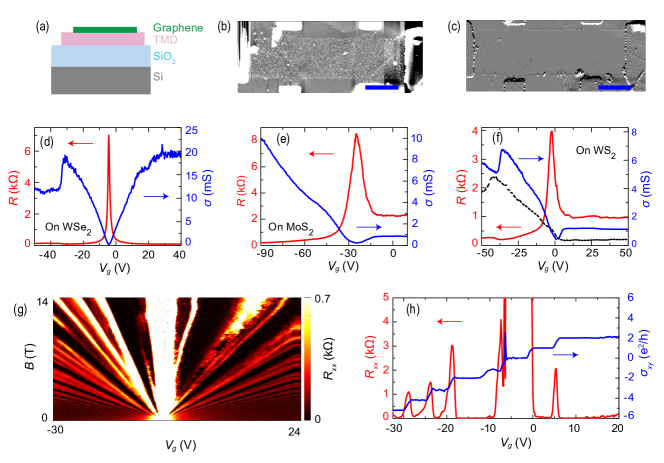
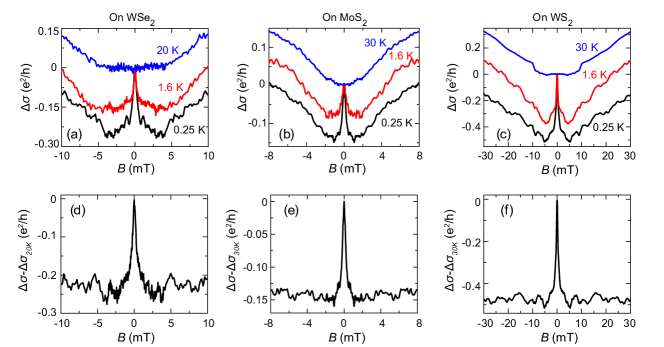
We use a combination of experimental techniques to demonstrate a general occurrence of spin-orbit interaction (SOI) in graphene on transition metal dichalcogenide (TMD) substrates. Our measurements indicate that SOI is ultra-strong and extremely robust, despite it being merely interfacially-induced, with neither graphene nor the TMD substrates changing their structure. This is found to be the case irrespective of the TMD material used, of the transport regime, of the carrier type in the graphene band, and of the thickness of the graphene multilayer. Specifically, we perform weak antilocalization measurements as the simplest and most general diagnostic of SOI, and show that the spin relaxation time is very short in all cases regardless of the elastic scattering time. Such a short spin-relaxation time strongly suggests that the SOI originates from a modification of graphene band structure. We confirmed this expectation by measuring a gate-dependent beating, and a corresponding frequency splitting, in the low-field Shubnikov-de Haas magneto-resistance oscillations in high quality bilayer graphene on WSe$_2$. These measurements provide an unambiguous diagnostic of a SOI-induced splitting in the electronic band structure, and their analysis allows us to determine the SOI coupling constants for the Rashba term and the so-called spin-valley coupling term, i.e., the terms that were recently predicted theoretically for interface-induced SOI in graphene. The magnitude of the SOI splitting is found to be on the order of 10 meV, more than 100 times greater than the SOI intrinsic to graphene. Both the band character of the interfacially induced SOI, as well as its robustness and large magnitude make graphene-on-TMD a promising system to realize and explore a variety of spin-dependent transport phenomena, such as, in particular, spin-Hall and valley-Hall topological insulating states.
연구 동기 및 목표
- 그래핀의 반도체 전이 금속 디칼코제나이드(TMD) 위에서 관측된 '디자이너' 스핀-오비트 상호작용(SOI)의 기원과 크기를 규명하는 것.
- 관측된 SOI가 다양한 TMD 재료와 그래핀 구조에서 일반적이고 내구성 있는 현상인지 확인하는 것.
- 이 이종 구조에서의 SOI 메커니즘으로서 불순물 기반과 밴드 구조 기반의 차이를 식별하는 것.
- 운반성질 측정을 통해 유도된 SOI에서 라슈바 및 스핀-밸리 결합 항의 강도를 정량화하는 것.
- 그래핀/TMD가 스핀-홀 및 밴드-홀 토폴로지 상태를 실현하기 위한 플랫폼으로서의 잠재력을 탐색하는 것.
제안 방법
- 스핀 회복 시간 추출을 통해 스핀-오비트 결합 강도를 탐사하기 위해 약한 반국소화(WAL) 측정을 수행한다.
- 고품질 이중층 그래핀/WSe₂에서 게이트 의존성 있는 Shubnikov-de Haas(SdH) 자기저항 진동을 측정하여 밴드 구조의 분리 여부를 탐지한다.
- SdH 진동의 주파수 분리 분석을 통해 라슈바 및 스핀-밸리 결합 상수를 추출한다.
- 실험 데이터를 해석하기 위해 스핀-오비트 항을 포함한 디랙 해밀토니안 기반의 이론 모델을 사용한다.
- 탄성 산란 시간이 다양한 장치에서 변화함에 따라 스핀 회복 시간을 비교하여 내재된 SOI 효과를 분리한다.
- WAL 데이터를 적합하기 위해 Hikami-Larkin-Nagaoka(HLN) 공식을 적용하여 스핀 회복 시간 τ_so를 추출한다.
실험 결과
연구 질문
- RQ1그래핀/TMD 기질 위에서 초강력 스핀-오비트 상호작용의 미세한 기원은 무엇인가?
- RQ2관측된 스핀-오비트 결합은 TMD 재료, 운반자 유형 또는 그래핀 두께에 관계없이 일반적인 특성인가?
- RQ3스핀-오비트 상호작용은 밴드 구조의 변화에 기인하는가, 아니면 불순물 산란에 기인하는가?
- RQ4그래핀-TMD 인터페이스에서 유도된 라슈바 및 스핀-밸리 결합 항의 정량적 값은 무엇인가?
- RQ5전기적 게이팅을 통해 유도된 SOI의 강도를 조절할 수 있으며, 이는 토폴로지적 스핀트로닉스 응용에 어떤 의미를 갖는가?
주요 결과
- 모든 장치에서 탄성 산란 시간과 관계없이 스핀 회복 시간 τ_so가 일관되게 ≤ 0.2 ps로 유지되며, 이는 내재된 강력한 SOI 메커니즘을 나타낸다.
- τ_so가 탄성 산란 시간이 거의 두 배수 정도 변화하더라도 짧게 유지되므로, 이 SOI는 불순물 기반의 것이 아니며, 내재된 메커니즘이다.
- WSe₂ 위의 이중층 그래핀에서의 게이트 의존성 SdH 진동은 약 ~10 meV의 주파수 분리를 보이며, SOI에 의해 유도된 밴드 구조의 변화를 직접적으로 증명한다.
- 라슈바 및 스핀-밸리 결합 항이 정량적으로 추출되어, 인터페이스에 의해 유도된 SOI에서의 역할을 확인한다.
- SOI 분리 강도는 약 ~10 meV로, 그래핀의 내재된 SOI보다 100배 이상 초과한다.
- SOI 효과는 다양한 TMD 재료, 운반자 유형 및 그래핀 다층막 두께에서 모두 일반적이며, 인터페이스 특유의 효과임을 나타낸다.
더 나은 연구,지금 바로 시작하세요
연구 설계부터 논문 작성까지, 연구 시간을 획기적으로 줄여보세요.
카드 등록 없음 · 무료 플랜 제공
이 리뷰는 AI가 만들고, 인간 에디터가 검토했습니다.