
[논문 리뷰] Origins and lifetimes of secular and tidal bars in simulated disc galaxies
본 연구는 TNG50에서 307개 MW 질량의 디스크 은하를 분석하여 자발적(bar 형태의 내부 형성) 바와 천만의 작용으로 유도된 바를 식별하고, 바 형성 채널을 중심 우주 항의 질량 분율 및 수명과 연결하는 해석적 프레임을 제시한다.
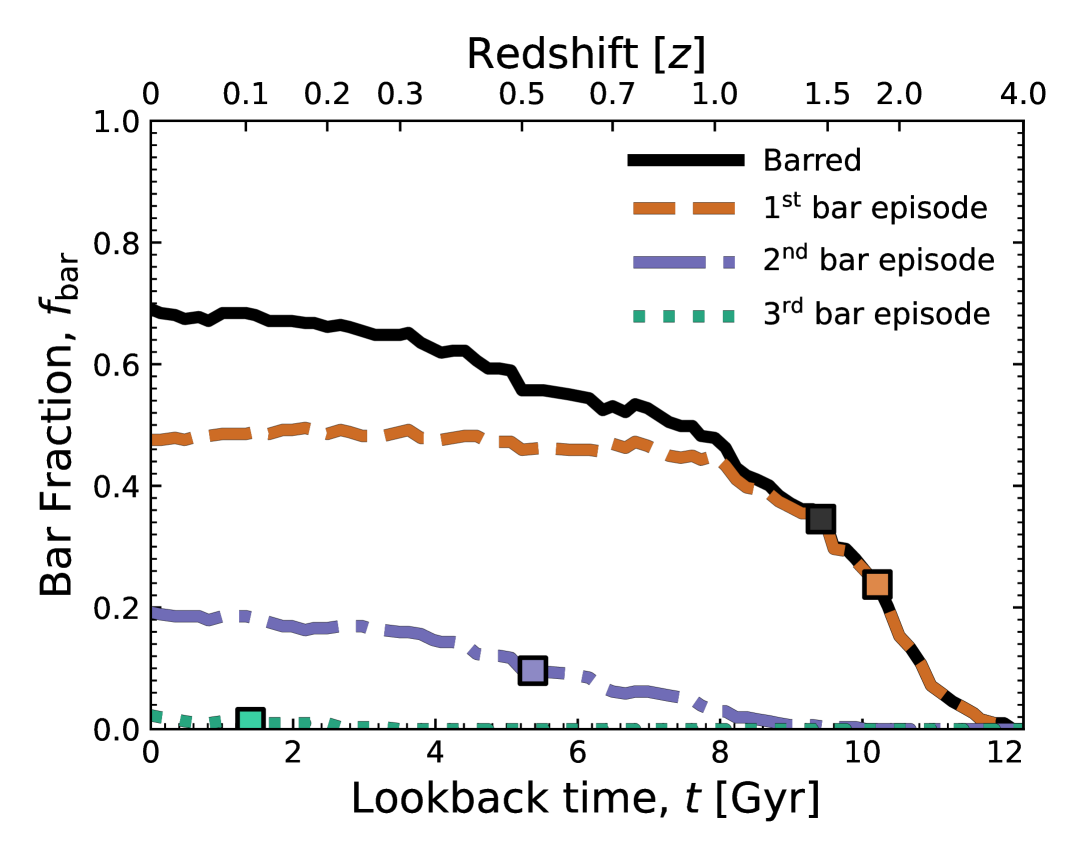
We investigate the formation of stellar bars in 307 Milky Way-mass disc galaxies in the TNG50 cosmological simulation. Most bars form rapidly in dynamically cold discs shortly after the central stellar mass exceeds that of dark matter. In these cases, bar formation is consistent with secular instabilities driven by the disc's self-gravity, which organises stellar orbits into a coherent bar structure. However, around 25 per cent of barred galaxies are dark matter dominated at the time of bar formation, $t_{bar}$, and remain so thereafter. We trace the origin of these bars to tidal perturbations induced by passing satellites or mergers using a new metric, $S_{bar}$, quantifying the tidal field acting on the galaxy. At the time of bar formation, we find a negative correlation between $S_{bar}$ and the central stellar-to-dark matter mass fraction, indicating that more dark matter-dominated discs require stronger tides to trigger bar formation. These tidally induced bars are more likely to be transient than those that form secularly, although bar properties are otherwise similar. However, the host galaxies differ: secular bars arise in relatively compact discs, while tidal bars appear in extended discs whose properties resemble those of unbarred galaxies. Tidal perturbations can therefore induce bars in galaxies otherwise stable to secular formation, highlighting the dual role of the internal galactic structure and the external environment in bar formation.
연구 동기 및 목표
- MW 질량의 디스크 은하에서 코스모로지컬 맥락 내에서 바가 어떻게 형성되는지 TNG50를 사용하여 조사한다.
- 원판의 자기중력과 외부 조석 교란이 바 형성에 어떤 역할을 하는지 결정한다.
- 바 형성 근처에서 작용하는 조석장을 정량화하기 위한 새로운 지표를 개발하고 적용한다.
- 샘플 전반에서 바 에피소드의 수명과 재발을 특징짓는다.
제안 방법
- 다면체( Fourier) 분해를 이용하여 정면에서의 별 표면 밀도를 바를 식별하고, m=2 모드(A2)와 바 특성(A2_max, R_bar, phi_2, Omega_bar)에 중점을 둔다.
- A2_max >= 0.2 및 R_bar >= 1.4 * epsilon_c인 상태가 최소 세 개의 스냅샷에서 바 단계의 시작으로 간주된다.
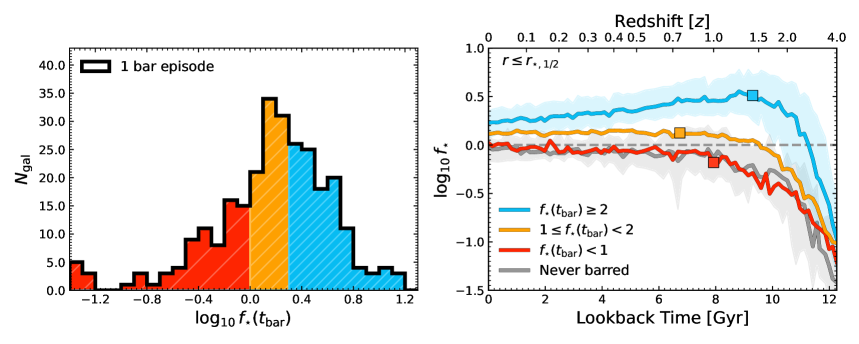
- bar 형성 시 r_star,1/2 내의 중심 별-암흑물질 질량 비율 f_star(t_bar)를 계산하여 디스크를 바 형성 시점에 대해 별 DOM인 지 혹은 DM-지배인지 분류한다.
- 주변 질량 분포로부터의 해석 텐서 T를 도입하고 T의 고유값의 노름으로 스칼라 S를 정의하여 조석 강도를 정량화한다(S_bar = t_dyn 전의 한 시점에서의 최대 S).
- f_star(t_bar)와 S_bar 사이의 상관관계를 분석하고, 자발적 바 대 조석 유도 바의 수명 및 특성을 비교한다.
실험 결과
연구 질문
- RQ1MW 질량의 디스크에서 형성된 바 중 얼마나 자발적으로인지 조석에 의해 발생하는지의 비율은?
- RQ2바 형성 시점의 중심 질량 분포에서 별-암흑물질 질량 비율은 자발적 바 형성의 가능성에 어떤 영향을 주는가?
- RQ3전역 조석장 지표가 자발적 바와 조석에 의해 유도된 바를 구분할 수 있으며, 그것이 바의 수명과 어떤 관련이 있는가?
- RQ4조석 유도 바가 관측 가능한 특성에서 자발적 바와 어떻게 다른가, 그리고 환경이 그들의 진화에 어떤 영향을 주는가?
주요 결과
- 바 형성 시점에 은하의 약 25%가 DM-지배적이며 이후에도 DM-지배적 상태를 유지하는 바가 있으며, 이들 바는 조석 트리거를 시사한다.
- S_bar와 f_star(t_bar) 사이에 음의 상관관계가 존재한다: 더 DM-지배적인 디스크일수록 바 형성을 트리거하기 위한 더 강한 조석이 필요하다.
- 자발적 바는 상대적으로 촘촘하고 별이 지배하는 디스크에서 형성되며 장수하는 경향이 있고, 조석 유도 바는 확장된 디스크에서 형성되어 더 자주 비장기적이다.
- 바는 별-지배 디스크와 DM-지배 디스크 모두에서 형성될 수 있지만, 지배적인 형성 채널은 디스크 중심 질량 지배도와 조석 환경에 달려 있다.
- 바의 수명은 디스크 특성과 상관관계가 있으며: 별-지배 디스크는 장수 바를 가지는 반면(D med ≈ 9 Gyr), DM-지배 디스크는 더 짧은 수명을 가지는 경향이 있다(D med ≈ 2 Gyr).
- 조석 교란은 자발적 형성에 안정적인 galaxies에서도 바를 유도할 수 있어 내부 구조와 외부 환경의 이중 역할을 강조한다.
더 나은 연구,지금 바로 시작하세요
연구 설계부터 논문 작성까지, 연구 시간을 획기적으로 줄여보세요.
카드 등록 없음 · 무료 플랜 제공
이 리뷰는 AI가 만들고, 인간 에디터가 검토했습니다.