
[논문 리뷰] PatchNet: A Simple Face Anti-Spoofing Framework via Fine-Grained Patch Recognition
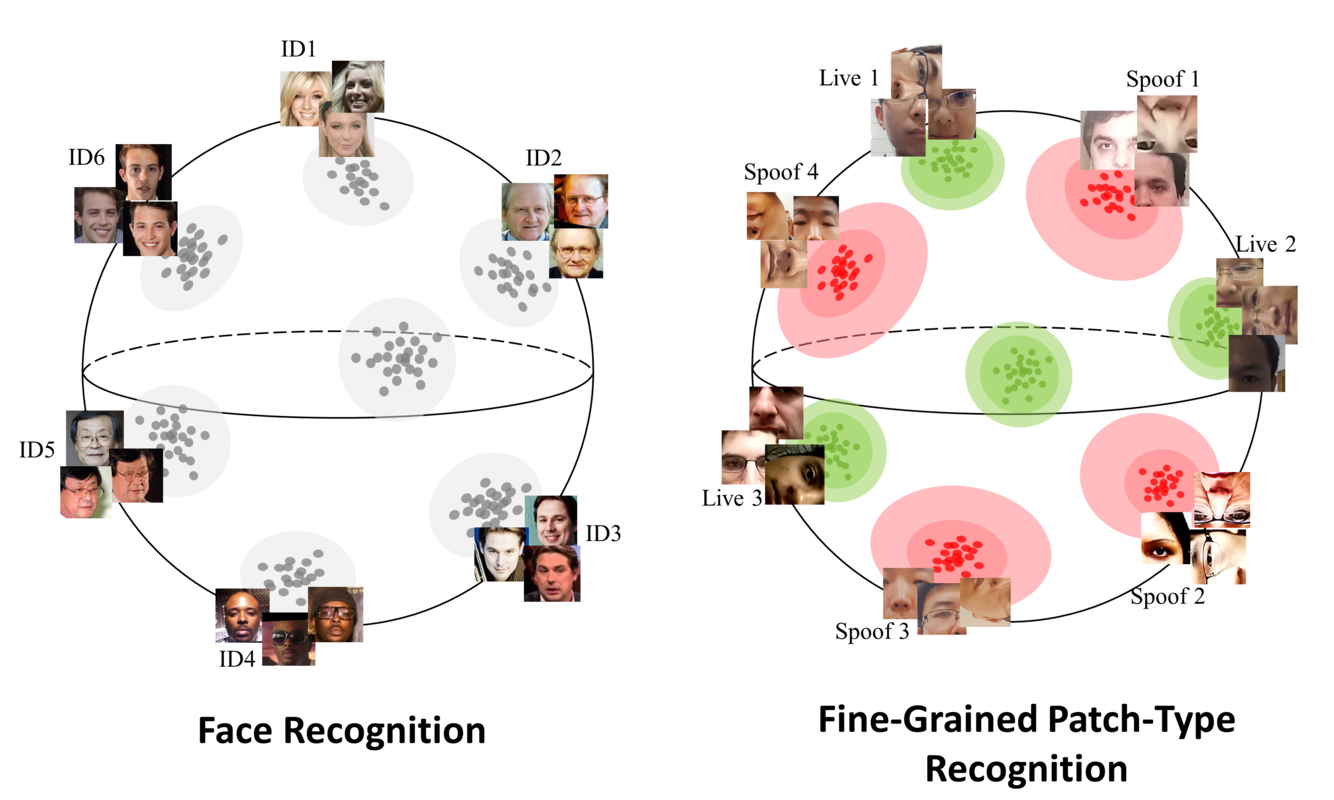
PatchNet는 얼굴 인증 회피 기법을 미세한 패치 유형 식별 문제로 재정의하여, 국소 이미지 패치를 사용해 촬영 장치와 제시 재료의 조합을 분류함으로써 새로운 얼굴 인증 회피 방지 프레임워크를 제안한다. 비대칭 마진 기반 손실과 자기지도 학습 유사도 손실을 활용하여, 내부 데이터셋, 교차 데이터셋, 도메인 일반화 벤치마크에서 최신 기술 수준의 성능을 달성하며, 국소적 특징 학습을 통해 예측할 수 없는 스푸핑 유형을 강력하게 탐지할 수 있다.
Face anti-spoofing (FAS) plays a critical role in securing face recognition systems from different presentation attacks. Previous works leverage auxiliary pixel-level supervision and domain generalization approaches to address unseen spoof types. However, the local characteristics of image captures, i.e., capturing devices and presenting materials, are ignored in existing works and we argue that such information is required for networks to discriminate between live and spoof images. In this work, we propose PatchNet which reformulates face anti-spoofing as a fine-grained patch-type recognition problem. To be specific, our framework recognizes the combination of capturing devices and presenting materials based on the patches cropped from non-distorted face images. This reformulation can largely improve the data variation and enforce the network to learn discriminative feature from local capture patterns. In addition, to further improve the generalization ability of the spoof feature, we propose the novel Asymmetric Margin-based Classification Loss and Self-supervised Similarity Loss to regularize the patch embedding space. Our experimental results verify our assumption and show that the model is capable of recognizing unseen spoof types robustly by only looking at local regions. Moreover, the fine-grained and patch-level reformulation of FAS outperforms the existing approaches on intra-dataset, cross-dataset, and domain generalization benchmarks. Furthermore, our PatchNet framework can enable practical applications like Few-Shot Reference-based FAS and facilitate future exploration of spoof-related intrinsic cues.
연구 동기 및 목표
- 기존 얼굴 인증 회피 기법의 한계를 해결하기 위해, 데이터셋 편향에 과적합되며 예측할 수 없는 스푸핑 유형에서 실패하는 문제를 해결한다.
- 특히 촬영 장치와 제시 재료의 조합을 특징으로 삼아, 스푸핑 탐지에 내재된 특징을 활용한다.
- 전체 이미지 분류가 아닌, 미세한 패치 수준의 인식에 초점을 맞춘 훈련 프레임워크를 개발하여 특징 일반화 능력을 향상시킨다.
- 학습된 임bedding 공간을 활용해 소수의 참조 기반 인증 회피 기법 및 패치 유형 검색과 같은 실용적 응용을 가능하게 한다.
제안 방법
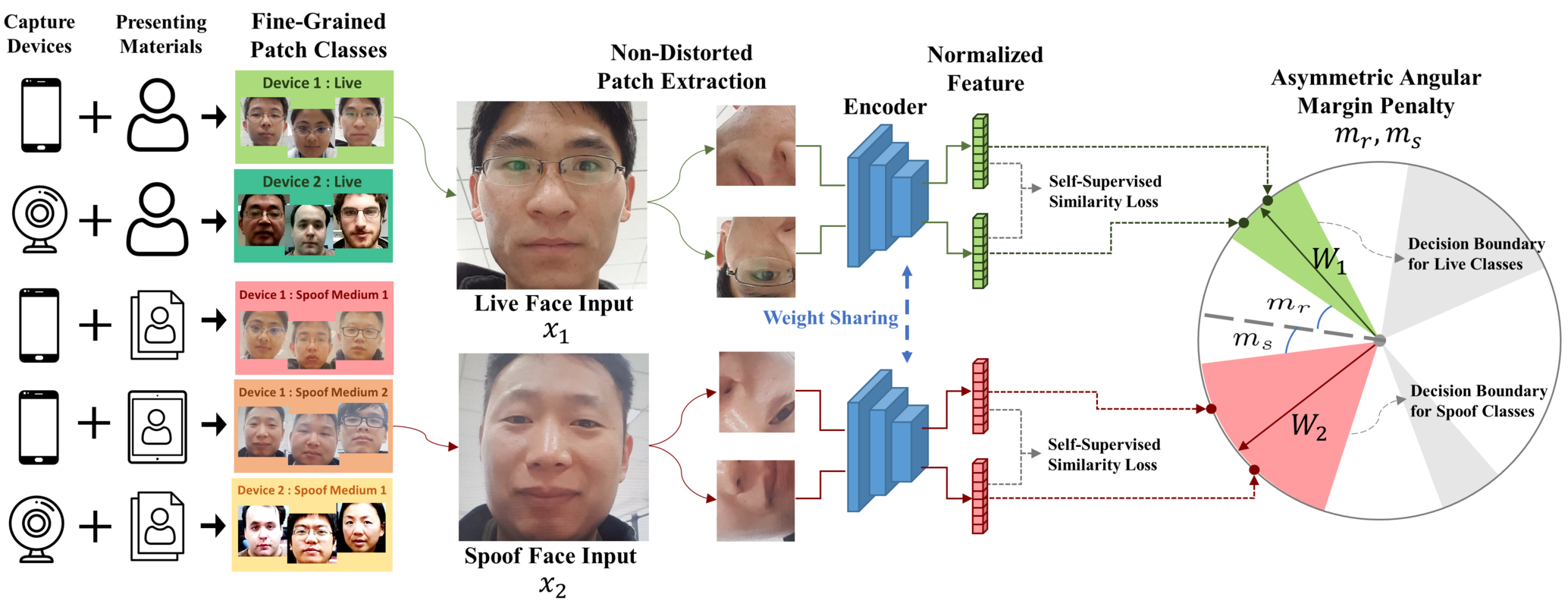
- 얼굴 인증 회피 기법을, 각 패치가 촬영 장치와 제시 재료 기반으로 분류되는, 미세한 패치 유형 식별 작업으로 재정의한다.
- 왜곡 없이 고정된 크기의 패치를 원본 얼굴 이미지에서 직접 자르며, 리사이징으로 인한 왜곡을 방지하고 분류에 유용한 국소적 특징을 유지한다.
- 라이브 클래스 임베딩에 더 큰 각도 마진을 적용함으로써 클래스 불균형 문제를 완화하고 분류 성능를 향상시키기 위해 비대칭 마진 기반 소프트맥스 손실을 도입한다.
- 한 번의 촬영 내에서 공간 변형(예: 회전, 위치 이동)에 대해 특징의 불변성을 강제하기 위해 자기지도 학습 유사도 손실을 제안한다.
- 딥 네ural 네트워크를 훈련시켜 패치를 정규화된 초구면에 임bedding함으로써, 후속 응용을 위한 코사인 유사도 기반 비교를 가능하게 한다.
- 결과적으로 생성된 정규화된 임베딩 공간을 활용해 소수의 참조 기반 FAS 및 패치 유형 검색 등의 응용을 수행한다.
실험 결과
연구 질문
- RQ1이진 라이브/스푸핑 분류를 넘어서, 미세한 패치 유형 식별이 얼굴 인증 회피 기법의 일반화 능력을 향상시키는가?
- RQ2촬영 장치와 제시 재료의 조합을 패치 유형으로 모델링함으로써, 예측할 수 없는 스푸핑 유형에 대한 강건성이 향상되는가?
- RQ3비대칭 마진 손실과 자기지도 학습 유사도 손실이 패치 임베딩 공간에서 특징의 분류 능력과 불변성을 얼마나 향상시키는가?
- RQ4학습된 패치 임베딩 공간이 소수의 참조 기반 인증 회피 기법과 같은 실용적 응용을 가능하게 하는가?
- RQ5개별 촬영 장치에서 성능가 어떻게 변하는가? 그리고 패치 수준 분석이 시스템 개선에 어떻게 기여할 수 있는가?
주요 결과
- PatchNet는 내부 데이터셋, 교차 데이터셋, 도메인 일반화 벤치마크에서 최신 기술 수준의 성능를 달성하며, O&C&I에서 M 프로토콜에 대해 AUC 98.46%를 기록했고, O&M&I에서 C 프로토콜에 대해 94.58%의 AUC를 기록했다.
- 개별 촬영 장치에서 PatchNet는 M1에서 99.54% AUC, M2에서 98.63% AUC, C3에서 98.13% AUC를 기록하여 저품질 장치에서도 강력한 강건성을 보였다.
- 10샷 라이브 참조 특징을 사용할 경우, M1에서 AUC 99.8%, C3에서 99.2%로 성능이 향상되어 소수의 샘플 상황에서도 높은 실용성을 입증했다.
- O 데이터셋의 라이브 샘플을 사용한 패치 유형 검색은 관련 라이브 및 스푸핑 유형을 성공적으로 식별했으며, 상위 7개 매칭 결과 중 고유사도 유형이 M 및 C 데이터셋으로부터 포함되었다.
- 테스트에서 모호한 라이브 유형(예: C2_L, C1_L, I_L)을 제거하면 AUC가 95.27%로 향상되고, 이를 스푸핑 클래스로 재정의하면 AUC가 95.87%로 상승했다.
- 절단 실험 결과, 비대칭 마진 손실과 자기지도 학습 유사도 손실이 모든 벤치마크에서 성능 향상에 기여하는 것으로 확인되었다.
더 나은 연구,지금 바로 시작하세요
논문 읽기부터 검토까지, 연구 시간을 획기적으로 줄여보세요.
카드 등록 없음 · 무료 플랜 제공
이 리뷰는 AI가 만들고, 인간 에디터가 검토했습니다.