
[논문 리뷰] Personalized Imputation in metric spaces via conformal prediction: Applications in Predicting Diabetes Development with Continuous Glucose Monitoring Information
이 논문은 거리 공간 내에서 근거 있는 확률 예측을 사용하여 연속 혈당 측정(CGM) 데이터의 개인화된 누락 데이터 보정을 위한 새로운 이단계 프레임워크를 제안한다. 이는 당뇨병 발병 예측을 향상시킨다. 포도당 프로파일을 2-워샤르슈타인 공간 내 확률 분포(포도당 밀도)로 모델링하고 개인화된 확률 예측을 적용함으로써, 기존 모델 대비 예측 정확도를 10% 이상 향상시킨다.
The challenge of handling missing data is widespread in modern data analysis, particularly during the preprocessing phase and in various inferential modeling tasks. Although numerous algorithms exist for imputing missing data, the assessment of imputation quality at the patient level often lacks personalized statistical approaches. Moreover, there is a scarcity of imputation methods for metric space based statistical objects. The aim of this paper is to introduce a novel two-step framework that comprises: (i) a imputation methods for statistical objects taking values in metrics spaces, and (ii) a criterion for personalizing imputation using conformal inference techniques. This work is motivated by the need to impute distributional functional representations of continuous glucose monitoring (CGM) data within the context of a longitudinal study on diabetes, where a significant fraction of patients do not have available CGM profiles. The importance of these methods is illustrated by evaluating the effectiveness of CGM data as new digital biomarkers to predict the time to diabetes onset in healthy populations. To address these scientific challenges, we propose: (i) a new regression algorithm for missing responses; (ii) novel conformal prediction algorithms tailored for metric spaces with a focus on density responses within the 2-Wasserstein geometry; (iii) a broadly applicable personalized imputation method criterion, designed to enhance both of the aforementioned strategies, yet valid across any statistical model and data structure. Our findings reveal that incorporating CGM data into diabetes time-to-event analysis, augmented with a novel personalization phase of imputation, significantly enhances predictive accuracy by over ten percent compared to traditional predictive models for time to diabetes.
연구 동기 및 목표
- 임상 연구에서 기능적이고 분포적 데이터의 개인화된 통계적으로 엄밀한 보정 방법이 부족한 문제를 해결하기 위해.
- 거리 공간 내에서 확률 분포로 표현된 누락된 연속 혈당 측정(CGM) 프로파일을 보정하기 위한 방법을 개발하기 위해.
- 고해상도 포도당 밀도 데이터를 디지털 바이오마커로 통합하여 비당뇨병 환자 집단에서 당뇨병 발병까지의 시간을 예측하기 위해.
- 다양한 데이터 구조와 통계 모델에 걸쳐 예측 성능을 향상시키는 일반화 가능하고 모델에 종속되지 않는 개인화된 보정 프레임워크를 제공하기 위해.
- 실제 종단점 추적 연구(AEGIS)에서 일부 참가자만이 완전한 CGM 데이터를 보유한 상황에서 방법을 검증하기 위해.
제안 방법
- 거리 공간 내 선형 모델에 대한 가중 최소 제곱 추정기 방법을 제안하여, 확률 분포와 같은 통계적 객체에 대한 회귀 분석을 가능하게 한다.
- 거리 공간에 특화된 새로운 확률 예측 알고리즘을 도입하며, 특히 2-워샤르슈타인 거리로 분포 응답의 불확실성을 측정한다.
- 제한된 거리 공간 내에서 조건부 프리셰 평균을 보정 대상으로 적용하여, 분포 데이터에 대해 일관성과 강건성을 확보한다.
- 개인화된 불확실성에 적응하는 확률 예측 기반의 개인화된 보정 기준을 활용하여 신뢰성과 校정도를 향상시킨다.
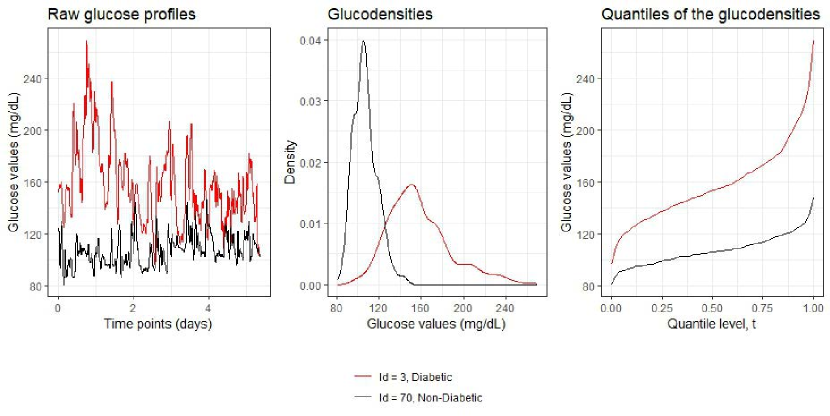
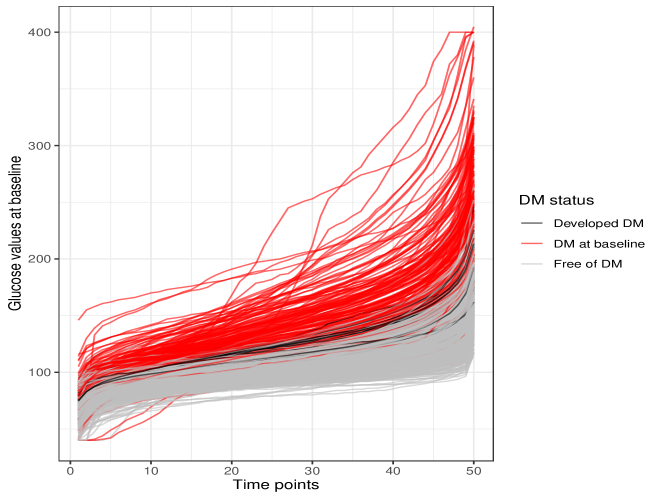
- 원시 CGM 데이터에서 유도된 포도당 밀도 표현을 사용하여 전체 시간적 포도당 동역학을 포착하고, 요약 통계량을 대체한다.
- 이중 단계 연구 설계를 통해 방법을 검증한다: 먼저 누락된 CGM 프로파일을 보정하고, 그 다음 C-지수와 AUC를 사용한 사건 발생까지의 시간 분석을 수행한다.
실험 결과
연구 질문
- RQ1거리 공간 내에서 개인화된 보정을 통해 누락된 CGM 데이터를 처리하면 비당뇨병 환자 집단에서 당뇨병 발병까지의 시간 예측이 향상되는가?
- RQ2포도당 프로파일의 분포 표현(포도당 밀도)을 통합할 경우, 전통적인 바이오마커 대비 예측 성능이 어떻게 향상되는가?
- RQ32-워샤르슈타인 공간 내에서의 확률 예측은 보정된 분포 응답의 신뢰성과 校정도를 얼마나 향상시키는가?
- RQ4다양한 데이터 구조와 통계 모델에 걸쳐 예측 정확도를 향상시키는 일반적인 목적의 모델에 종속되지 않는 보정 기준을 개발할 수 있는가?
- RQ5개인화된 불확실성 측정이 고해상도 포도당 데이터를 사용한 사건 발생 예측 모델의 C-지수와 AUC에 어떤 영향을 미치는가?
주요 결과
- 제안된 방법은 기존의 스칼라 바이오마커에만 의존하는 전통적 모델 대비 당뇨병 발병까지의 시간 예측 정확도를 10% 이상 향상시킨다.
- 개인화된 확률 예측 프레임워크는 반경 110에서 C-지수 0.90를 달성하여, 62명의 보정된 CGM 데이터를 포함하며 강력한 校정도와 커버리지 성능을 보였다.
- 시간에 따른 AUC는 전통적인 CGM 위험 평가를 뛰어넘어 일관되게 높아져, 동적 예측 성능이 뛰어남을 시사한다.
- 예측 밴드가 있는 조건부 프리셰 평균은 개인화된 포도당 동역학을 효과적으로 포착하며, 확률 예측 프레임워크에서 반경이 커질수록 불확실성이 증가함을 보였다.
- 단지 코hort의 일부(1,516명 중 580명)만이 완전한 CGM 데이터를 보유한 상황에서도 모델 성능이 크게 향상되어, 비용 제약이 있는 종단점 추적 연구에서의 유용성을 검증했다.
- 개인화된 보정된 CGM 데이터를 통합한 모델의 C-스코어는 0.805에 도달하여, 기능적 데이터가 없는 모델 대비 상당한 향상이 있었다.
더 나은 연구,지금 바로 시작하세요
논문 읽기부터 검토까지, 연구 시간을 획기적으로 줄여보세요.
카드 등록 없음 · 무료 플랜 제공
이 리뷰는 AI가 만들고, 인간 에디터가 검토했습니다.