
[논문 리뷰] Practical Guidance for Bayesian Inference in Astronomy
cross-disciplinary translation of Bayesian notation and practical guidance for performing Bayesian inference in astronomy, with parallax as running example and emphasis on priors, likelihoods, posteriors, and posterior predictive checks.
In the last two decades, Bayesian inference has become commonplace in astronomy. At the same time, the choice of algorithms, terminology, notation, and interpretation of Bayesian inference varies from one sub-field of astronomy to the next, which can lead to confusion to both those learning and those familiar with Bayesian statistics. Moreover, the choice varies between the astronomy and statistics literature, too. In this paper, our goal is two-fold: (1) provide a reference that consolidates and clarifies terminology and notation across disciplines, and (2) outline practical guidance for Bayesian inference in astronomy. Highlighting both the astronomy and statistics literature, we cover topics such as notation, specification of the likelihood and prior distributions, inference using the posterior distribution, and posterior predictive checking. It is not our intention to introduce the entire field of Bayesian data analysis -- rather, we present a series of useful practices for astronomers who already have an understanding of the Bayesian "nuts and bolts" and wish to increase their expertise and extend their knowledge. Moreover, as the field of astrostatistics and astroinformatics continues to grow, we hope this paper will serve as both a helpful reference and as a jumping off point for deeper dives into the statistics and astrostatistics literature.
연구 동기 및 목표
- Terminology와 표기 차이를 천문학과 통계학 간에 명확히 하여 재현성과 이해를 증진한다.
- 천문학적 문제에서 priors, likelihoods, 및 posterior distributions를 지정하는 데 대한 실용적 지침을 제공한다.
- running example으로 삼차배 시차를 이용한 거리 추정으로 Bayesian 워크플로를 설명한다.
- 모델 적합성과 계산 점검을 위한 진단 도구로서 posterior predictive checks를 강조한다.
제안 방법
- 데이터 y와 매개변수 theta에 대한 Bayes’ theorem과 표준 표기법을 제시하고, p(theta|y)와 p(y|theta)를 강조한다.
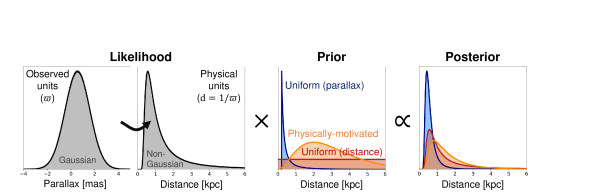
- parallax에 대한 가능도는 p(y|d) 또는 p(y|varpi)로 정의하고, 관련 샘플링 분포와 모델 선택(예: Gaussian vs 이산)을 논의한다.
- 정보가 있는 사전과 비정보적 사전 등 사전 분포를 논의하고, 거리/시차에 대한 절단된 균등분포와 물리적으로 유도된 사전의 예를 포함한다.
- 단일 항성 및 군집 거리 문제에 대한 후방 형태를 도출하고, 닫힌 형태가 없을 때 후방을 계산하거나 근사하는 방법을 설명한다.
- posterior predictive checks를 활용한 실제 데이터와 posterior predictive 분포로부터 시뮬레이션된 데이터 간의 차이를 진단 도구로 설명한다.
실험 결과
연구 질문
- RQ1천문학과 통계학 사이에서 Bayesian 표기법과 개념을 명확성과 재현성을 위해 어떻게 번역해야 하는가?
- RQ2천문학적 Bayesian 모델에서 priors와 likelihoods를 지정하는 최선의 관행은 무엇이며, 이러한 선택이 후방 추론에 어떤 영향을 미치는가?
- RQ3parallax 데이터로부터의 거리 추정에 대한 후방 분포를 어떻게 사용하고 검증할 수 있는가, 별 cluster에 대해서도 마찬가지인가?
- RQ4모델 적합성과 계산 방법 평가를 위한 posterior predictive checks는 astrostatistics에서 어떤 역할을 하는가?
주요 결과
- Bayesian 표기의 명확한 번역은 연구자들이 학문 간 결과를 해석하는 데 도움을 준다.
- 제한된 데이터나 매개변수화가 사전의 함의를 바꿀 때(예: 거리 vs 시차) 후방에 큰 영향을 미친다.
- 물리적으로 유도된 사전(d^2 e^{-d/L} 등)은 거리에서의 단순한 균등 사전보다 공간 밀도를 더 잘 반영한다.
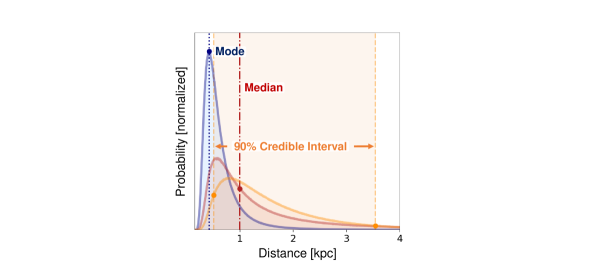
- 후방 분포는 다모드 또는 비대칭일 수 있어 평균이나 1-시그마 구간 같은 간단한 요약보다 시각화와 적절한 요약이 필요하다.
- posterior predictive checks는 모델 평가 및 샘플링이나 모델 오정합 진단에 유용하다.
- running parallax 예제는 여러 측정치를 결합하고 파생량에 불확실성을 전파하는 방법을 보여준다.
더 나은 연구,지금 바로 시작하세요
논문 읽기부터 검토까지, 연구 시간을 획기적으로 줄여보세요.
카드 등록 없음 · 무료 플랜 제공
이 리뷰는 AI가 만들고, 인간 에디터가 검토했습니다.