
[논문 리뷰] Problematic Advertising and its Disparate Exposure on Facebook
이 연구는 132명의 사용자로 구성된 3개월간의 종단적 패널을 분석하여 페이스북 광고의 문제적 요소를 조사한다. 문제적 광고의 주요 유형으로는 기만적 광고, 페이스북에서 금지한 광고, 클릭 유도 광고, 민감한 주제를 다룬 광고를 식별하였으며, 노인층과 소수민족 사용자들이 이에 비해 특히 높은 노출을 경험하고 있음을 발견하였다. 연구는 문제적 광고 노출의 22%가 플랫폼 수준의 개인화 알고리즘에 기인한 것으로 분석하여 광고 배달 시 알고리즘 편향이 존재함을 시사한다.
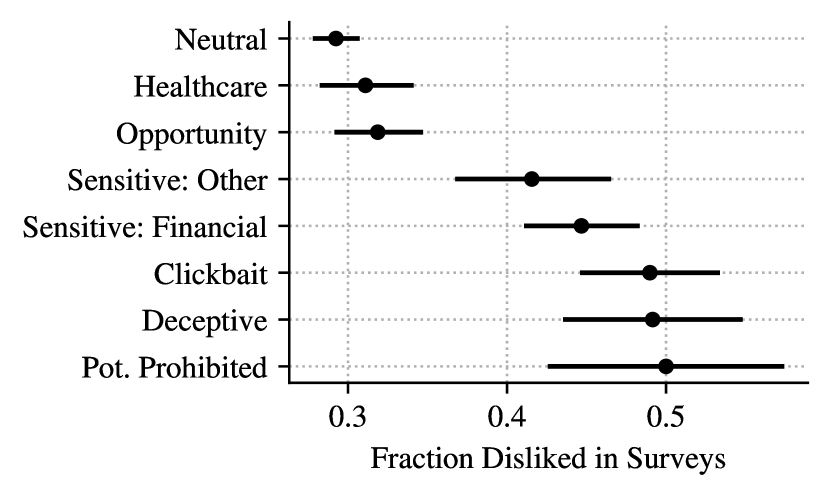
Targeted advertising remains an important part of the free web browsing experience, where advertisers' targeting and personalization algorithms together find the most relevant audience for millions of ads every day. However, given the wide use of advertising, this also enables using ads as a vehicle for problematic content, such as scams or clickbait. Recent work that explores people's sentiments toward online ads, and the impacts of these ads on people's online experiences, has found evidence that online ads can indeed be problematic. Further, there is the potential for personalization to aid the delivery of such ads, even when the advertiser targets with low specificity. In this paper, we study Facebook -- one of the internet's largest ad platforms -- and investigate key gaps in our understanding of problematic online advertising: (a) What categories of ads do people find problematic? (b) Are there disparities in the distribution of problematic ads to viewers? and if so, (c) Who is responsible -- advertisers or advertising platforms? To answer these questions, we empirically measure a diverse sample of user experiences with Facebook ads via a 3-month longitudinal panel. We categorize over 32,000 ads collected from this panel ($n=132$); and survey participants' sentiments toward their own ads to identify four categories of problematic ads. Statistically modeling the distribution of problematic ads across demographics, we find that older people and minority groups are especially likely to be shown such ads. Further, given that 22% of problematic ads had no specific targeting from advertisers, we infer that ad delivery algorithms (advertising platforms themselves) played a significant role in the biased distribution of these ads.
연구 동기 및 목표
- 사용자가 문제적이라고 느끼는 페이스북 광고의 구체적 유형을 특정하는 것.
- 페이스북에서 문제적 광고에 대한 노출에 인구통계적 격차가 존재하는지 조사하는 것.
- 광고주 또는 광고 플랫폼(개인화 알고리즘을 통해)이 문제적 광고의 왜곡된 배포에 주로 기여하는지 판단하는 것.
제안 방법
- 3개월 동안 페이스북 광고 경험을 종단적으로 추적하기 위해 다양성이 확보된 132명의 유료 참가자를 모집하였다.
- 참가자의 데스크톱 브라우저를 인스트루멘터하여 모든 페이스북 광고를 로그 기록하고, 페이스북이 제공하는 세부 타겟팅 정보를 추출하였다.
- 계산 기반 연구, 사회과학 연구 및 플랫폼 정책를 바탕으로 8종류의 광고 유형(클릭 유도 광고, 민감한 주제, 기회 관련 광고 포함)을 포함한 광고 유형 코드북을 개발하였다.
- 인간 평가자들을 활용하여 코드북을 기반으로 수집된 32,000건 이상의 광고를 정의된 유형으로 분류하였다.
- 참가자들이 수신한 광고에 대한 감정을 평가하기 위해 정기적인 설문조사를 실시하여 문제적이라고 인식되는 유형을 식별하였다.
- 통계 모델링을 적용하여 문제적 광고에 대한 인구통계적 격차를 분석하고, 광고주 타겟팅과 플랫폼 개인화 알고리즘의 역할을 분리 분석하였다.
실험 결과
연구 질문
- RQ1사용자가 페이스북에서 문제적이라고 느끼는 광고 유형은 무엇인가?
- RQ2사용자 간 문제적 광고의 분포에 인구통계적 격차가 존재하는가?
- RQ3광고주와 광고 플랫폼의 개인화 알고리즘이 문제적 광고 배포의 관찰된 격차에 어느 정도 기여하는가?
주요 결과
- 참가자들은 기만적 광고, 페이스북에서 금지한 콘텐츠, 클릭 유도 광고, 민감한 주제 광고(예: 금융, 도박, 다이어트 보조제)를 가장 문제적이라고 인식하였다.
- 노령 사용자는 젊은 사용자보다 기만적 광고와 클릭 유도 광고에 더 높은 노출을 경험하는 경향이 뚜렷했다.
- 흑인 참가자들은 클릭 유도 광고에 비해 특히 더 많이 노출되어 노출의 인종적 격차를 보였다.
- 남성은 재정 광고(규제 및 정책 제재로 인해 민감한 주로 간주됨)를 더 자주 접하게 되었으며, 이는 잠재적 피해와 이점이 혼재된 성격을 지녔다.
- 문제적 광고의 22%는 광고주로부터의 특정 타겟팅이 없었으며, 이는 플랫폼 수준의 개인화 알고리즘이 그들의 편향된 배포에 주요 역할을 했다는 것을 시사한다.
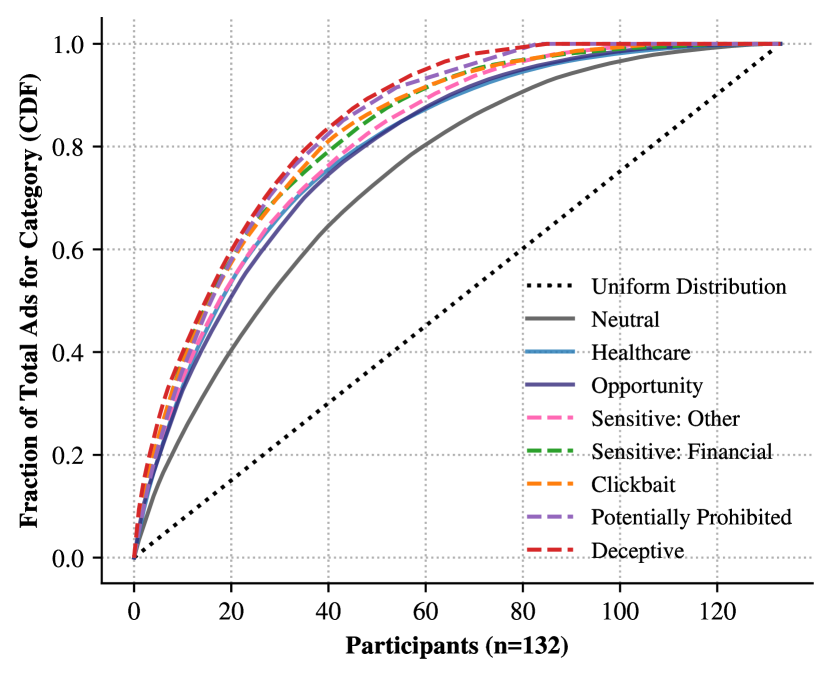
- 문제적 광고의 분포는 비균형적이었으며, 일부 사용자는 그러한 콘텐츠에 대한 중앙값 노출보다 3배 이상 높은 노출을 경험하였다.
더 나은 연구,지금 바로 시작하세요
논문 읽기부터 검토까지, 연구 시간을 획기적으로 줄여보세요.
카드 등록 없음 · 무료 플랜 제공
이 리뷰는 AI가 만들고, 인간 에디터가 검토했습니다.