
[논문 리뷰] Proof-of-work consensus by quantum sampling
이 논문은 블록체인에서의 고전적 해싱을 대체하기 위해 굵은 입자 샘플링(CGBS)을 사용하는 양자 기반 작업 증명(PoW) 합의 기반을 제안한다. 포크 상태 또는 가우시안 입력 상태를 활용한 양자 샘플링을 통해 고전적 마이너는 계산적으로 비가역적이며, 양자 우월성을 확보함으로써 에너지 효율성과 양자 우월성 공격에 대한 저항성을 확보한다. 이는 정직한 참여를 유도하는 나시 균형을 제공한다.
Since its advent in 2011, boson sampling has been a preferred candidate for demonstrating quantum advantage because of its simplicity and near-term requirements compared to other quantum algorithms. We propose to use a variant, called coarse-grained boson-sampling (CGBS), as a quantum Proof-of-Work (PoW) scheme for blockchain consensus. The users perform boson sampling using input states that depend on the current block information and commit their samples to the network. Afterwards, CGBS strategies are determined which can be used to both validate samples and reward successful miners. By combining rewards for miners committing honest samples together with penalties for miners committing dishonest samples, a Nash equilibrium is found that incentivizes honest nodes. We provide numerical evidence that these validation tests are hard to spoof classically without knowing the binning scheme ahead of time and show the robustness of our protocol to small partial distinguishability of photons. The scheme works for both Fock state boson sampling and Gaussian boson sampling and provides dramatic speedup and energy savings relative to computation by classical hardware.
연구 동기 및 목표
- 비트코인과 같은 고전적 작업 증명(PoW) 블록체인의 높은 에너지 소비와 환경 영향을 해결하기 위해.
- 특히 그로버 알고리즘에 의해 영향을 받을 수 있는 양자 우월성 공격에 강건한 PoW 기반 설계를 위해.
- 특히 빛의 양자 기술—구체적으로 입자 샘플링—을 활용하여 실용적인 블록체인 합의를 실현하기 위해.
- 정직한 마이닝 행동을 보상과 제재를 통해 유도하는 나시 균형을 확립하기 위해.
- 포크 상태 및 가우시안 입자 샘플링 변형이 블록체인 환경에서 동일한 보안성과 효율성으로 적용 가능한지 입증하기 위해.
제안 방법
- 블록체인 마이닝을 위한 양자 계산 퍼즐로 굵은 입자 샘플링(CGBS)을 제안한다.
- 입력 상태로 포크 상태 또는 압축된 진공 상태를 사용하며, 출력 분포는 고전적으로 계산하기 위해 #P-난이도를 가진다.
- 간이자 행렬의 허프니안을 사용하여 간이자 행렬과 변형 계수로부터 유도된 출력 확률을 계산한다.
- 가우시안 입자 샘플링의 모드별 분포를 계산하기 위해 특성 함수 접근법을 적용하여 다항 시간 샘플링을 통해 검증이 가능하도록 한다.
- 정직한 행동을 보장하기 위해 보상 및 제재 메커니즘을 도입하여, 사기 행위가 최적의 전략이 되지 않는 나시 균형을 형성한다.
- 샘플의 일관성과 효율성을 보장하기 위해 허프니안 기반 확률 분포와 바인딩 샘플링 프로토콜을 사용하여 샘플을 검증한다.
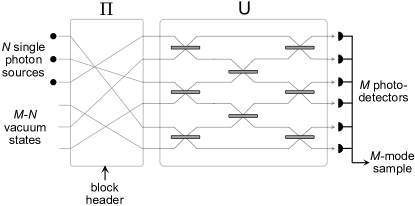
실험 결과
연구 질문
- RQ1굵은 입자 샘플링은 블록체인 작업 증명을 위한 안전하고 효율적인 계산 퍼즐로 기능할 수 있는가?
- RQ2양자 샘플링은 어떻게 구성되어야 하며, 고전적으로 비가역적이면서도 정직한 참가자에게는 양자 우월성을 제공할 수 있는가?
- RQ3양자 PoW 시스템에서 정직한 마이닝 행동을 어떻게 유도할 수 있으며, 나시 균형이 존재하는가?
- RQ4포크 상태 및 가우시안 입자 샘플링은 동일한 보안성과 효율성으로 블록체인 합의 프레임워크에 적합하게 변형될 수 있는가?
- RQ5제안된 기반은 그로버 알고리즘과 같은 양자 속도 향상 공격에 어떻게 대비하는가?
주요 결과
- 제안된 CGBS 기반 PoW 기반은 고전적 PoW에 비해 높은 속도 향상과 에너지 절감을 실현하며, 샘플링에서의 양자 우월성을 활용한다.
- 허프니안 기반 출력 확률을 계산하는 데 있어 #P-난이도로 인해 고전적 마이너에 대해 안전하다.
- 정직한 마이닝이 보상과 제재를 통해 유도되는 나시 균형이 달성되어 사기 행위를 억제한다.
- 이 방법은 포크 상태 및 가우시안 입자 샘플링 모두에 적용 가능하며, 후자는 특성 함수와 공분산 행렬을 사용하여 바인딩 분포를 계산한다.
- 가우시안 입자 샘플링의 확률 분포는 변형된 행렬의 허프니안을 통해 유도되며, 특성 함수 접근법을 통해 검증된다.
- 특성 함수를 이산 점에서 다항 시간 평가함으로써 양자 샘플의 효율적 검증이 가능해진다.

더 나은 연구,지금 바로 시작하세요
논문 읽기부터 검토까지, 연구 시간을 획기적으로 줄여보세요.
카드 등록 없음 · 무료 플랜 제공
이 리뷰는 AI가 만들고, 인간 에디터가 검토했습니다.