
[논문 리뷰] Prospective and retrospective coding in cortical neurons
이 논문은 개별 콘크리트 신경세포가 내재된 막 동역학, 특히 나트륨 채널의 실활화와 적응 메커니즘을 통해 입력에 비해 출력 작동이 앞서는 '선제적 코딩'을 나타낼 수 있다고 제안한다. 허드킨-후크리의 모델과 시뮬레이션 기반 추론을 사용하여 이러한 시간 지연을 제어하는 최소한의 세 가지 핵심 매개변수를 규명하였으며, 단일 신경세포의 동역학이 생물학적 지연을 고려할 때도 미래의 입력을 실시간으로 예측할 수 있음을 보여주며, 빠른 신경 처리와 생물물리적 지연을 조화롭게 한다.
Brains can process sensory information from different modalities at astonishing speed; this is surprising as the integration of inputs through the membrane of each individual neuron already causes a delayed response. Neuronal recordings {\em in vitro} reveal a possible explanation for this fast processing, in terms of individual neurons advancing their output firing rates with respect to the input, a concept which we refer to as prospective coding. The underlying mechanisms of prospective coding, however, are not completely understood. We propose a mechanistic explanation for individual neurons advancing their output on the level of single action potentials and instantaneous firing rates. We show that the spike generation mechanism can be the source for prospective (advanced) or retrospective (delayed) responses. A simplified Hodgkin-Huxley model identifies sodium inactivation as a source for prospective firing, controlling the timing of the neuron's output as a function of the voltage and its temporal derivative. We further show that slow adaptation processes, such as spike-frequency adaptation or deactivating dendritic currents, represent mechanisms generating prospective firing for inputs that undergo slow temporal modulations. In general, we show that adaptation processes at different time scales can cause advanced neuronal responses to time-varying inputs that are modulated on the corresponding time scales.
연구 동기 및 목표
- 시간에 따라 변하는 입력에 대해 개별 콘크리트 신경세포가 선제적(앞선) 반응을 생성할 수 있는지 여부를 조사하여, 이러한 시간 지연 증가가 인구 수준의 메커니즘을 필요로 한다는 가정을 도전한다.
- 선제적 코딩을 가능하게 하는 단일 신경세포 내의 생물물리적 메커니즘, 특히 이온 채널의 동역학과 적응 과정에 초점을 맞춘다.
- 허드킨-후크리 모델의 어떤 매개변수가 신경세포의 출력이 입력 조절에 비해 언제 발생하는지 제어하는지 규명한다.
- 전체 허드킨-후크리 시뮬레이션에 비해 계산 비용이 훨씬 낮은 단순화된 속도 모델을 개발하여 선제적 코딩을 캡처한다.
- 선제적 반응이 통계적 오류가 아니라 단일 시험에서 내재된 신경세포 동역학에서 기인하는 것임을 검증한다.
제안 방법
- 저자는 신경피질과 해마 신경세포의 실험적으로 캘리브레이션된 허드킨-후크리 모델을 사용하여 10 Hz에서의 노이즈가 섞인 정현파 모odulated 입력에 대한 반응을 시뮬레이션한다.
- 역문제를 해결하기 위해 시뮬레이션 기반 추론(SBI)을 적용하여, 신경세포의 출력이 선제적인지 후행적인지 결정하는 최소한의 매개변수 집합을 규명한다.
- SBI 프레임워크는 관측된 단계 이동(예: +4.2 ms의 앞서기)을 조건으로 하여 사후 분포를 조건화하여 매개변수 공간 분석과 사후 예측 검증을 가능하게 한다.
- 단순화된 속도 모델을 유도하여 전체 허드킨-후크리 시뮬레이션의 일부분에 불과한 계산 비용으로 선제적 반응을 재현하며, 적응 과정을 사용하여 더 긴 시간 스케일로 확장한다.
- 신호 분석은 출력의 작동률에 정현파 함수를 피팅하여 단계 이동을 추정하고, 스파이크 트레인 간의 시간 지연을 정량화하기 위해 이산 상관관계를 사용한다.
- 가속도 변수 동역학(m, h, n)과 그 시간 상수를 분석하며, 활성화 및 실활화 동역학의 변화가 반응 시간에 미치는 영향에 집중한다.
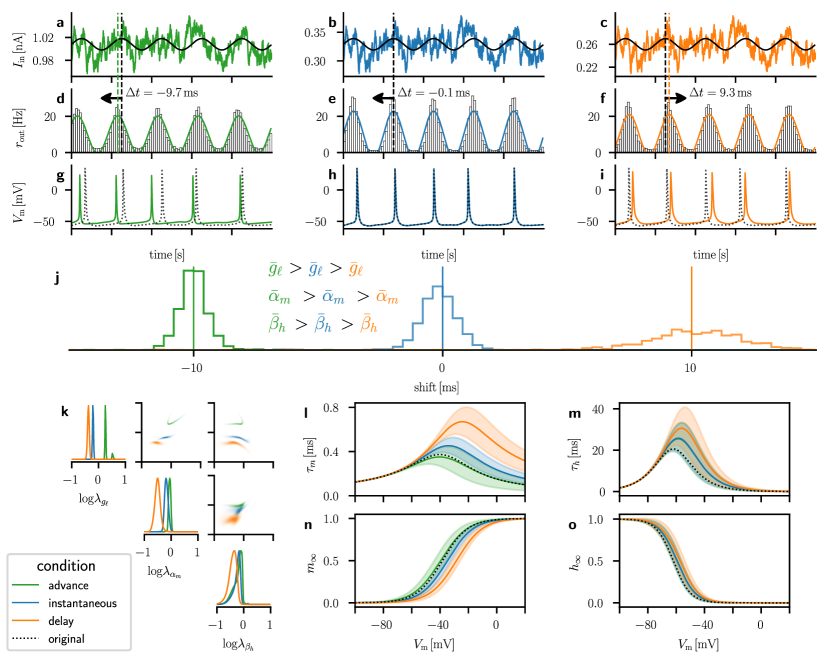
![Figure 1 : Hodgkin-Huxley model parameters define whether neuronal firing is prospective or retrospective. (a, b) The output firing rate $r_{\mathrm{out}}$ of a neocortical neuron model [ 10 ] is phase-advanced by $4.2\,$ ms with respect to the $10\text{\,}\mathrm{H}\mathrm{z}$ amplitude modulation](https://ar5iv.labs.arxiv.org/html/2405.14810/assets/x1.png)
실험 결과
연구 질문
- RQ1개별 콘크리트 신경세포는 단일 시험에서도 입력에 비해 앞선 출력 반응을 생성할 수 있는가?
- RQ2허드킨-후크리 프레임워크 내에서 단일 신경세포에서 선제적 코딩과 후행적 코딩을 가능하게 하는 생물물리적 메커니즘은 무엇인가?
- RQ3허드킨-후크리 모델의 어떤 특정 매개변수가 입력 조절에 비해 신경세포 출력의 시간에 영향을 주는가?
- RQ4다양한 시간 스케일에서의 적응 과정(예: 스파이크 주기 적응, 느린 실활화)은 천천히 변화하는 입력에 대해 선제적 반응을 생성할 수 있는가?
- RQ5관측된 단계 이동은 통계적 오류인가, 아니면 내재된 신경세포 동역학에서 기인하는가?
주요 결과
- 허드킨-후크리 모델은 10 Hz의 진폭 조절 입력에 대해 출력 작동이 4.2 ms 앞서는 것을 재현하며, in vitro 실험 관측 결과와 일치한다.
- SBI는 선제적 또는 후행적 반응 여부를 결정하는 데 핵심적인 세 가지 매개변수—λgℓ, λαm, 및 λβh—로 구성된 최소한의 매개변수 공간을 규명한다.
- 나트륨 채널의 실활화(하나의 게이트인 h-게이트 동역학에 의해 제어됨)가 선제적 작동을 가능하게 하는 주요 메커니즘으로 규명되었으며, 출력의 시점은 전압과 그 도함수에 의해 동시에 제어된다.
- 스파이크 주기 적응과 느린 실활화를 포함한 다양한 시간 스케일의 적응 과정이, 해당 스케일에 맞게 조절되는 입력에 대해 선제적 반응을 생성할 수 있음을 보여준다.
- 단순화된 속도 모델은 전체 허드킨-후크리 시뮬레이션의 일부분에 불과한 계산 비용으로도 선제적 코딩을 성공적으로 재현하며, 장시간 스케일의 동역학 탐색에 효율적이다.
- 사후 예측 검증을 통해 모델이 조건화된 단계 이동을 정확히 재현함을 확인하여 추론 프레임워크와 규명된 메커니즘의 생물학적 타당성을 검증한다.
더 나은 연구,지금 바로 시작하세요
논문 읽기부터 검토까지, 연구 시간을 획기적으로 줄여보세요.
카드 등록 없음 · 무료 플랜 제공
이 리뷰는 AI가 만들고, 인간 에디터가 검토했습니다.