
[논문 리뷰] Pure Spectroscopic Constraints on UV Luminosity Functions and Cosmic Star Formation History From 25 Galaxies at $z_\mathrm{spec}=8.61-13.20$ Confirmed with JWST/NIRSpec
이 논문은 JWST/NIRSpec를 사용하여 고적성($z_{\, spec}=8.61-13.20$)에서 분광학적으로 확인된 25개의 은하로부터 UV 광도 함수와 우주 별형성률 밀도(SFR densities)를 도출하며, 순수 분광 제약치와 특정 빠른 진화 모형에 도전하는 하한치를 제공합니다.
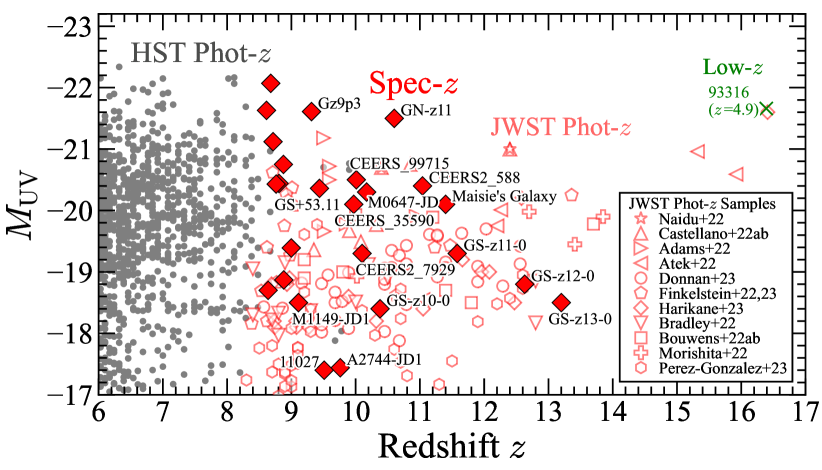
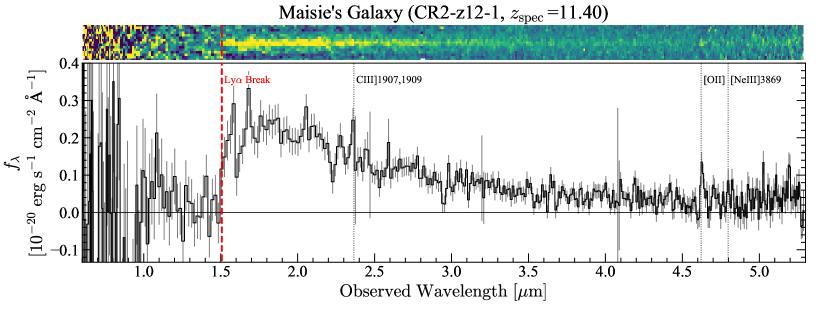
We present pure spectroscopic constraints on the UV luminosity functions and cosmic star formation rate (SFR) densities from 25 galaxies at $z_\mathrm{spec}=8.61-13.20$. By reducing the JWST/NIRSpec spectra taken in multiple programs of ERO, ERS, GO, and DDT with our analysis technique, we independently confirm 16 galaxies at $z_\mathrm{spec}=8.61-11.40$ including new redshift determinations, and a bright interloper at $z_\mathrm{spec}=4.91$ that was claimed as a photometric candidate at z~16. In conjunction with nine galaxies at redshifts up to $z_\mathrm{spec}=13.20$ in the literature, we make a sample of 25 spectroscopically-confirmed galaxies in total and carefully derive the best estimates and lower limits of the UV luminosity functions. These UV luminosity function constraints are consistent with the previous photometric estimates within the uncertainties and indicate mild redshift evolution towards z~12 showing tensions with some theoretical models of rapid evolution. With these spectroscopic constraints, we obtain firm lower limits of the cosmic SFR densities and spectroscopically confirm a high SFR density at z~12 beyond the constant star-formation efficiency models, which supports earlier claims from the photometric studies. While there are no spectroscopically-confirmed galaxies with very large stellar masses violating the $Λ$CDM model due to the removal of the bright interloper, we confirm star-forming galaxies at $z_\mathrm{spec}=11-13$ with stellar masses much higher than model predictions. Our results indicate possibilities of high star-formation efficiency (>5%), hidden AGN, top-heavy initial mass function (possibly with Pop-III), and large scatter/variance. Having these successful and unsuccessful spectroscopy results, we suggest observational strategies for efficiently removing low redshift interlopers for future JWST programs.
연구 동기 및 목표
- $z>8$에서 강건한 분광적 적지(spectroscopic redshifts)를 통해 초기 은하 형성 이해를 촉진합니다.
- $z\,\sim\,9-12$에서의 UV 광도 함수의 깨끗한 측정과 $z$\sim12에서의 SFR 밀도에 대한 하한치를 제공합니다.
- UV LF의 적지에 따른 진화를 평가하고 rapid-evolution 모델과의 비교를 수행합니다.
- 고-z 샘플에서의 Star formation efficiency, IMF, AGN 활동, 저적체(interloper) 오염 가능성에 대한 시사점을 논의합니다.
제안 방법
- EROs, ERS, GO, DDT 프로그램으로부터 JWST/NIRSpec 스펙트럼을 수집·재분석하여 확실한 적지를 얻습니다.
- 문헌에서 분광학적으로 확인된 은하를 보강하여 $z_{\rm spec}=8.61-13.20$의 25개 대상 샘플을 구성합니다.
- 두 가지 효과적 부피 추정 방법을 사용하여 세 개의 적지에서 UV 광도 함수를 계산합니다($z\sim9$, $z\sim10$, $z\sim12$) 및 $z\sim16$에서 상한을 구합니다.
- 공개된 효과적 부피를 이용하고 보수적으로 NIRSpec 관찰장(Field of view)을 사용하여 선택 효과를 반영한 관측 부피를 추정합니다.
- 분광 샘플로부터 우주적 SFR 밀도를 도출하고, 하한치를 포함하며 모델과 비교합니다.
- 향후 JWST 설계 및 관측에서 저적대(interloper) 제거 전략을 논의합니다.
실험 결과
연구 질문
- RQ1분광학적으로 확인된 은하를 바탕으로 $z\sim9$, $z\sim10$, $z\sim12$에서의 UV 광도 함수 제약은 무엇입니까?
- RQ2분광학적 제약이 UV LF의 적지 진화를 $z\sim12$ 쪽으로 완만하게 시사합니까?
- RQ3$z\sim9-12$에서의 우주적 SFR 밀도에 대한 하한은 무엇이며, 이를 상수-별생성 효율 모델과 비교하면 어떻습니까?
- RQ4데이터가 표준 $\Lambda$CDM 예측에 도전하는 높은 질량의 별, 예: 높은 별형성 효율, 숨겨진 AGN, 탑-헤비 IMF 등과 같은 신호를 나타냅니까?
- RQ5$z>10$ 은하를 목표로 하는 JWST 설계에서 저적대(interloper) 제거를 가장 잘 돕는 관측 전략은 무엇입니까?
주요 결과
- 25명의 분광학적으로 확인된 은하에서의 UV 광도 함수 제약은 불확실성 내에서 이전의 광학적 추정과 일치하며 $z\sim12$로의 약한 진화를 보입니다.
- 우주적 SFR 밀도에 대한 확고한 하한이 있으며, 데이터는 상수별생성 효율 모델을 넘는 $z\sim12$에서의 높은 SFR 밀도를 지지합니다.
- $z\sim11-13$에서 분광학적으로 확인된 일부 은하의 질량은 모델 예측보다 커 이러한 높은 별형성 효율이나 대안적 과정들을 시사합니다.
- $z_{spec}=4.91$의 밝은 저이행(interloper)을 제거하면 밝은 $z\sim>10$ 은하에 대한 CDM 예측과의 긴장을 줄일 수 있지만, 여전히 질량 및 SFR 함의에서 긴장은 남아 있습니다.
- 이 연구는 고효율의 별생성, 숨겨진 AGN 활동, 탑-헤비 IMF, 고-z 은하 특성의 큰 산포 가능성을 지목하며, 향후 JWST 프로그램에서 저적대의 간섭자를 피하기 위한 전략을 논의합니다.
더 나은 연구,지금 바로 시작하세요
논문 읽기부터 검토까지, 연구 시간을 획기적으로 줄여보세요.
카드 등록 없음 · 무료 플랜 제공
이 리뷰는 AI가 만들고, 인간 에디터가 검토했습니다.